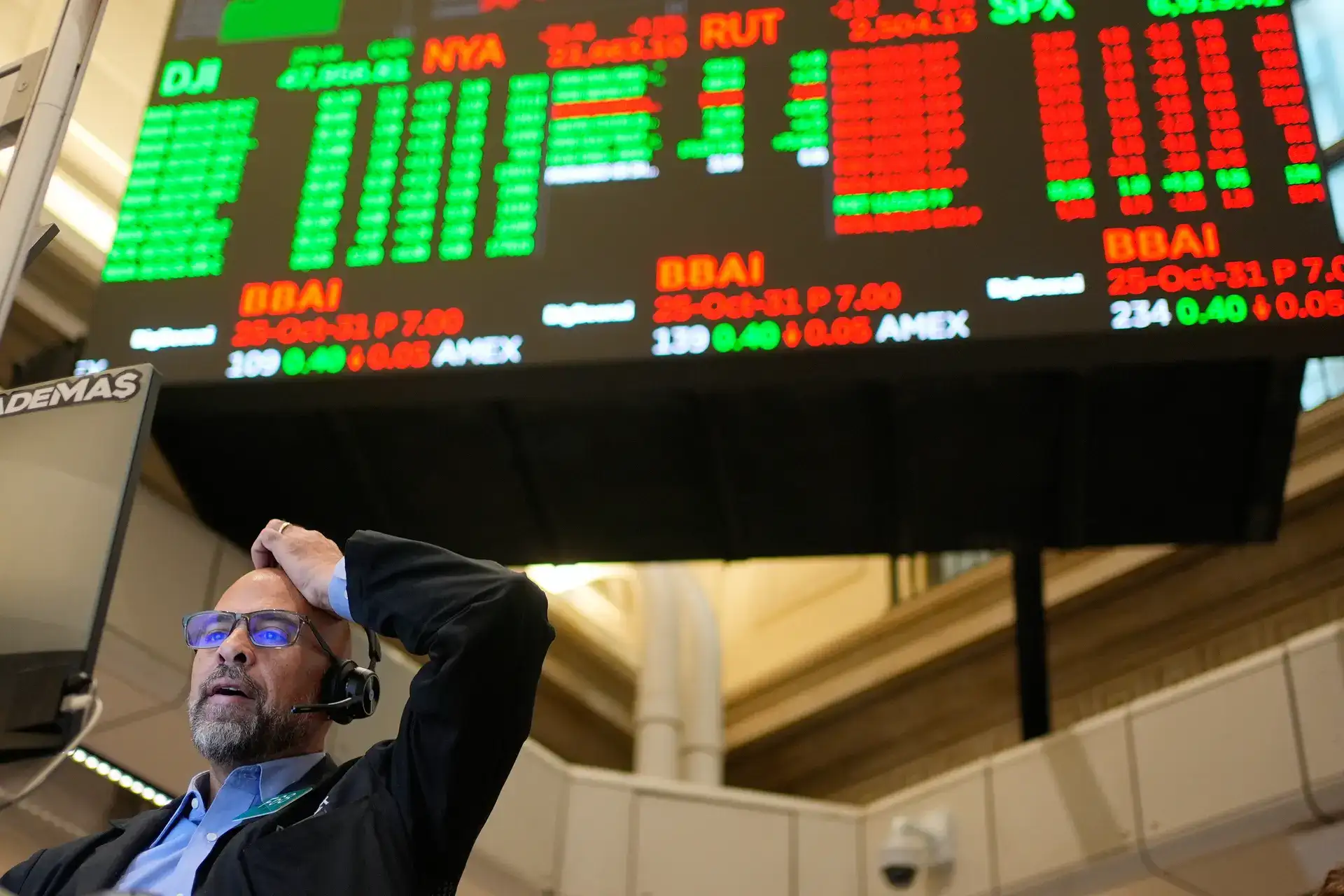
US stock market crash today: The S&P 500 erased all of its intraday gains on Tuesday, June 9, 2026, plunging more than 2% from its session high and wiping out approximately $1.3 trillion in market value in just two hours. What started as a cautiously optimistic morning for Wall Street turned into a sharp, disorderly retreat by midday, driven by a sudden collapse in chip stocks, a reversal in Magnificent Seven momentum, and fresh anxieties around inflation data due the following day. The speed of the decline was jarring — not because markets haven't seen drops before, but because this one arrived without a single headline catalyst, which is often the most unsettling kind of selloff on Wall Street.
The S&P 500 settled around 7,263, down 1.92% on the day, while the Nasdaq Composite fell 3.18% to 25,105. The Dow Jones Industrial Average declined a comparatively modest 0.96% to 50,299, cushioned by defensive names. The real damage was concentrated in technology, where the DJ Technology index dropped 4.45% and the Philadelphia Semiconductor Index — the most closely watched barometer of chip health — cratered 7.54%, erasing nearly all of Monday's recovery. The S&P 500 VIX surged 20.67% to 22.83, signaling that institutional investors were rapidly repricing risk across the board.
Context matters here. Just the day before, Monday had looked like a pivot — a clean bounce for beaten-down semiconductor names, with the iShares Semiconductor ETF surging nearly 6% and the broader Nasdaq gaining 0.9%. Tuesday's reversal didn't just erase that. It suggested the bounce was fragile from the start, built on thin conviction rather than any genuine change in the fundamental picture. When the chips cracked again, they cracked hard.
Why did the US stock market crash today despite falling oil prices? Chip Stocks Trigger the S&P 500 Collapse on June 9
Marvell Technology was the most visible flashpoint. Shares had jumped nearly 10% on Monday and pushed higher still at Tuesday's open, but by midday the stock had reversed to down 13%, leading all Nasdaq decliners. Nvidia, which had opened Tuesday nearly 1% higher, turned negative and fell roughly 3.5% — losing $7.55 to trade around $201. Apple, already weakened by investor skepticism following its Worldwide Developers Conference, dropped over 4%, shedding $13 to $288.50.
Salesforce fell 5.51% and Cisco dropped 5.01%. Caterpillar slid 3.37% — a notable signal because Caterpillar is often read as a proxy for global industrial confidence, not just a domestic tech story. When both semiconductor stocks and industrial bellwethers sell off together, it usually means something broader than a single sector story is playing out. The NQ Computer index's 4.25% drop confirmed this wasn't a niche correction — it was a broad repricing of risk in growth-sensitive assets.
The PHLX Semiconductor Index's 7.54% single-day loss is worth dwelling on. All 30 semiconductor stocks in the index declined — not one managed a gain. That kind of uniformity within a sector rarely happens by accident. It reflects coordinated repositioning by institutional managers who had bought Monday's bounce and saw Tuesday's early strength as the exit they needed.
What Does the S&P 500 Drop Tell Us About Inflation Fears Ahead of Wednesday's CPI?
Underneath the equity drama, Tuesday's market structure carried a clear message about what investors were actually worried about: Wednesday's May Consumer Price Index report. The CPI print was forecast to show a year-over-year gain of 4.2%, which would mark the highest annual inflation reading in three years. For a Federal Reserve that has spent two years trying to contain price pressures, a number like that arriving now forces a serious reassessment of the rate outlook.
The 10-year Treasury yield sat at approximately 4.53% on Tuesday, down only slightly from Monday's close near 4.57%. That marginal decline looks like comfort but tells a different story — bond markets aren't pricing in relief anytime soon. Gold futures fell 1.8% to $4,285 per ounce. Oil prices pulled back 5.3%, with West Texas Intermediate dropping to $86.45 a barrel after President Trump signaled a potential U.S.-Iran deal was close — removing one inflationary input, while the rest of the picture remained complicated.
Bitcoin fell below $61,000, down from overnight highs near $63,800. The cryptocurrency had already briefly breached $60,000 the prior Friday for the first time since October 2024 — a psychologically important level that added to the broader sense of fragility in risk assets. When Bitcoin, equities, and commodities all face simultaneous pressure, it reflects a unified pullback from speculative positioning across asset classes — and Tuesday had all three moving in the same direction.
Defensive Sectors Held Firm While Technology Bled: What the Sector Rotation Reveals
Not everything fell on Tuesday, and the divergence between sectors was striking. DJ Financials gained 0.56%, DJ Health Care rose 0.72%, DJ Telecom climbed 1.46%, and DJ Utilities added 0.92%. Within the S&P 500, Consumer Discretionary gained 0.49% while S&P 500 Energy added 1.14%. These are not coincidental moves. They represent a deliberate rotation by large institutional investors out of high-multiple growth and into dividend-paying, cash-flow-positive businesses that hold up better in a high-rate, high-inflation environment.
The NQ Insurance index surged 1.92% and the NQ Bank index climbed 0.92%. Compare those to the NQ Computer index's 4.25% plunge or the PHLX Semiconductor's 7.54% collapse and a clear picture emerges. Investors aren't fleeing stocks entirely — they are fleeing the specific corner of the market most sensitive to valuation compression under rising rates. Technology stocks, especially chip designers and mega-cap software, carry multiples that only make mathematical sense when discount rates are low. When rates threaten to stay elevated, those multiples compress — sometimes viciously.
Home Depot topped the Dow gainers at 3.28%, followed by Procter & Gamble at 2.72%, Sherwin-Williams at 2.63%, Coca-Cola at 2.36%, and McDonald's at 2.37%. These are not exciting, fast-growing companies. They are steady, predictable cash machines — and on days like Tuesday, that predictability is exactly what the market pays a premium for.
Nuvalent's 40% Surge and Vail Resorts' Slide: The Stories Within the S&P 500 Wreckage
Not every stock was caught in the undertow. Nuvalent surged nearly 40% to $123.35, hitting a new all-time high after GSK announced it would acquire the oncology-focused biotech for $124 per share — a total equity value of $10.6 billion. GSK CEO Luke Miels described Nuvalent's two lung cancer drugs in development as potential best-in-class assets that could seek FDA approval this year. J.M. Smucker jumped 11% on earnings. These moves remind investors that company fundamentals still matter, even on macro-driven days.
Vail Resorts told a grimmer tale. Shares fell roughly 5%, pulling the stock back into negative territory for the year, after the ski resort operator lowered its full-year profit guidance for the second time in 2026. CEO Rob Katz described the past season as one of the worst snowfall years in history in the western U.S., with industry-wide Rocky Mountain ski visits down 24%. For context, the prior worst non-COVID performance over 40 years was an 8% drop in 2012. Vail now expects full-year profits of $128 million to $162 million, down from prior guidance of $144 million to $190 million.
SailPoint sank 14% post-earnings. Together, these individual stories illustrate how Tuesday's market contained both macro-level fear and company-specific reckonings happening at once. The S&P 500's 2% drop was not a monolithic event — it was hundreds of individual stories resolving in the same direction simultaneously.
What Tuesday's $1.3 Trillion S&P 500 Wipeout Means for the Road Ahead
The two-hour, $1.3 trillion S&P 500 erasure on June 9, 2026 is significant not because it sets a new record — it doesn't — but because of what it reveals about the architecture of the current market. The rally that preceded it was built on sentiment and short-covering in semiconductor stocks, not on a genuine improvement in the earnings or rate outlook. When that sentiment shifted, the unwind was immediate and brutal, concentrated precisely where it had been most inflated.
Wednesday's CPI reading now carries enormous weight. If the 4.2% year-over-year forecast proves accurate or worse, the Federal Reserve's path stays restrictive — and the valuation case for high-multiple tech becomes harder to defend. If the number surprises to the downside, a relief rally in growth stocks is possible. But markets rarely give clean binary outcomes. The more likely scenario is a number landing close to expectations, keeping uncertainty elevated and forcing investors to sit with the discomfort of not knowing which way the next move breaks.