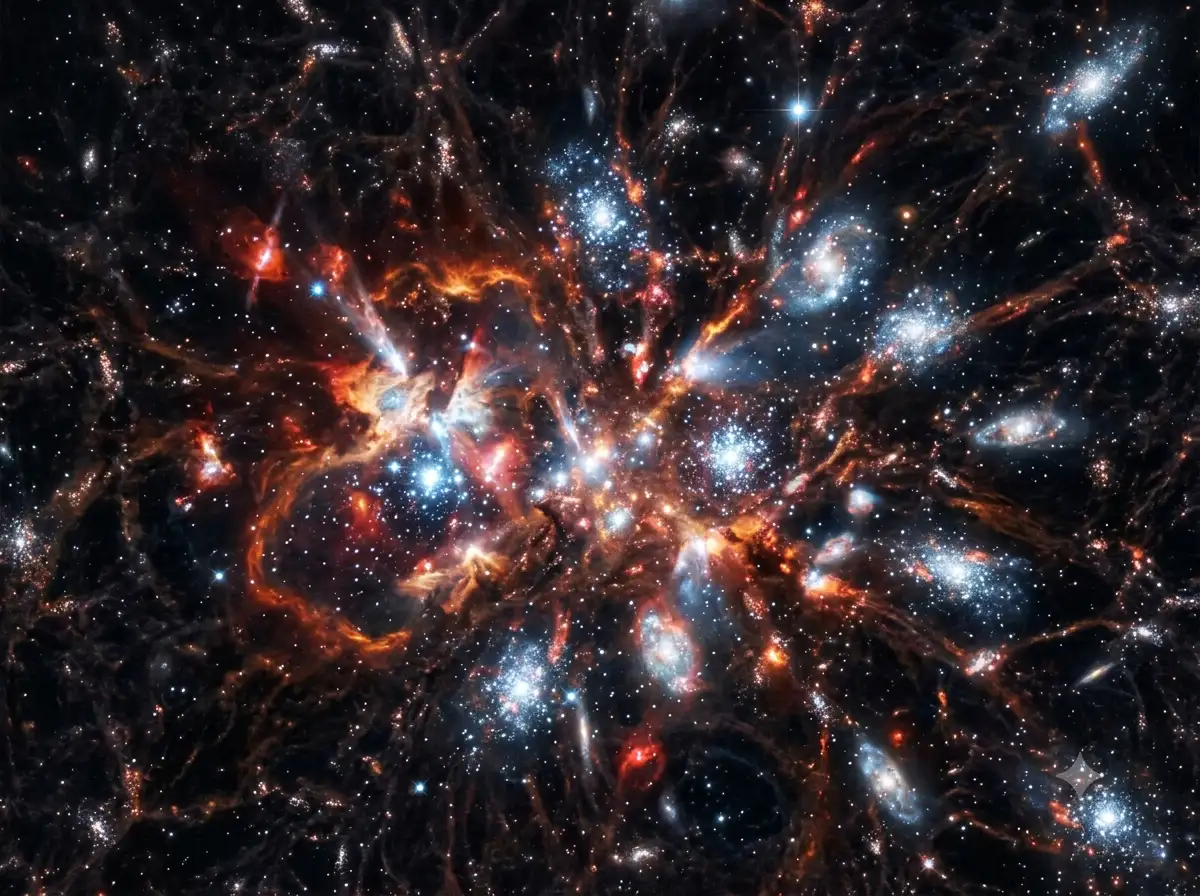
This gas led to the formation of stars and expansion of galaxies in the early Universe , according to new research that has provided direct evidence of neutral gas inside distant galaxies. Scientists have long known that stars are born from gas clouds, but observing the neutral gas that serves as the fuel for star formation has remained difficult. A new study led by researchers from Chiba University in Japan has now overcome this challenge. Using observations from the Atacama Large Millimeter/submillimeter Array (ALMA) and data from the James Webb Space Telescope (JWST), the team detected signals from neutral gas in galaxies that existed only 700 to 800 million years after the Big Bang.
This gas led to the formation of stars and expansion of galaxies. This is how it happened?
Neutral gas acted as the main source of material for star formation in the early Universe. Large clouds of this gas gathered inside young galaxies. Over time, gravity pulled the gas closer together, creating dense regions. As these regions became denser, temperatures and pressures increased, leading to the birth of new stars. The formation of stars added mass and energy to galaxies, helping them grow and develop. As generations of stars continued to form from neutral gas, galaxies expanded in size and structure. This process played a major role in shaping the Universe and creating many of the galaxies that exist today.
How the first galaxies began to form?
The first galaxies started taking shape in the early Universe roughly a few hundred million years after the Big Bang. These young galaxies contained large reservoirs of cold gas. Over time, this gas collapsed under gravity and formed stars. As more stars formed, galaxies grew larger and developed into the structures observed today across the cosmos.
Scientists believe that understanding this gas is essential for explaining how galaxies expanded and evolved. However, studying the gas directly has been a major challenge because it is difficult to observe across vast cosmic distances.
What is neutral gas?
Neutral gas is gas made up of atoms that are not electrically charged. In galaxies, neutral gas serves as the raw material from which stars form. When enough neutral gas gathers in one region, gravity causes the gas to collapse. This process eventually creates dense areas where stars are born.
Neutral gas differs from ionized gas. Ionized gas has lost or gained electrons and behaves differently under physical conditions found inside galaxies. While telescopes can often detect stars and ionized gas, observing neutral gas directly has been much more difficult.
Here's how researchers studies this gas
Researchers focused on a signal known as the [O I] 145 micrometer emission line. This signal is produced by neutral oxygen atoms and acts as a direct tracer of neutral gas. By detecting this signal, scientists could study the material that fuels star formation.
As neutral gas gathers inside galaxies, it provides the necessary conditions for stars to emerge. New stars contribute to the growth of galaxies by adding mass and influencing their surroundings.
As star formation continues over time, galaxies expand and develop more complex structures. This process played a major role in shaping the Universe. The researchers explain that studying neutral gas allows scientists to understand the source of star formation and the mechanisms behind galaxy growth.
Why studying neutral gas has been difficult?
Modern observatories such as the James Webb Space Telescope and the Hubble Space Telescope can observe stars and hot gas in distant galaxies. However, these telescopes cannot directly detect much of the neutral gas responsible for creating stars. Scientists often rely on signals such as the [C II] emission line. The problem is that this signal can come from both neutral and ionized gas regions.
As a result, researchers have struggled to determine how much of the observed signal originates from neutral gas. To solve this issue, the team focused on the [O I] 145 micrometer emission line because it provides a more direct measurement of neutral gas.
What the new study says?
The study was led by Yoshinobu Fudamoto and Masamune Oguri from the Center for Frontier Science at Chiba University. Other researchers involved included Akio K. Inoue, Hanae Inami, and Takuya Hashimoto. The research is scheduled for publication in the Astrophysical Journal on June 15, 2026.
The team observed four typical star-forming galaxies that existed approximately 700 to 800 million years after the Big Bang. Using ALMA, they successfully detected the [O I] 145 micrometer emission line in all four galaxies. This achievement allowed researchers to directly trace neutral gas in galaxies from the early Universe.
Research data and study results
To strengthen their findings, the scientists also examined the [N II] 205 micrometer emission line. Unlike [C II], the [N II] signal traces only ionized gas. The researchers found that the [N II] signal was weak or absent in the galaxies they studied. This suggested that most of the detected emission originated from neutral gas rather than ionized gas. By comparing [O I], [C II], and [N II] observations, the team was able to isolate the contribution of neutral gas.
According to Dr. Fudamoto, these observations represent the most distant direct detection of neutral gas in typical star-forming galaxies so far. The researchers also used the [O I] and [C II] data to model physical conditions within the gas. Their analysis showed that gas densities were very high. The densities were comparable to those found in starburst galaxies, which are known for intense star formation.
At the same time, the radiation field was lower than what is typically observed in starburst galaxies. These results suggest that early galaxies were compact regions where dense gas supported active star formation.
What the findings mean for astronomy?
The study establishes the [O I] emission line as a valuable tool for investigating neutral gas in the early Universe. According to Dr. Inoue, the findings open a new window into understanding the fuel behind star formation. The research also allows scientists to make better use of previous [C II] observations collected over many years.
By combining different signals, astronomers can now gain a clearer understanding of how galaxies formed and evolved. The work demonstrates how ALMA and JWST can complement each other to study some of the earliest stages of cosmic history.
Future plans for the research team
The researchers plan to extend their observations to a larger sample of galaxies. Future studies will combine data from ALMA, JWST, and other observatories to build a broader picture of galaxy formation from the cosmic dawn to the present day.
Scientists hope these observations will help answer one of humanity's oldest questions: how the Universe and our own Milky Way formed and evolved over billions of years. As more data become available, researchers expect to gain deeper insights into the role of neutral gas in shaping galaxies and driving star formation throughout cosmic history.