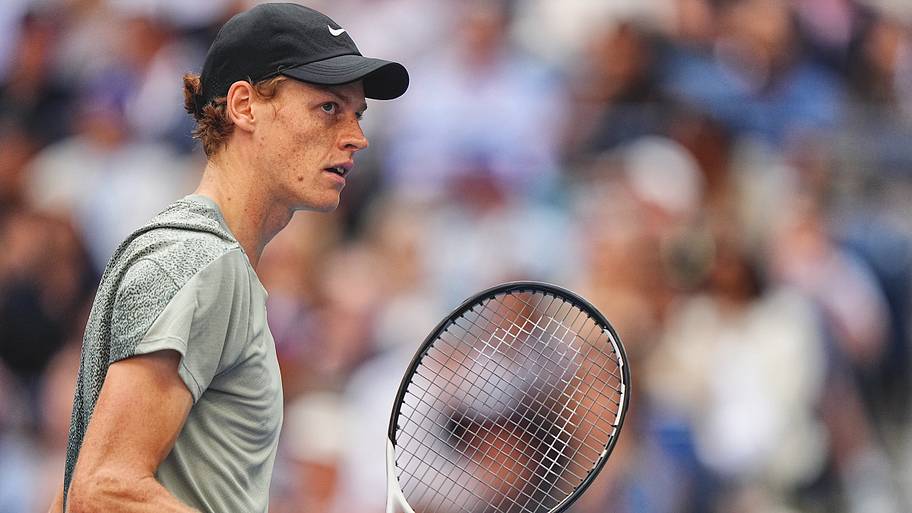
Thwock. Thwock. Thwock. Even by the metronomic standards of a tennis practice session, there’s something singularly routine about Jannik Sinner’s. Robotic is probably too uncharitable, as it takes away agency and humanity, both of which are present. But watching Sinner pound ball after ball with a marriage of destructive power and accuracy? It is to watch an engineer at work. Sinner is tennis’s answer to that coworker who shows up reliably, goes about their business with neither look-at-me flourish nor drama, and happens, simply, to be better at their job than anyone else in the office.
Sinner’s practice court could be a collection of clay-covered rectangles at the Foro Italico, a Mussolini-inspired tennis complex in Rome, where pine scents the air and motors hum in the distance. It could be at the Indian Wells Tennis Garden in California’s Coachella Valley, where Sinner won tennis’s so-called “fifth major” in March. It could be his home base, the Monte-Carlo Country Club, an Old Europe redoubt above the Mediterranean, where Sinner invited your intrepid correspondent to watch him put in a one-hour session.
In truth, settings don’t matter much. One Sinner session might as well be a continuation of the previous one. Same drills. Same positioning. Same array of shots popping off Sinner’s racquet, hitting their marks, often eluding the reach of his practice partner and smacking into the back fence.
As Sinner explains it, relentless, ritualized practice builds a kind of muscle memory for matches. Just as winning builds reserves of confidence, routine helps with occupational challenges. “Tennis is very emotional, it’s very mental,” Sinner says. “You have days where everything works well, and then I have days when nothing works, and then you have to find a solution. When you feel you’ve done it before, it’s easier. When you’ve had it before, it’s easier.”
What Sinner does (win ruthlessly; after taking Rome, he has claimed the trophy at five of the seven tournaments he’s entered in 2026) and has (monstrous talent, professionalism, height and reach), as well as what Sinner doesn’t do (self-destruct) and lacks (distraction, injury, wasted movement), has propelled him to the top of the sport. He’s currently ranked No. 1 and will occupy the top line of the draw at the 2026 French Open, which kicks off on Sunday in Paris. With his rival and the event’s defending champion, Carlos Alcaraz, sidelined with a wrist injury, Sinner is, overwhelmingly, the favorite to win the title, thus completing the career Grand Slam (i.e., the box set of all four).
But beyond that, Sinner, only 24, has crossed that imaginary line from present to future, and is now playing for his place amid the all-time greats. After taking the title in Rome, he’s now won 29 consecutive matches. In 2026, he has more tournament wins (five) than defeats (two).
There are 14 top-tier tennis events—the four majors plus the so-called ATP Masters 1000s, spread over a variety of surfaces and time zones. Sinner has won each at least once, save Roland Garros. A win in Paris would mark his fifth major, the same number Djokovic, the all-time men’s leader with 24, had at Sinner’s age.
Sinner is already, by orders of magnitude, the best Italian player ever. He was recently voted Italy’s most popular sportsman, more acknowledged than even the country’s biggest soccer stars. No less than Pope Leo XIV counts himself as a fan. Andrea Bocelli, the Italian tenor, showed up at a Sinner practice session last week in Rome. The tricolore flag accompanies Sinner’s name on scoreboards and in media guides.
But if not outright misleading, it’s only part of the story. At the risk of some felony-grade stereotyping, Sinner does not hew to the conventional impressions of an Italian. The olive-skinned, sea-faring dandy gallivanting on the Mediterranean or Adriatic? That ain’t him.
Sinner was born in 2001, in the Dolomite region of the Italian Alps, a few miles from the Austrian border. His first language was German, not Italian. He grew up not on a beach, but on ski slopes, his blaze of red hair poking out from a helmet. His father was a chef at the local lodge, while his mother was a waitress. As a boy, he emulated Bode Miller more than he did Roger Federer or Rafael Nadal. A junior ski champion, he could easily have been in February’s Milan Cortina Games, had he not decided to trade in ski poles for racquets.
Sinner is asked about his fateful sports switch so frequently that the ATP provides his response as a talking point, saving him the trouble of answering for the millionth time. “In skiing, you have to go downhill for maybe 90 seconds, and if you make one mistake, then it’s over. In tennis, you can play two hours, make many mistakes and still win the match.”
A pro since 2018, Sinner was known in the first few years of his career as an ascending talent who carried himself with reserved modesty—he began every interview by saying “thanks for having me”—and had an allergy to controversy. During matches, he performed with bloodless efficiency, but with a stubborn habit of fading in best-of-five matches that relied more on endurance than crisp ball striking.
If the salon had gotten restless, he had not. Reflecting on the good-not-great years, he says, “God gave me a good talent to play tennis. And then, at some point, you have to use it. When you are 20 years old, you don’t know exactly what kind of talent you have. To meet your potential, you need physical shape, and you need self-belief … that takes time.”
His time came in 2024. At the Australian Open, he beat the mighty Djokovic—the event’s 10-time winner—en route to winning his maiden major. And the spigot was tapped. He went 73–6 on the year, won eight titles, including the U.S. Open, and finished ranked No.1. Even with his reflexive modesty, he conceded, “I couldn’t have asked for a better year.”
And it made the events that followed—the lone stain on Sinner’s canvas—all the more unlikely and awkward. At the 2024 event in Indian Wells, Calif., Sinner tested positive for trace amounts of clostebol, a synthetic anabolic steroid. (This is the same substance that led to the 80-game suspension of San Diego Padres star, Fernando Tatís Jr.)
Sinner’s explanation? His Italian physiotherapist, Giacomo Naldi, had cut his finger and treated the minor wound with Trofodermin, an over-the-counter substance that contains clostebol. He then gave Sinner a massage without gloves. The trace amount of clostebol on Naldi’s finger triggered the positive test. Without relitigating the case, there are salient points that both exculpate Sinner (the trace amounts; an explanation deemed credible by investigators who ruled that the player did not “bear fault or negligence”) and implicate Sinner (how could an experienced physiotherapist be so careless to the point of recklessness?)
At first, Sinner escaped with virtually no penalty from the International Tennis Integrity Agency (ITIA), which heard the case. But the World Anti-Doping Agency (WADA) appealed, arguing that, under a strict liability standard, some penalty was warranted. The Court of Arbitration for Sport (CAS) heard the case and, in the end, Sinner agreed to a 90-day ban during the spring of 2025, which caused him to miss important tournaments but no major events.
During his suspension, Sinner laid low. He recalls that as a condition of the ban. “I could hardly do anything related to sports,” not even attending a game of his beloved AC Milan. So he and his father went to Scandinavia and learned to drive on ice. He spent time in the Italian Alps. He practiced in Monte Carlo, where he has a residence. He also fired the members of his team who were, at a minimum, deeply negligent.
Showing off toughness and resilience in a way he’s seldom asked to on the court, he returned from that suspension a year ago and quickly redirected the discussion back to his tennis. In the past year, he’s toggled between unbeatable and unplayable. Sinner is like Alexander the Great, a young conqueror whose success won’t come down to theatrics but to will and discipline, which is a thrill to behold in its way, and a delicious contrast to his rival.
Here we thought tennis was due for a lull after the breakup of the Big Three, following the departures of Federer (2022) and Nadal (2024). Djokovic, improbably (but so on-brand), is still out there competing at 39 years old. These three dominated the men’s game the way yellow dominates the color scheme of a tennis ball, winning 66 majors and playing each other, in some combination, 150 times, usually in the finals. How could the sport not inevitably dip in their absence? This was the NBA without Michael Jordan, hockey without Wayne Gretzky or impressionism without Claude Monet.
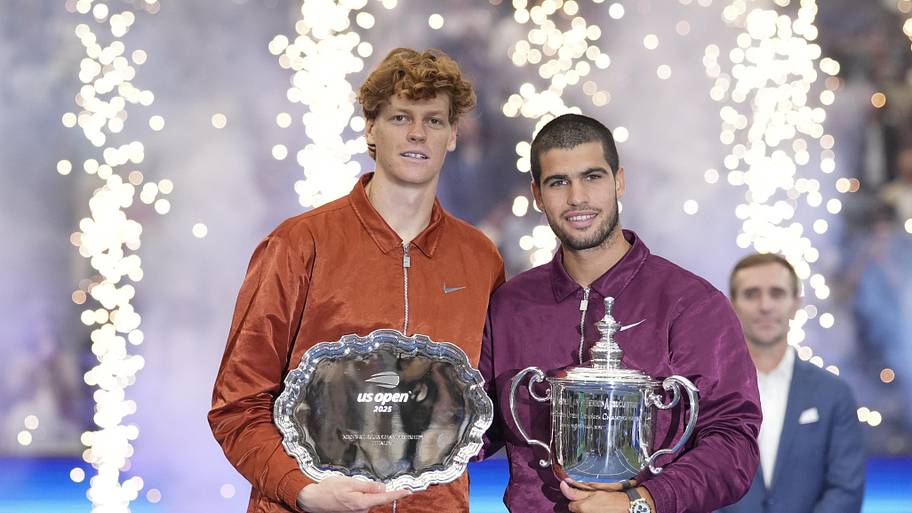
But the tribute videos were barely in the can when two new stars sprouted. Either Sinner or Alcaraz has won each of the past nine majors. And they have faced off in the finals of three of the past four. Like all the best rivalries, theirs is a study in contrast. The shot-making stage presence of Alcaraz, pitted against the steadiness of Sinner. Sinner’s exceptional reach vs. Alcaraz’s blinding speed—the free-form artist vs. the clinician. The six-inch height difference.
At the beginning of tournaments, Alcaraz and Sinner start as far from each other as possible, with one on the top line of the draw and the other on the bottom. Inevitably, and inexorably, they converge. In addition to the contrasts, Sinner and Alacaraz feature another key component of rivalry: oscillation. That is, like the old scoreboard dot races, when one marches forward, the other catches up.
Consider last year. For the first time in a major final, they met to decide the fate of Roland Garros. After Sinner held match point, Alcaraz stormed back to win the match and defend his title, the longest final in the tournament’s history.
A mortal blow to Sinner? Hardly. Five Sundays later, he exacted revenge in the Wimbledon final, unseating Alcaraz, the defending champion. Two months after that, the pendulum swung back the other way, Alcaraz at peak powers, beating Sinner in New York to win the U.S. Open for a second time. After the match, Sinner lamented, “I need to fix some things if I’m going to have more success against Carlos.”
He did just that, amping up his serve and beating Alcaraz to take the ATP Finals in Milan, a win he says “was especially sweet,” since it was in front of a partisan crowd. Advantage, Sinner. But at January’s Australian Open, Sinner struggled in the heat—perhaps his biggest weakness, and one he can’t do much about given biology and genetics—and was eventually beaten by Djokovic, whom Alcaraz then beat in the final to win his seventh major. Advantage, Alcaraz. But since then, Sinner has won five titles while Alcaraz has won “just” one. Advantage, Sinner.
The two have already faced each other 17 times. (For perspective, that’s more head-to-head matches than Björn Borg and John McEnroe played throughout their entire careers.) And how closely matched are Sinner and Alcaraz? Before they played their first match of the 2026 season, in the finals of Monte Carlo, Tennis Channel offered a graphic showing that each of them had won the same number of career titles: 26. Each had spent the same number of weeks ranked No.1: 66. And almost freakishly, each had won the precise same number of points against the other: 1,651. Crazy, right?
Sinner won the match that day, improving his head-to-head record against Alcaraz to 7–10. When Sinner jumped into the pool behind the court in the tournament’s time-honored victory celebration, who captured that moment on video? Carlos Alcaraz. (Pause here to imagine, say, Jimmy Connors losing to McEnroe—or vice versa—and then sticking around to memorialize the winner’s victory exultations.)
Sadly, in that match Alcaraz aggravated a wrist injury. A week later, he announced that it would cause him to pull out of Roland Garros. The two-time defending champion will not three-peat. An encore of last year’s spellbinding final will not be possible, at least not in 2026. If this didn’t so much open the door for Sinner as it blasted it off the hinges, he didn’t see it that way. “For me, it’s nice when he’s around. It makes me look at the draw and see the matches in a different way,” Sinner said of Alcaraz’s withdrawal announcement. “Tennis is a much better sport when he’s around.”
Nevertheless, Alcaraz’s absence means that Sinner—despite never having won the tournament—goes to the French Open not simply as the favorite but as a favorite versus the field. His tournament to lose is a harsh statement when there are 127 colleagues in the draw. But short of a force majeure—an unfortunate injury, or an unseasonably hot day that brings into play Sinner’s fair complexion and past struggles with extreme conditions—anything short of a title would be a convulsive upset.
Tennis’s subdued killer will spend the week leading up to the French Open in Monte Carlo, before he begins his assault on Paris, one battle after another. You’ll find him back at the club, going through his usual paces, using those practice sessions to unencumber himself from any pressure.
He’ll smack the ball around, shower, and grab a pasta lunch in the cafe. And then, he’ll ride his Vespa up the hill to his apartment.
Without pausing to admire the view, he’ll keep climbing.