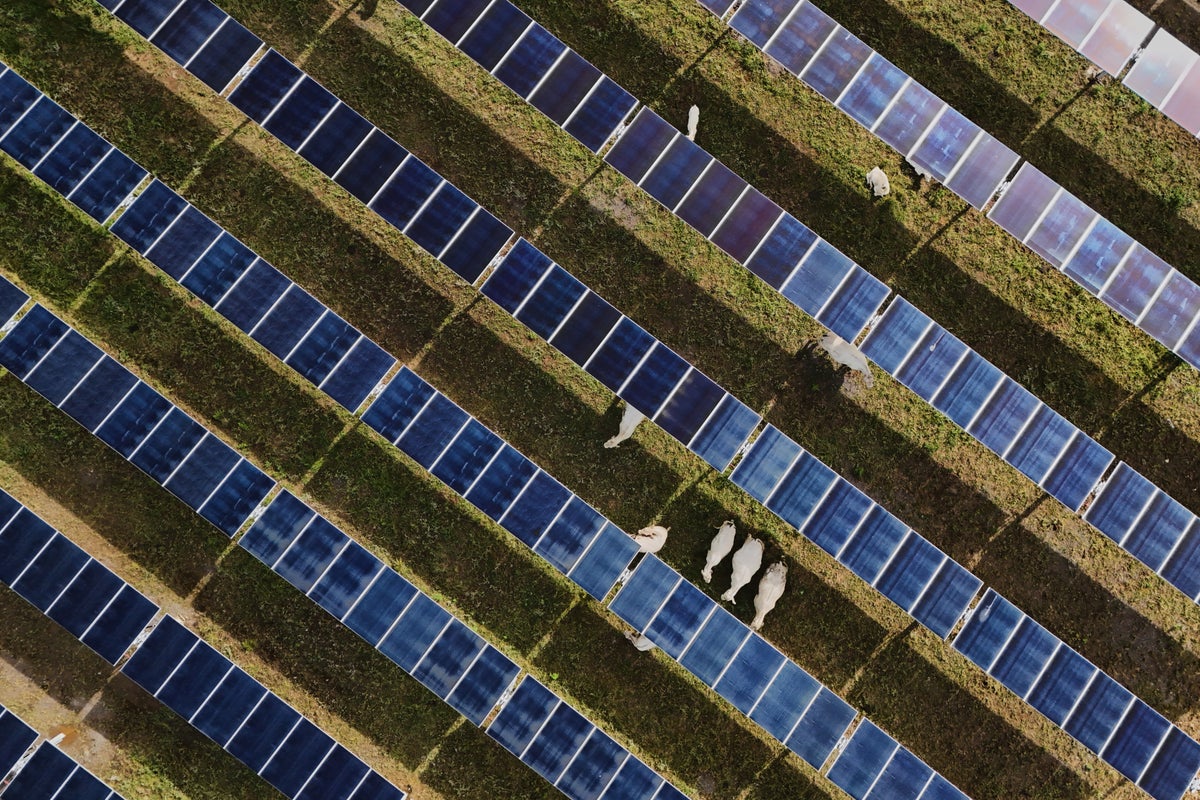
Even as President Donald Trump boosts coal over clean energy, solar power is hitting new milestones in the U.S. and remains the leading source of new power.
Data released Wednesday by global energy think tank Ember, along with a report by the Solar Energy Industries Association and analytics firm Wood Mackenzie, show the continued growth of solar and decline of coal in the United States despite federal policy. In May, for the first time, solar supplied more of the nation’s electricity than coal, or 12.8%, Ember said. Coal supplied 12.2%, its fourth-lowest monthly share ever.
“For years solar power has risen in the U.S. electricity mix," said Nicolas Fulghum, senior energy and data analyst at Ember. "At the same time, coal power has lost its status, first as the largest source in the U.S. mix, and then gradually over the years has fallen even further.”
Solar also became the third-largest source of electricity in the U.S. in May, behind natural gas and nuclear, Fulghum said. Coal generation hit an all-time monthly low in April and rebounded only modestly in May, allowing increasing solar generation to overtake coal, he added.
Electricity is produced by converting sources of energy — fossil fuels, renewable resources and nuclear — into electrical power. Burning coal, oil and natural gas for electricity emits carbon dioxide, trapping heat in the atmosphere and warming the planet. By contrast, solar, wind, geothermal, hydropower and nuclear are carbon-free.
After about two decades of essentially flat electricity consumption in the U.S., electricity demand is increasing to power artificial intelligence, grow domestic manufacturing and electrify transportation and heating. Fulghum said he expects to see more months where solar exceeds coal generation, before overtaking it on an annual basis in a few years.
These milestones signify that solar “has staying power” at a time where there's less support for renewable energy at the federal level, he added.
Wind and solar combined have overtaken coal in the past, and wind power alone has outpaced coal during spring months when wind speeds pick up. Ember gets its hourly and monthly data from the U.S. Energy Information Administration.
Globally, electricity generation from renewables is growing rapidly. Renewables will become the largest global energy source, used for almost 45% of electricity generation by 2030, according to the International Energy Agency.
Trump helps the struggling US coal industry while curtailing solar and wind
Last week, Trump announced a plan to boost the struggling U.S. coal industry by spending nearly $700 million to support coal-fired power plants and coal exports. Trump said at a White House event that “coal’s a great business,” and that "in terms of power, there’s really nothing like it.”
Martin Pochtaruk, CEO and founder of Canadian-based solar panel manufacturer Heliene, said Trump can say that coal is coming back, but investors will invest their money in whatever brings the best return. And for power generation that is solar, making it the fastest-growing fuel, he added.
A White House spokeswoman defended the administration's overall energy policies, saying they were geared toward strengthening the country's security.
“The President has reversed the Left’s devastating policies, saved the American coal industry, prevented the retirement of more than 17 gigawatts of power, and saved lives during heightened demand periods," Taylor Rogers said in a statement.
While Trump is trying to reverse the coal industry's decline, solar has been the top source for new power for five years, SEIA said. SEIA and Wood Mackenzie said solar and battery storage were practically the only energy resources being built in the first quarter, making up 91% of all new generating capacity.
The Trump administration has canceled solar and wind projects, implemented policies that slowed clean energy permitting and development and terminated $7 billion in funding intended for affordable solar energy projects across the U.S.
“As power demand skyrockets, political and regulatory attacks are slowing down the exact resources we rely on,” Darren Van’t Hof, interim president and CEO of SEIA, said in a statement. “Impeding the only sector that is actively building new power is a reckless gamble that will only drive electricity bills higher.”
Several groups sued the Environmental Protection Agency over canceling the Solar for All program. A district court dismissed the case last week citing lack of jurisdiction. The plaintiffs have another filing pending in the Court of Federal Claims.
In a ruling Saturday, a federal judge struck down guidance from the Internal Revenue Service restricting tax credits for wind and solar projects.
Trump has blamed renewable energy sources such as wind and solar power for skyrocketing energy costs. But energy analysts say recent price hikes are based on growing demand, aging infrastructure and increasingly extreme weather events that are exacerbated by climate change. Most recently, the war in Iran that Trump launched has also led to a spike in energy costs.
Top states for solar voted for Trump
States won by Trump in the 2024 election accounted for 74% of all solar capacity installed in the first quarter of 2026, with Texas, Florida, Ohio, Indiana, Michigan, Arizona and Mississippi ranking among the top 10 states for new solar additions, SEIA said. The U.S. now exceeds a total of 6 million installations nationwide across all solar sectors, which includes large-scale solar arrays, commercial, community solar and residential or rooftop solar.
Johanna Neumann, at the Environment America Research and Policy Center, said it's “good news for our health and our planet that solar continues to grow,” and also, not surprising.
“Today we can harness solar more affordably than any other energy source. It’s scalable. And it’s also our most abundant renewable energy source,” said Neumann, senior director of the center's campaign for 100% renewable energy. “So I think it’s hard to keep the lid on a good idea, especially if the economics are tilting in your favor as well, which they are in the case of solar.”
Environment America's renewable energy dashboard shows that 32 U.S. states generated at least 10% of their retail electricity sales from solar, wind and geothermal energy last year, compared to 18 states in 2016. Clean energy in the South is booming, particularly in Florida, Arkansas and Mississippi, Neumann said.
“I think there is a misconception in the United States that clean energy is something for the coasts and liberal cities,” she said. “The true story of renewable energy is a 50-state story.”
___
The Associated Press’ climate and environmental coverage receives financial support from multiple private foundations. AP is solely responsible for all content. Find AP’s standards for working with philanthropies, a list of supporters and funded coverage areas at AP.org.