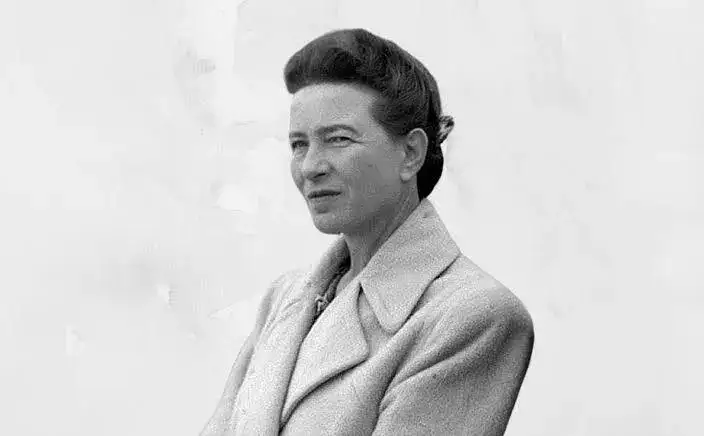
Quote of the Day by Simone de Beauvoir: Simone de Beauvoir equality quote has resurfaced today, and it feels more relevant than ever. She once said that equality is not achieved when women become like men, but when every person is free to pursue their potential without barriers, prejudice, or unequal opportunities. That single line carries decades of struggle, thought, and lived experience.
Simone de Beauvoir, the French philosopher and writer, spent her life questioning what freedom really means for women and for society at large. Her words were never about competition between genders. They were about removing walls that stop people from becoming who they truly are. Today, as workplaces, schools, and homes still debate fairness, this Simone de Beauvoir equality quote offers a quiet but powerful reminder. Equality is not about copying anyone. It is about open doors, fair chances, and the freedom to grow without judgment standing in the way.
Quote of the Day by Simone de Beauvoir: The Deep Life Lesson on Women's Rights, Equal Opportunity, and the Freedom to Become Who You Are
Simone de Beauvoir was born in Paris in 1908, at a time when women had few choices outside marriage and motherhood. She studied philosophy, wrote fiercely, and questioned everything society expected of her. Her famous book, The Second Sex, published in 1949, became a foundation for modern feminist thought. In it, she argued that society, not biology, shapes what it means to be a woman. This Simone de Beauvoir equality quote grew from that same idea. She was not asking women to act like men or take on male roles to prove their worth.
Instead, she was pointing toward something deeper. Real equality means a world where ability, not gender, decides opportunity. A woman who wants to be a scientist should not face extra hurdles. A man who wants to stay home and raise children should not face ridicule either. De Beauvoir lived this philosophy herself. She chose an unconventional life with the writer Jean-Paul Sartre, refusing marriage and traditional domestic roles, not out of rebellion alone, but to prove that freedom looks different for everyone.
You might wonder why a quote from decades ago still feels so fresh. The answer lies in how society often confuses equality with sameness. Many workplaces today measure success using one template, often modeled on traditional male career paths. Long hours, constant availability, and rigid timelines are seen as signs of dedication. But what about someone managing caregiving duties, health challenges, or different working styles? The Simone de Beauvoir equality quote reminds us that fairness is not about fitting everyone into the same mold.
Consider the real-life example of Marie Curie, the first woman to win a Nobel Prize, and the only person to win it in two different sciences. She did not succeed by copying her male peers. She succeeded because she was finally given access to laboratories, education, and resources that were once denied to women. Her success came from opportunity, not imitation. This is exactly what de Beauvoir meant. When barriers fall, talent rises naturally, regardless of gender. The lesson here is simple but often ignored: equal opportunity unlocks human potential in ways that forcing sameness never can.
How can we apply the Simone de Beauvoir equality quote in daily life?
Applying this Simone de Beauvoir equality quote does not require grand gestures. It starts with small, honest choices. Think about a manager reviewing two candidates for a promotion. One has a traditional, uninterrupted career path. The other took a break for family responsibilities but gained valuable skills during that time. Judging both purely on the traditional timeline ignores real potential. True equality means evaluating people on what they can do, not on whether their journey matches an old template.
History offers another powerful lesson through Ruth Bader Ginsburg, the former U.S. Supreme Court Justice. Early in her career, she faced rejection simply because she was a woman and a mother. Law firms doubted her commitment despite her brilliant academic record. She did not change who she was to fit expectations. Instead, she pushed for legal systems that judged people by merit, not by outdated assumptions. Her persistence, despite repeated failures, eventually reshaped gender equality laws in America. This mirrors the heart of the Simone de Beauvoir equality quote completely.
What lessons can we learn from Simone de Beauvoir's life and success?
Simone de Beauvoir's own life was full of difficult decisions and bold choices. She faced criticism for choosing an unmarried, intellectual life when society expected women to prioritize family. Her major success was not just writing The Second Sex, though that book alone changed feminist thought worldwide. Her greater achievement was proving that a woman could be a serious philosopher, novelist, and public intellectual, taken as seriously as any man in her field.
She failed many times too. Her early teaching career faced restrictions, and her ideas were dismissed by many critics during her lifetime. Yet she kept writing, kept questioning, and kept challenging norms quietly but firmly. Her critical mindset was simple: question what feels "normal," because normal is often just unexamined habit. The Simone de Beauvoir equality quote captures this entire philosophy in one sentence. Freedom is not about becoming someone else. It is about removing the obstacles that stop you from becoming fully yourself, and allowing that same freedom for everyone around you, regardless of gender, background, or expectation.
Other famous quote by Simone de Beauvoir
- “One is not born, but rather becomes, a woman.”
- “Change your life today. Don’t gamble on the future, act now, without delay.”
- “The most important thing is to free oneself from one’s own limitations.”
- “I am too intelligent, too demanding, and too resourceful for anyone to take charge of me entirely.”
- “Life is occupied in both perpetuating itself and surpassing itself.”
- “The secret of happiness and the reason for being alive is giving meaning to life.”
- “Representation of the world, like the world itself, is the work of men.”