The EU and UK car industries are urging the European Commission to adjust the Brexit trade deal and suspend, for a second time, tariffs on imports of electric vehicles.
They have expressed concerns that they will not be able to meet the conditions set for 1 January 2027 for tariff-free sales. This is because of strict rules of origin over what products can qualify for tariff-free trade under the EU-UK Trade and Cooperation Agreement which has applied since 2021.
Under the 2020 Brexit deal, 55% of a car’s value had to be made in Europe by 1 January 2027 to avoid tariffs, but 70% of the battery pack and 65% of the battery cell also had to be made in Europe.
It was originally envisaged that 30% of battery packs and battery cells would be made in the EU or the UK within years of the deal – with the rules of origin regime incentivising investment in domestic battery manufacturing.
By 2023, it was clear this was not the case, partly because of Covid and partly because of shortages of semiconductors caused by Russia’s invasion of Ukraine.
Under mounting pressure from the car industry, the European Commission agreed to suspend the rules for three years until the end of this year. You can read the full story here:
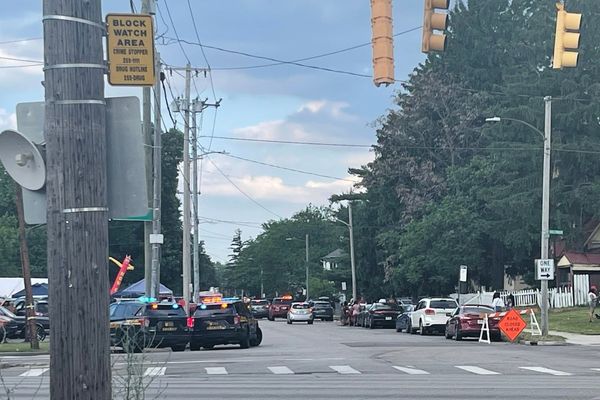
Three more people have been charged with violent disorder after protests in Southampton last week following the murder of Henry Nowak. It brings the total number of people charged after disorder in the city to 14.
Darren Medhurst, 36, of Carnation Road, Southampton; Jordan Hambleton, 19, of Rollesbrook Gardens, Southampton; and Callum Darch, 27, of St Blaize Road, Romsey, were charged with violent disorder, Hampshire Police said. All of them will appear at Southampton Magistrates’ Court on Monday.
Zia Yusuf says UK police are 'institutionally racist'
Reform UK’s home affairs spokesperson Zia Yusuf said that UK police are “institutionally racist”, claiming that there is “structural anti-white prejudice”.
When asked by Laura Kuenssberg if he thinks the police are institutionally racist, he said: “I think the correct answer to that has to be yes given literally on their website it tells people not to treat people the same – to not be colour-blind.”
“So if you ask me if there is institutional racism when literally the justice minister and the police’s own guidelines instruct officers not to treat people the same, according to their race, there can only be one answer and that is yes.”
Yusuf said Hampshire police’s race action plan – and the national plan - states that officers must prioritise offences that cause the most harm to ethnic minorities.
“If you tell police officers that there will be, quote, ‘zero tolerance for any form of racism, or defiance of these guidelines, and you must prioritise the concerns of ethnic minorities, and do not treat everybody the same, and do not be colour-blind’- those are direct quotes from the guidelines – then the logical conclusion Laura is what you saw on the bodycam,” Yusuf said.
“The only way literally that we can ensure that we do not have another situation like the tragedy of Henry’s death is through political means,” he added.
There are no official figures on anti-white bias in operational policing, but the statistics that do exist show longstanding racial bias against ethnic minorities, and especially against black people.
As the Guardian’s police and crime correspondent Vikram Dodd notes in this useful explainer, the police race action plan, launched after the murder of George Floyd in the US, was meant to tackle the enduring problems police have with race. But there has been little improvement.
Updated
A parliamentary committee that scrutinises public spending has made scathing comments about the impact of delays in the publication of the government’s defence investment plan (Dip).
In a report, the public accounts committee (PAC) said the delay was undermining credibility with the UK’s allies. The chair of the committee of MPs, Geoffrey Clifton-Brown, said:
Those responsible may argue there are good reasons for the Dip’s continuing absence, but our report makes clear that excuses to the effect of ‘taking the time to get the details right’ simply do not cut it.
Whatever the content of the Dip when it eventually does appear, the damage from its absence has been done – to the nation’s credibility, to its safety, to its armed forces, and to certainty within its entire defence industrial base…
Any government minister attempting to explain away this delay to the Dip should instead ask themselves what message the bureaucratic drift of the past months has given to the public, as well as the UK’s allies and its adversaries, and simply apologise.
The Ministry of Defence (MoD) “has not yet decided which capabilities, infrastructure and people it requires to transform the armed forces to be warfighting-ready within the budget available” and “nor has it secured the cross-government agreement that the plan needs”, the report added. You can read the full story here:
Starmer to target net zero and transport to fund defence - report
There is an interesting report in the Sunday Times saying that Keir Starmer is considering targeting net zero and transport as he looks for cuts to fund his defence investment plan.
Starmer will reportedly cut capital investment, which covers (long-term) investment in buildings and equipment, across all government departments by 1% to raise about £6bn by the end of this parliament – but is seeking to impose further cuts on transport and net zero.
The highly anticipated defence investment plan, according to Starmer, will be published before the Nato summit in Turkey, beginning on 7 July. It will lay out how new equipment and defence infrastructure will be paid for over the coming decade.
The plan has been delayed since last year because of a stand-off within the Cabinet over costs, reporting by The Times has suggested, amid warnings that the military faces a £28bn funding gap over the next four years.
Updated
Laura Kuenssberg moves onto pressing David Lammy on defence after MPs warned the government’s delay in publishing the defence investment plan (Dip) undermined the UK’s credibility with its allies at a time of rising global conflict threat.
The justice secretary said the UK’s prime minister, Keir Starmer, is meeting with allies today (when he will host Volodymyr Zelenskyy, Emmanuel Macron and Friedrich Merz in No 10 to discuss ongoing support for Ukraine), adding that 1,400 new defence contracts have been granted since Labour came into power in July 2024, with £270bn to be invested in defence by the next election, which must be called by August 2029.
“More spending on defence than any year under the Tories, under this government,” Lammy told the BBC.
When asked if he would be happy to give up some of his budget within the justice department for defence spending, Lammy swerved directly answering the question.
Instead, he said: “The first purpose of any government is defence of the nation. I am not going to comment on the discussions I have with the Treasury.”
Updated
Speaking to Laura Kuenssberg on her Sunday politics programme on the BBC, David Lammy said ethnic minorities are disproportionately in the criminal justice system, so “context can matter” but it “cannot eclipse violence”.
Asked if the police should take into account the colour of someone’s skin, the justice secretary said:
We are all equal before the law, so that is not the starting point, but it is the case, recognising that in our country it is still the case that on arrest, on prosecution, conviction, I’m afraid, in our prisons, ethnic minorities are disproportionately in the criminal justice system.
So, context can matter, but it cannot eclipse violence or the fact that we need our police to act to mitigate and deal with crimes in our communities, whatever the colour of your skin or background.
Lammy went on to say that he doesn’t agree there is “two-tier” policing in the UK, a claim propagated by the right which suggests police deal more harshly with white people than other ethnic groups.
Nigel Farage, the Reform party leader, said Hampshire police’s treatment of Nowak was proof of “a two-tier culture in this country, where the rights and privileges of white people matter less than those of ethnic minorities”. In fact, as my colleagues note in this story, recent figures show Hampshire police officers are more than five times more likely to stop and search black people than white people.
The attorney general’s office is considering the jail sentence given to Vickrum Digwa after receiving “multiple requests” to review it under the unduly lenient sentence (ULS) scheme.
As we mentioned in the opening post, Vickrum Digwa, 23, was jailed for life with a minimum of 21 years on Monday for murdering Henry Nowak in Southampton last December.
Trevor Phillips asked David Lammy if he thinks the attorney general will take it for review, to which the justice secretary replied: “He is considering that as we speak”.
David Lammy said wherever there is “privilege” it can be “taken away if it doesn’t command the full confidence of the public”, when asked about the blade Vickrum Digwa used to murder Henry Nowak.
Asked whether it is “time to review the issue of whether the blade he (the killer) claims was religious, the 8in one, is permissible”, the justice secretary told Sky News:
I think it’s important to emphasise he claimed that. There is doubt as to whether this was religious, this 8in blade that was used, one, and two, you cannot carry a blade that is used in any way to harm life, that is illegal in our country, whatever the circumstances.
In the end, where exceptions are made of this kind, whether it’s for Scots or whether it’s for Sikhs. It is a privilege to be able to enjoy that with the confidence of the public.
Now, right across the country, Sikhs, Scots, for ceremonial purposes, cultural purposes, carrying relatively small blades goes on peacefully every single day of the week, and we should remember that.
But it is a privilege, and wherever there’s privilege, that can be taken away if it doesn’t command the full confidence of the public.
Under UK law a person can possess a kirpan for religious, ceremonial, sporting or historical reasons. But, like any bladed article, a kirpan can become an offensive weapon if it is used unlawfully, as my colleague Aamna Mohdin notes in this useful explainer.
Watching Nowak bodycam footage brought back memories of George Floyd, Lammy says
David Lammy said seeing the bodycam footage of the arrest of Henry Nowak – after the student had been repeatedly stabbed – was “deeply traumatic”.
Lammy, who has two sons and one daughter, explained to Sky News:
I thought of my own sons around the same age. It brought back memories of George Floyd, of Stephen Lawrence.
It was so painful, so harrowing, so horrendous – and my heart goes out to that family for the grace and dignity with which they are now having to conduct their lives sort of in the full lights basically of not just UK attention on this but now global attention on this desperate, desperate tragedy.
Lammy says he told JD Vance that Nowak case had 'nothing to do with mass migration'
On Friday evening, the US vice-president, JD Vance, blamed Henry Nowak’s murder on the “mass invasion of migrants” and said the “only response” was “righteous anger”, prompting a rebuke from Downing Street which hit out at “people trying to interfere in our democracy and seeking to stir up division”.
The UK justice secretary and deputy prime minister, David Lammy, revealed to Sky News’ Trevor Phillips that he spoke to Vance yesterday following his intervention. Lammy, who is rumoured to be good friends with the vice-president, said:
I spoke to the vice president yesterday, and I wanted to emphasise a number of things.
The first is that our democratic process is working well. This young man has been convicted. There is an investigation into the police by the Independent Police (Conduct)Authority.
There is an investigation into Hampshire Police by the inspectorate. The (attorney general) is looking at the sentencing in relation to this. The national police chiefs are looking at the guidance in relation to this.
The second thing was I disagree with him. This has got nothing to do with mass migration. This young man was a Brit. Let’s be clear about that. And I said, ‘look, Mr vice president, you’re wrong about this’.
And it’s also the case that actually murder is coming down in the United Kingdom. So we had an agreeable conversation. But we disagree.
Asked how Vance reacted, Lammy said the vice-president has a “longstanding concern about what he calls western values”, adding that the conversation ended very amicably.
“I also urged him that it’s not helpful to tweet in this way, partly because of what the Nowak family have asked for, and reminded him about their desire not to make this an issue of division and hatred but to make this an issue of common sense.”
Updated
Police planned intervention during trial of Henry Nowak’s killer - report
Good morning and welcome to our live coverage of UK politics. The justice secretary, David Lammy, is being interviewed by the BBC and Sky News this morning and will likely be asked about the future of police reform in the wake of the murder of 18-year-old Henry Nowak.
The case has come under fresh scrutiny today with a report in the Sunday Times revealing that Hampshire and Isle of Wight Constabulary tried to intervene during the trial of Nowak’s killer but were warned by the Crown Prosecution Service it could jeopardise the case.
The police force wanted to release a statement to address what it described as online “disinformation” while court proceedings were at a critical point against Vickrum Digwa, according to the report.
It is understood the statement contained information about the process of a court case, reminded people that nothing could be published that could prejudice legal proceedings, and said that police would answer questions once the trial was complete.
A CPS spokesperson said:
The CPS highlighted to the police that protecting the integrity of the ongoing trial was essential, and of the risks of referring to any aspect of the evidence before it had been heard by the court and the case had been summed up by the judge to the jury.
However, it was made clear that whether a statement was released was ultimately a police operational decision.
Nowak, a first-year accountancy and finance student at the University of Southampton, was fatally stabbed in Southampton last December by Digwa, 23, after a night out with friends.
When police arrived at the murder scene, Digwa falsely claimed Nowak had racially abused him and knocked his turban off. Nowak was handcuffed and arrested despite telling officers he had been stabbed and could not breathe.
Digwa was given a life sentence with a minimum of 21 years in prison for stabbing Nowak with a ceremonial knife with a 21cm blade, which he carried as part of his Sikh religion.
Hampshire police have apologised for their actions, which received global attention after being criticised by the owner of X, Elon Musk, and senior politicians in the Trump administration, and led to violent disorder in Southampton last week.
Hampshire police have been subjected to accusations of “two-tier justice” and anti-white bias after the murder of Nowak despite data discrediting claims that UK police actions disadvantage white people.