
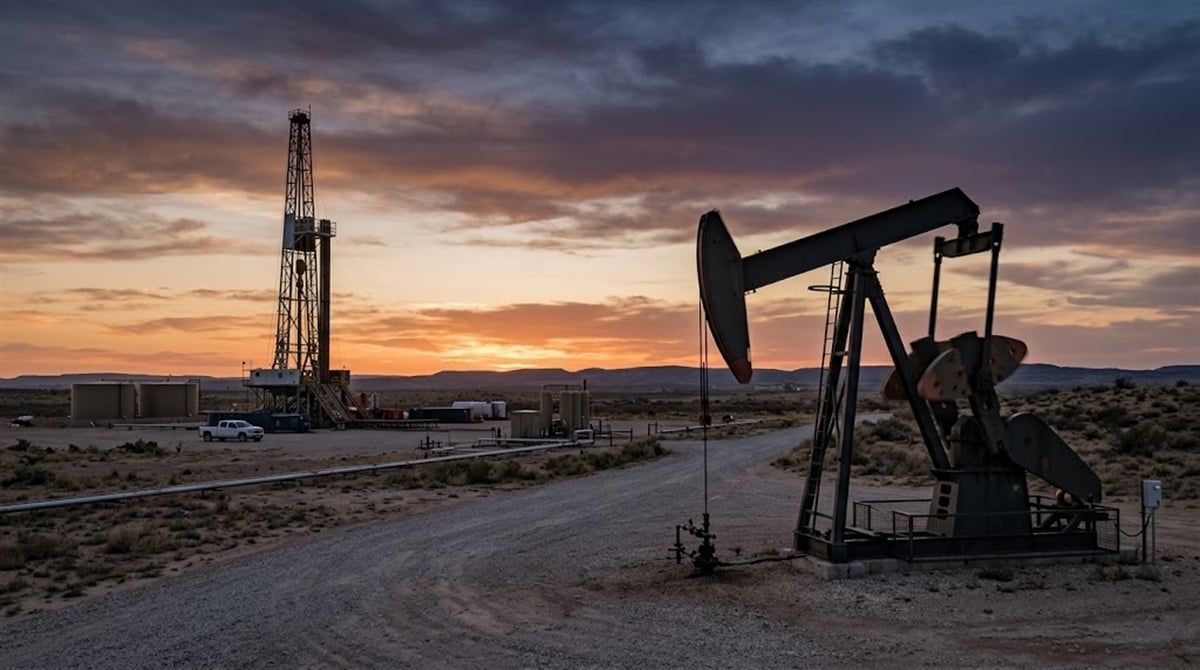
Investing in energy stocks right now is a confidence test. WTI (West Texas Intermediate) crude has pulled back from its recent highs, and there are several macroeconomic and geopolitical reasons for investors to question the future of global demand, such as:
-
Restricted traffic in the Strait of Hormuz
-
Slower Chinese industrial activity
-
The lagged effect of rate policy
-
Potential OPEC supply decisions
All of this is making oil investors more cautious, which is understandable. But it misses the point when applied uniformly to the sector.
The names worth owning into a potential price dip aren't the ones that need $80 crude to generate returns. They're the ones with cost structures, revenue models, and balance sheets that hold up at $65 or lower.
That’s the case with these companies. One is a low-breakeven producer with a demonstrated capital return discipline, one is a fee-based midstream operator that barely notices commodity prices, and one is a Williston Basin pure-play that built its dividend structure precisely to self-adjust when oil softens.
The Benchmark for Low-Breakeven Discipline
EOG Resources (NYSE: EOG) is the first name energy analysts look at when the commodity outlook gets uncertain. The company has spent the better part of a decade building the lowest-cost production profile among large-cap U.S. upstream (i.e., exploration and production) operators.
EOG hammered that point home in its Q1 2026 earnings report. Net income grew to $1.98 billion, operating cash flow reached $2.97 billion, and total production jumped to 124.5 million barrels of oil equivalent, which was well above the prior year's 98.1 million. Revenue climbed 22% to $6.92 billion.
Plus, EOG returned nearly $950 million to shareholders during the quarter through its regular dividend and share repurchases, closed the period with $3.85 billion in cash, and maintained a debt-to-total-capitalization ratio of just 20% against an undrawn $3 billion credit facility.
EOG is holding its full-year capital budget flat at $6.5 billion while raising oil production guidance. Between Q1 2022 and Q1 2026, the company added nearly 100,000 barrels per day of oil production while returning approximately $20 billion to shareholders and generating an average return on capital employed by 27%.
Most importantly, the company cited a program-level breakeven oil price below $50 WTI. That means if WTI dips to $65, EOG doesn't cut the dividend that currently pays out $4.08 per share annually, or draw down its credit line. Instead, it adjusts the pace of activity, deploys cash from the fortress balance sheet, and waits. That's exactly what makes it the anchor energy holding in a commodity-uncertain environment.
Oil Price Is Mostly Noise
Williams Companies (NYSE: WMB) is not a traditional oil company; it’s positioned as a midstream energy infrastructure business. Specifically, WMB operates the Transco pipeline system, which is the largest natural gas pipeline in North America. The company also has extensive gathering, processing, and storage assets that work together to transport approximately 30% of the nation's natural gas. The revenue model is predominantly fee-based.
This business model was on display in the company’s Q1 2026 earnings report. Adjusted EBITDA hit a record $2.254 billion, up 13% year-over-year. GAAP net income rose 25% to $864 million. Available funds from operations grew 22% to $1.77 billion.
The growth came from Transco expansion projects, higher storage revenues, new deepwater Gulf volumes (up more than 60% in EBITDA contribution), and natural gas storage performance up 35%. These growth drivers don't rely on a specific oil price.
The growth backlog adds a second layer. For example, Williams recently signed a $2.3 billion agreement for Neo, a behind-the-meter power project with 682 megawatts of installed capacity. Fee-generating contracts like these are assets with long-dated cash flow certainty, no matter what happens to the price of crude oil.
The Variable Dividend Structure That Does the Heavy Lifting
Chord Energy Corp. (NASDAQ: CHRD) is a midcap exploration & production company with a compelling return structure. The company pays a fixed base dividend of $1.30 per share per quarter. It then layers variable dividends and buybacks on top when free cash flow supports it.
When oil softens, the variable component shrinks. When oil runs, shareholders capture the upside. The base dividend is calibrated to a share price that doesn't require elevated WTI to sustain.
In a $65 WTI world, Chord's base dividend likely holds; the variable component steps back, and buybacks moderate. The balance sheet absorbs the adjustment.
The company’s Q1 earnings report was operationally strong. Average production reached 275,615 barrels of oil equivalent per day, with crude oil at 158,027 Bopd.
Operating cash flow was $507.5 million, funding $344.9 million of capital spending and generating $324 million in adjusted free cash flow. Adjusted earnings per share came in at $4.56, ahead of estimates.
Management raised full-year oil production guidance to 160,000–162,000 barrels per day while holding CapEx flat. Where that production takes place is a key part of the story. The Williston Basin acreage is high-quality by any measure. Bakken wells in Chord's core operate at breakeven oil prices well below current levels. The $1 billion share repurchase authorization is an additional capital return tool that management activated with $70.7 million in repurchases in Q1.
The article "Oil Could Dip, But These 3 Energy Stocks Still Look Built to Win" first appeared on MarketBeat.