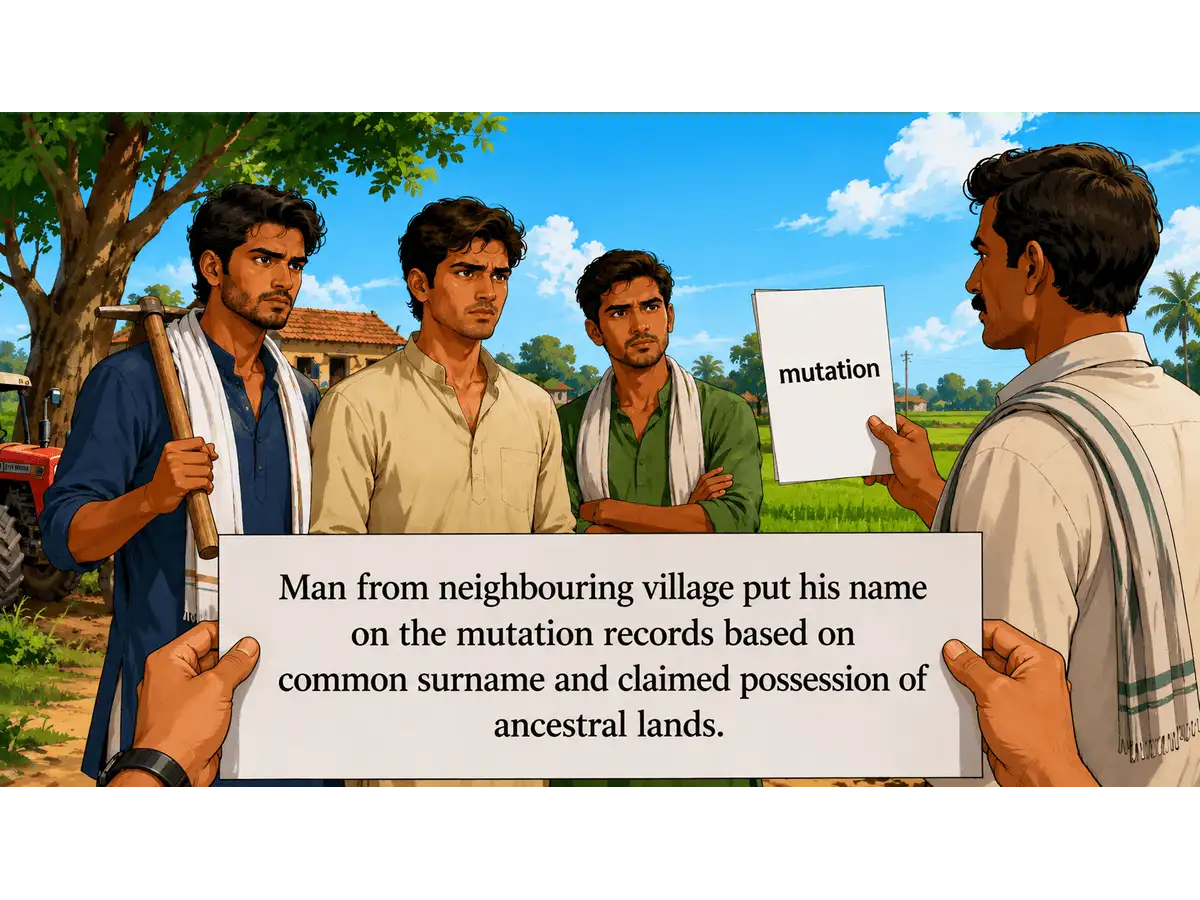
Just when G. Thippeswamy, G. Virupakshappa and G. Rajashekharappa, three brothers and farmers from G.B. Hatti village were happily tending to their ancestral agricultural lands in Chirathagundu Village, Karnataka, a man named Basappa showed up claiming he owned the land. He argued that their ancestors Doddamallappa and Sannamallappa had sold the land, back in 1946, to his ancestor Goudar Sannabasappa.
Basappa even mutated his name in the revenue records, using the common surname 'Rajashekharappa' to back up his claim to the ancestral land of G. Thippeswamy, G. Virupakshappa and G. Rajashekharappa (the three brothers).
However, Basappa could not produce any sale deed to prove the claim, and thus the Karnataka High Court on May 14, 2026 rejected his ownership claim and restrained him from preventing possession of the land by the three brothers.
Brief background about the ancestral land dispute
The case was fought between the family of G. Thippeswamy and others on one side, and Basappa on the other.
The plaintiffs G. Thippeswamy, G. Virupakshappa and G. Rajashekharappa were all brothers and farmers from G.B. Hatti village.
They claimed that the lands originally belonged to their ancestor, Goni Mallappagari Patil Danappa, and later devolved upon his sons Doddamallayya and Sannamaalayya. According to them, the family had been in possession of the lands for generations. They relied on old settlement records, encumbrance certificates and revenue entries to support their case.
The dispute began after Basappa, a resident of Rayapura village in Molakalmuru Taluk in Chitradurga District, claimed ownership over the same lands.
Basappa argued that the plaintiffs' ancestors had sold the property in 1946. He further claimed that the revenue records stood in the name of his father, Rajashekharappa, and after his father's death, the mutation entries were transferred to his own name by revenue authorities in 1997.
The three brothers contended that their ancestors were the land's original owners and they could produce the resettlement register extract as evidence.
As reported by LawTrend, the brothers argued that Doddamallappa and Sannamallappa executed a registered mortgage deed on February 18, 1930, in favour of one Siddayyankote Sannabasappa for Rs 500, but never alienated the property.
The brothers asserted that the revenue entries from 1968-1969 reflecting the name "Rajashekharappa" belonged to G. Rajashekarappa, and not Basappa's father. The plaintiffs claimed that Basappa had illegally obtained a mutation order in 1997 by taking advantage of the identical name.
Back in 1997, a title dispute case (civil suit) was originally filed by the three brothers, seeking declaration of title and injunction. Fast forward to 2005, the trial court tossed out the suit, which led the plaintiffs to approach the Karnataka High Court.
On May 14, 2026, the High Court reversed the trial court's judgment, ruling that Basappa couldn't prove any sale transaction or title over the lands, and declared the plaintiffs and certain other family members as joint owners of the properties.
To back up his claim that Patil Sannamallappa and Doddamallappa had executed a sale deed in 1946 in favour of Goudar Sabasappa, Basappa couldn't produce any sale deed or even an entry of that person's name in the revenue records
It's worth mentioning that the revenue authorities had told Basappa that the records would depend on the outcome of the 1997 title suit, which has now been settled as the high court declared that G. Thippeswamy and his two brothers hold the title.
Also read: Mutation and bank loan don’t prove land ownership: Why HC denied ancestral land claim
Karnataka High Court order and discussion
The Karnataka High Court examined the documentary evidence namely the mortgage deed (1930) and encumbrance certificate but found no sale deed presented by Basappa.
The high court said: "Once mortgage is always mortgage and mortgage will not become owner of the mortgaged property. Defendant No. 1 (Basappa) has not produced any sale deed for having his ancestors purchasing the suit properties."
The high court also said that the three brothers' case is more probable than the defendant no. 1 (Basappa). The court also said that in civil disputes, the standard of proof is a preponderance of probability. The court also referred to the extract of voters' list for election of Member of Legislative Assembly for 1995 and found that the name of one G. T.Rajeshekharaih, Gauramma Rajashekaraih and G. T. Mallikarjun is mentioned as a resident of G.B.Hatti.
Plaintiff No.3 - G.Rajeshekharaih son of Tippeswamy is the resident of G.B.hatti.
Considering these aspects, the high court said that the voter list pertains to plaintiff No.3 while Basappa is a resident of Rayapur village in Molakalamuru Taluk in Chitradurga District. He couldn't produce any document to prove that Rajashekharappa, the father of defendant No.1 was residing in G.B.hatti.
Thus the court concluded that the 'Rajashekharappa' named in the revenue records was Plaintiff Number 3 as he was a resident of the G.B.hatti, village where the lands were located while Basappa lived in another village.
Order:
The suit of the plaintiffs is decreed as under:
a) Plaintiff Nos.1 to 4, defendant Nos.3 to 6 and other legal heirs of Doddamallappa and Sannamallappa are joint owners and in possession of suit Item Nos.2 and 3 properties.
b) Defendant Nos.1 and 2 and their legal representatives are restrained from interfering in possession of the suit properties.