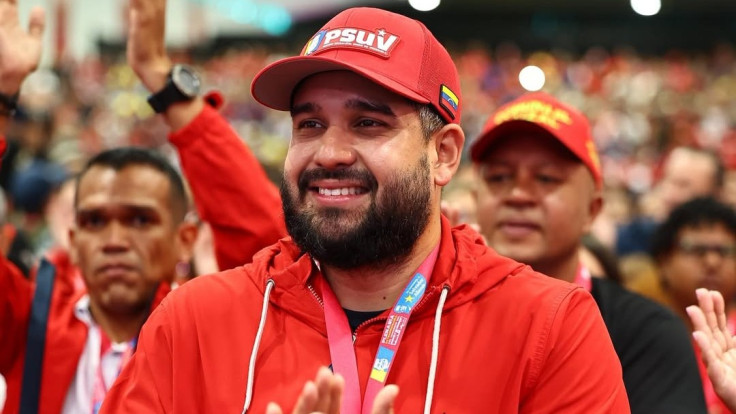
Nicolás Maduro Guerra, the son of former Venezuelan President Nicolás Maduro and a defendant in a U.S. drug-trafficking case, was appointed this week to continue leading Venezuela's parliamentary friendship group with Japan, underscoring how he has maintained a visible public role in Caracas despite facing criminal charges in the United States.
Venezuela's National Assembly announced Tuesday that Maduro Guerra would again preside over the Venezuela-Japan parliamentary group alongside ruling party lawmaker José Villarroel.
The appointment, reported by EFE, was confirmed by National Assembly Vice President Pedro Infante as lawmakers also unveiled new parliamentary friendship groups with more than 20 countries.
Maduro Guerra, a legislator from the ruling Socialist Party, was added in January to a superseding indictment unsealed by the U.S. Department of Justice in the Southern District of New York. The indictment accuses him, his father Nicolás Maduro and other Venezuelan officials of conspiracy to import cocaine into the United States and weapons-related offenses.
The Justice Department document alleges that Maduro Guerra, identified in the indictment by the aliases "Nicolasito" and "The Prince", attended a 2020 meeting in Medellín, Colombia, with representatives of dissident factions of the former Revolutionary Armed Forces of Colombia (FARC) to discuss transporting cocaine and weapons through Colombia and toward the United States.
Prosecutors also alleged that Maduro Guerra traveled frequently to Venezuela's Margarita Island aboard a PDVSA-linked aircraft allegedly associated with narcotics operations. If convicted in the United States, legal analysts cited by NTN24 have said he could face a life sentence.
Despite the charges, Maduro Guerra has continued to participate publicly in Venezuela's political and diplomatic initiatives. In a May interview with Spain's ABC newspaper, he defended the governing Chavista movement while acknowledging that it should "ask forgiveness for excesses."
He also argued that Venezuela needed greater economic normalization and foreign investment after years of sanctions and political crisis. "Venezuela has to open itself to the world," he said.
Japan was among the countries that reacted publicly after the January 3 U.S. operation in Caracas that resulted in the capture of Nicolás Maduro and former first lady Cilia Flores. Tokyo said at the time it would support diplomatic efforts aimed at restoring democracy and stability in Venezuela.
The National Assembly also announced renewed parliamentary groups with Argentina, Canada and several Asian countries as Venezuela seeks to expand international political and commercial ties following the restoration of diplomatic relations with the United States earlier this year.