

I've always loved journaling but sometimes when my mornings are too stressful it's hard to focus long enough to gather my thoughts. And then there's always writer's block. Despite writing all day for work, when I want to turn my own ideas into thoughtful projects, the momentum isn't always there.
What I actually needed wasn't more willpower — I thoroughly enjoy writing. But I needed a starting point. A single good question, handed to me, every day so the only decision left was to answer it.
So I built one. I'm calling it The Prompt Deck.
What it is
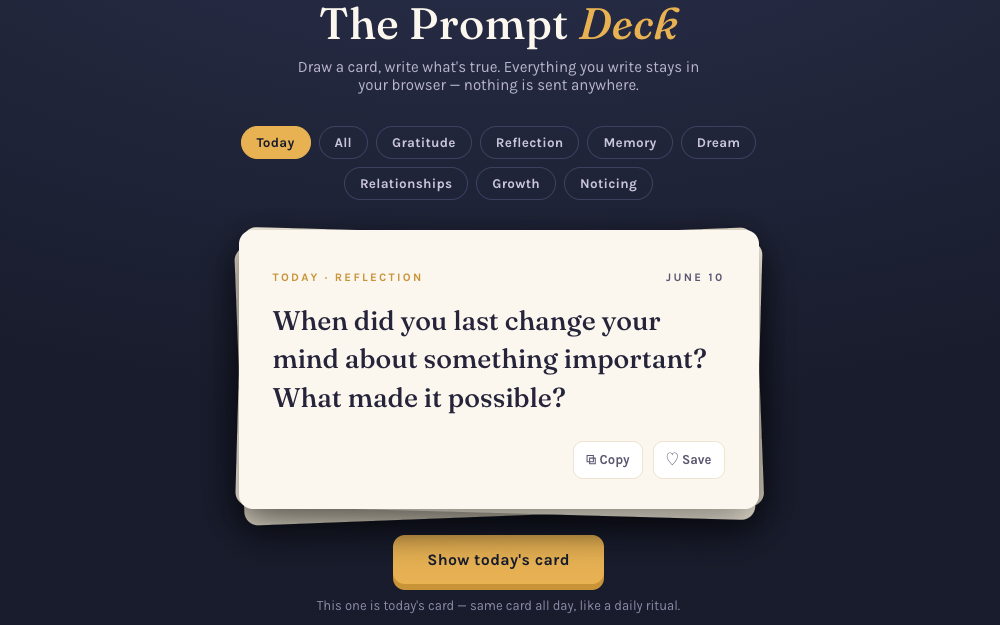
The Prompt Deck is a tiny web app that works like a deck of index cards. When I open it, the day's card is waiting for me — one journal prompt, the same one all day, so it feels like a small daily ritual instead of a slot machine.
Some days the card asks something gentle: Describe the light in the room you're in right now. Some days it goes deeper: What are you pretending not to know? If today's card isn't the one, I can always draw a new one from seven categories — Gratitude, Reflection, Memory, Dream, Relationships, Growth and Noticing.
There's a little writing space right underneath the card. Whatever I write, it automatically saves in my own browser or on my phone. It's all private. I can also tap the heart next to each card to save prompts I want to return to, and copy and care to paste into a notebook app.
Here's the part that still surprises me: I built it

AI is about solving problems. I often think "what is the problem I'm trying to solve?" and then ask AI to help me. In this case, I needed prompts to get my creativity flowing in the morning.
Yet, I didn't write the code. I described what I wanted to Claude in plain English — a daily journal prompt, categories, a deck-of-cards feel, favorites, a private writing space — and it built the entire thing as a single file in one sitting.
We went back and forth a little, the way you would with a friend who happens to know how to code. I'd say what felt off; it would adjust. The whole process took less time than I've spent picking out a notebook.
This was actually my second project recently. I also made The Summer Box, an activity finder for keeping kids busy, the same way. Once you realize you can just describe the small tool you wish existed and have it appear, you start noticing all the little problems in your life that a tiny app could solve.
Want to build your own version?
This is the part I really want to convince you of: you can do this too, and you don't need to know how to code.
Here's the whole recipe:
- Describe the tool you wish existed. Open Claude ( claude.ai — the free tier is plenty for this) and explain your idea like you'd explain it to a capable friend. Be specific about how you want it to feel . Mine went something like: "I want a journal prompt app that feels like drawing a card from a deck. One prompt per day, plus categories I can browse. Calm, nighttime colors. Everything private."
- Go back and forth until it feels right. Don't settle for the first draft. "Make the prompts warmer." "Bigger text on phones." "Add a save button." Each tweak takes seconds.
- Ask for it as a single file you can deploy to Netlify. What you'll get is a self-contained index.html file with everything baked in, which is the easiest possible thing to put online.
- Put it on the internet — for free, in about a minute. This is the step that sounds technical and absolutely isn't. Go to netlify.com You can create a free account if you don't have one. Then drag your file (or the zip Claude gives you) onto the page.
Final thoughts
Making apps that are truly useful is really rewarding. Now, whenever I think "I wish there was an app for..." I simply vibe code it myself. And, what's great about making apps yourself, whenever you want to change something — new prompts, new colors, a new feature — just go back to the conversation and ask. Drag the new file onto Netlify and your link updates.
Try my Prompt Deck for yourself or make your own dream app. There are no rules for vibe coding. Just let your imagination flow and see where Claude Code takes you. OpenAI's Codex and Gemini are also perfect for vibe coding, so don't sell yourself short.