I did not leave India out of anger.
I left because, in the early 2000s, becoming a doctor often felt less like a test of merit and more like a test of money, contacts, silence, and luck. My story is personal. But it is also the story of many Indian students who were told they were not good enough by a system that was itself not good enough.
Bias began at school
I was in Class 10 when my biology teacher dared me to take biology in Class 11. I never could quite explain what I wanted from her — approval, maybe, or just some sign that she saw something in me. She was strict does not cover it. Sometimes it was painful. There were barely 10 students in the class, and I was somehow never her favourite. She would call me an “outstanding student” and then make me stand outside the door if I was even a minute late for biology lab. I feared her. I also wanted her respect more than anyone else’s. I never got it.
At the same time, home was unstable. An uncle was in Delhi for cancer treatment, and my mother was constantly moving between home, Rajiv Gandhi Cancer Hospital in Rohini, and Apollo in Sarita Vihar. Medicine was not an abstract dream for me. It was happening inside my own family. I still remember explaining the digestive system to relatives because my uncle had colon cancer. Biology became my favourite subject. I wanted to be a doctor.
I also began to see how unfairness works.
It was Class 12 now. In the final CBSE biology practical, an external examiner was supposed to award part of our marks independently. Most of us received somewhere around 25 to 28 out of 30. One student – the teacher’s chosen one, as was always quietly understood – initially received much lower. Then the biology teacher argued with the examiner until that student received a 30. I did not have the words for it then, or the platform, or any real understanding of what it would mean years later. Now I do: corruption does not always announce itself. Sometimes it begins the moment someone decides fairness is negotiable. And when one person draws their moral line in the wrong place, it is never just one child who pays.
That is why when I hear about NEET paper-leak allegations, I do not see something new. I see the same old habit wearing a new uniform.
After school, advice to buy a seat
I was still in Class 12. I was patriotic. I believed in doing the right thing, though my moral compass was still finding its bearing. The internet then took three minutes to connect on a dial-up modem. There were no podcasts, no biographies at your fingertips, no easy way to find stories of people who had stood up to unfair systems. 3 Idiots had not even been made yet.
At home, the academic pressure was brutal. I remember my mother beating me for poor marks. My face hurt enough that wearing a motorbike helmet to Aakash tuition was genuinely painful. The police stopped me once for carrying the helmet on my arm instead of wearing it. I refused to pay anything and handed them my license instead. My family said I should have just “given something” and saved myself the court trouble.
My chemistry and physics scores dragged my average down. I did not qualify for Delhi College of Engineering despite a decent rank, but I never wanted engineering anyway. I had qualified for the AIIMS entrance exam, and that was what mattered to me.
Family friends came to the house to console us, as if someone had died. And almost every one of them had the same suggestion: if necessary, buy a seat at a donation college.
This was before NEET. Every college had its own exam, its own process, its own back doors. That system gave corruption more entrances than anyone could count. People spoke of leaked papers casually, without shock, the way you talk about traffic or weather. If my family had the money, I might have ended up in a paid seat whether I agreed to it or not. Honestly, I am not sure my moral compass was strong enough then to have refused. I would have done almost anything to escape the pressure at home, and my family would have done the same to have one less thing to worry about.
I remember my father taking me to meet a man he knew from his college days – now a politician. Help was discussed. Help had a price. I was pointed toward a South Indian dental college where the donation was around Rs 3.5 lakh. I am grateful today that my family could not afford it. I cannot brace the idea of being a dentist – pun intended. And had we paid, reading about NEET leaks now would carry a different kind of pain.
I heard stories from friends too: someone paid for a seat in Bangalore, someone in Manipal, someone somewhere else. Someone close to my family, a little later, reportedly got a medical rank without ever appearing for the exam, and a better rank for his MD at a higher price. I will not name anyone. The point was never one family. The point is that many families knew the game and played it anyway, quietly, telling themselves they were just helping their own child.
That invisible child on the other side of that transaction – the one who studied, who did not have contacts or cash – lost a future someone stole. Corruption does not always announce itself. Sometimes it begins the moment someone decides fairness is negotiable.
The journey to Russia and future in US
So I went to Moscow.
Yes, Moscow. In Russia. There was no donation. Admission into the English-medium batch was straightforward – it was new, and they were still filling seats. From Armenia to Uzbekistan, embassies were hosting seminars at the time, making foreign medical education sound almost glamorous: “Study in Yerevan, MBBS and MD combined,” low fees, big promises. Many educated Indian families did not understand that an MD from abroad was not the same as an Indian MD. Hope was being marketed to the desperate.
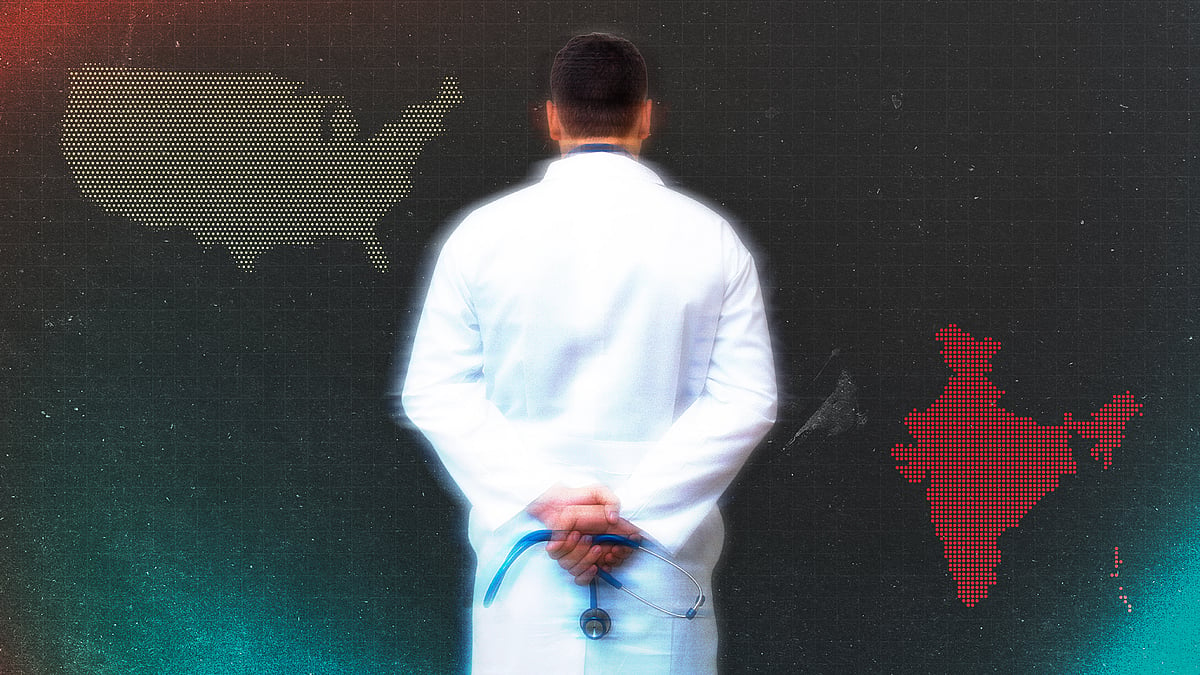
Russia was good to me in many ways. I studied enough to pass. I never felt I had stolen anyone’s seat. But the good stretch ended in June 2007. After that, the choices were clear: return to India, clear the Foreign Medical Graduate Examination, and then figure out how to specialise without money for a seat, or rebuild somewhere else. Most of foreign medical graduate peers returned to India. As far as I knew, many of them paid for MD or DNB seats. Some of us chose the harder road.
I came to the United States for, I suppose, a future.
I signed up for an unpaid research position at what I will diplomatically call a rebound university. That time broke me down and helped me rebuild. I studied for four USMLE exams. I went unmatched once. I kept going. Eventually, I matched into an internal medicine residency, completed internship, became a chief resident, and then did fellowship in pulmonary and critical care medicine at a genuinely top US institution. For Indian context: the equivalent of MD Medicine and DM in two specialties, more or less simultaneously.
Today I am certified by the American Board of Internal Medicine in three subspecialties. I teach medical students, residents, and fellows. When we see patients together, I tell them that books can teach them medicine – my job is to teach judgment, humility, and the discipline to think slowly. And no one here is trying to recover the cost of a purchased seat. That is my real joy.
But the wound is still there.
For years I believed I was not good enough for India. Now I know I was. A confused and corrupt system made me feel otherwise.
One exam can’t fix a society that wants shortcuts
India now has NEET, and that is better than hundreds of private doors with private keys. But one exam cannot fix a society that still treats shortcuts as a backup plan. NEET-UG 2024 had over 24 lakh registered candidates while medical seats remain far fewer. That pressure makes families desperate. Desperation creates markets. Markets create brokers. And brokers quietly destroy faith in the whole institution. The NEET scandal is not a story about one exam. It is a mirror held up to everything around it.
In Texas, where I practice, every physician must understand medical jurisprudence. Referral kickbacks from labs and hospitals are illegal. Paid patient solicitation can become a felony under Texas law. In India, referral cuts to labs, pharmaceuticals, and hospitals are still whispered about as if they are just how business works. Call it what it is: betrayal dressed up as commerce. Medical professionals are soldiers for the sick. Taking kickbacks is like selling battle plans to the enemy.
During COVID, when India was suffering, I joined India COVID SOS. I helped people directly and through their doctors, including senior, highly decorated physicians who needed guidance they could not get elsewhere. India’s system had not earned my loyalty. Its people had not lost it.
My only real regret is leaving friends and family behind. But perhaps families like mine also failed ourselves. We complained about corruption and still looked for the shortcut when we were afraid. We hated the system and quietly tried to work around it. Maybe the exile was not punishment. Maybe it was education.
India has enough brilliant doctors. What it is short of is doctors who are citizens first. Who see the patient before they see the fee. It needs medical colleges where seats are earned. It needs exams people can trust. It needs families who stop keeping corruption as a backup option. It needs teachers who do not bend marks for favourites.
I left India to become a doctor. India should ask itself why so many of us had to.
The writer is a faculty member at a medical college in the US.
We take no ads, bow to no government or corporation, and answer only to you, the reader. This Press Freedom Month, pay to keep news free.
Newslaundry is a reader-supported, ad-free, independent news outlet based out of New Delhi. Support their journalism, here.