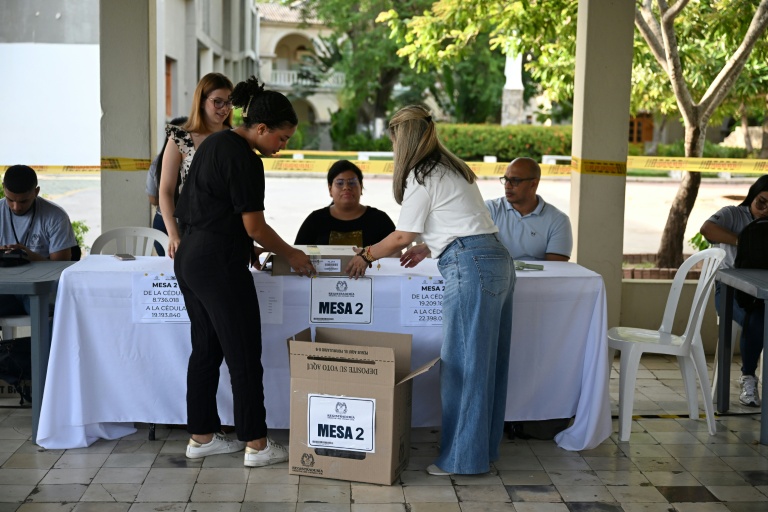
BOGOTá - Colombians began voting in a presidential runoff Sunday, choosing between a hard-right, White House-backed lawyer and a leftist senator to decide the fate of a stumbling peace process and strained ties with Washington.
Up to 41 million voters will choose between frontrunner Abelardo de la Espriella and his leftist rival Ivan Cepeda -- the latest in a series of hyper-polarized Latin American elections.
Security issues dominated a campaign marred by guerrilla bomb attacks and the murder of a leading conservative presidential candidate.
"I have to say, there is a certain fear," 59-year-old Alex Vizcaino told AFP while voting in the Caribbean coast city of Barranquilla. "It's the first election where you feel this bit of fear."
"There are a lot of fanatics. You see a lot of violence," he said. "I think everyone's hope, regardless of political color, is that things change."
De la Espriella, a dual US-Colombian national who calls himself "The Tiger," won May's first-round vote by promising to wage war on drug-running guerrilla groups who refused to sign a 2016 peace accord.
He has won President Donald Trump's "complete and total endorsement" and hopes to ride a right-wing wave that has swept rightist candidates to power in Bolivia, Chile, Costa Rica, Ecuador and Honduras.
From behind bulletproof glass and with a military salute, he has rallied support with a cry of "stand firm for the homeland!"
He told AFP that if elected, he wants US backing for a 90-day campaign of airstrikes against armed groups producing coca, the raw material of cocaine.
He advocates the right to carry arms, construction of mega-prisons, fracking, cutting the size of the state, and has said that it would be "ideal" to dollarize Colombia's economy.
Cepeda is a 63-year-old philosopher-turned-senator and human rights defender and has been a key figure behind the current government's policy of negotiating "total peace" with armed groups.
He is the son of a communist senator killed by right-wing paramilitaries and is the political heir to outgoing President Gustavo Petro -- who is constitutionally barred from running.
Critics say Petro's leftist government has allowed armed groups to grow richer from trafficking, expand their territory and gain power.
Cepeda recently told AFP that he would "take stock" of peace talks and "make the necessary changes." He has long favored dialogue over an iron fist security approach.
Cepeda's support comes mainly from progressives and the poor -- who have benefited from a reduction in poverty, higher wages, and lower unemployment in what is still one of the most unequal countries in the world.
The first round of voting showed a total collapse of Colombia's political center and the traditional right, which has run the country for much of the last two centuries.
During that vote De la Espriella garnered 44 percent of the vote, against Cepeda's 41 percent, with neither getting the majority needed to avoid a Sunday's runoff.