
Kazakhstan is betting on artificial rain as the answer to its prayers for more water. As one of the regions worst hit by global warming, Central Asia is scrambling for ways to keep its crops alive during prolonged droughts.
Cloud seeding will be used in the Turkistan region, which did not see rainfall for a full eight months in 2025.
“Kazakhstan is making a practical step towards the formation of the new system of climate sustainability. This is the first time a project of this magnitude, aimed at increasing precipitation, has been launched,” said Kazakhstan’s Deputy Prime Minister and Minister of Digital Development, Zhaslan Madiyev, at a ceremony to launch the Rain Enforcement Project.
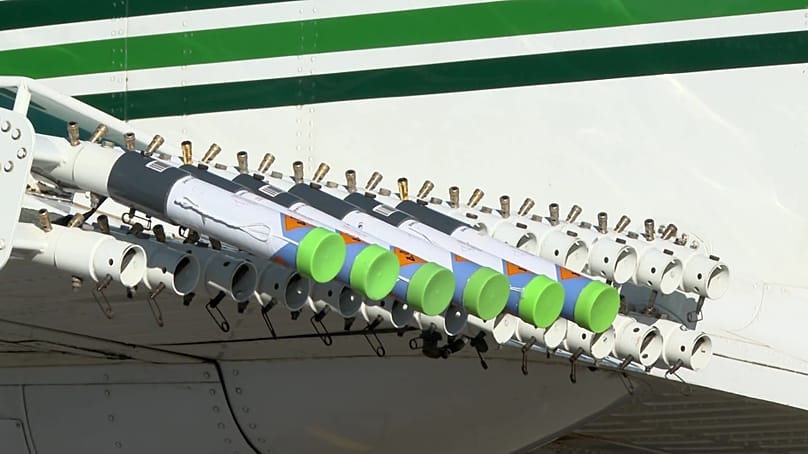
What is cloud seeding?
Clouds need tiny water or ice droplets called nuclei to make rain. The weather modification method uses planes and ground-based cannons to shoot particles into clouds making more nuclei, attracting moisture that falls as snow and rain.
Usually silver iodide is used, but it can also be dry ice and other materials. The method, first pioneered in the 1940s, became popular in the US West starting in the 1960s, mostly for snow.
It can't create water from a clear sky - particles must be shot into a storm cloud that already holds moisture to get it to fall, or to fall more than it otherwise would naturally.
Kazakhstan's Rain Enforcement Project, the first of its kind in Central Asia, will help to water more than 900,000 hectares in the Turkistan region - increasingly difficult to tend to with the usual irrigation systems.
Is cloud seeding environmentally friendly?
The process is tested to make sure the salts used do not pollute the water and the soil.
Experience shows it can increase the precipitation in a region by 10-20 per cent. It is estimated it will save Kazakhstan around €65 million euro a year, mainly through the increase of crop yields.
Which countries use cloud seeding?
Governments in drought-stricken regions like the west of the US and UAE are often willing to invest in technology like seeding in the hopes of getting even a small amount of water.
Utah, in the US, estimates cloud seeding helped increase its water supply by 12 per cent in 2018, according to an analysis by the state's Division of Water Resources.
Dozens of countries in Asia and the Middle East also use cloud seeding.
UAE experts fly in to share cloud seeding expertise
Cloud seeding has been done in the United Arab Emirates since the 1980s so there's no better nation to share their knowledge and expertise.
Experts from the UAE's National Meteorological Centre are training Kazakh meteorologists, engineers and pilots to use technology and follow processes needed to stimulate rain to fall from clouds.
“This project is educational, we shall stay here for two months and in that time we shall transfer our knowledge to meteorologists, engineers, pilots and other staff. We shall see the results of this project after its completion. This project can increase precipitation up to 20 percent and if we reach that 20 percent we will consider it a success,” said Abdulla Ahmed Al Mandous, General Director of the UAE National Meteorological Centre.
“We work with the operations on the ground. They see the cloud, they have radars and satellites. But we are their eyes in the sky, we fly into the cloud and give them information about the cloud, the updraft, the temperature, the type of the cloud,” said the pilot of the special aircraft brought to Kazakhstan. “Then the experts in the operations decide about the numbers of flares we are going to activate, and we fly and activate those flares.”