
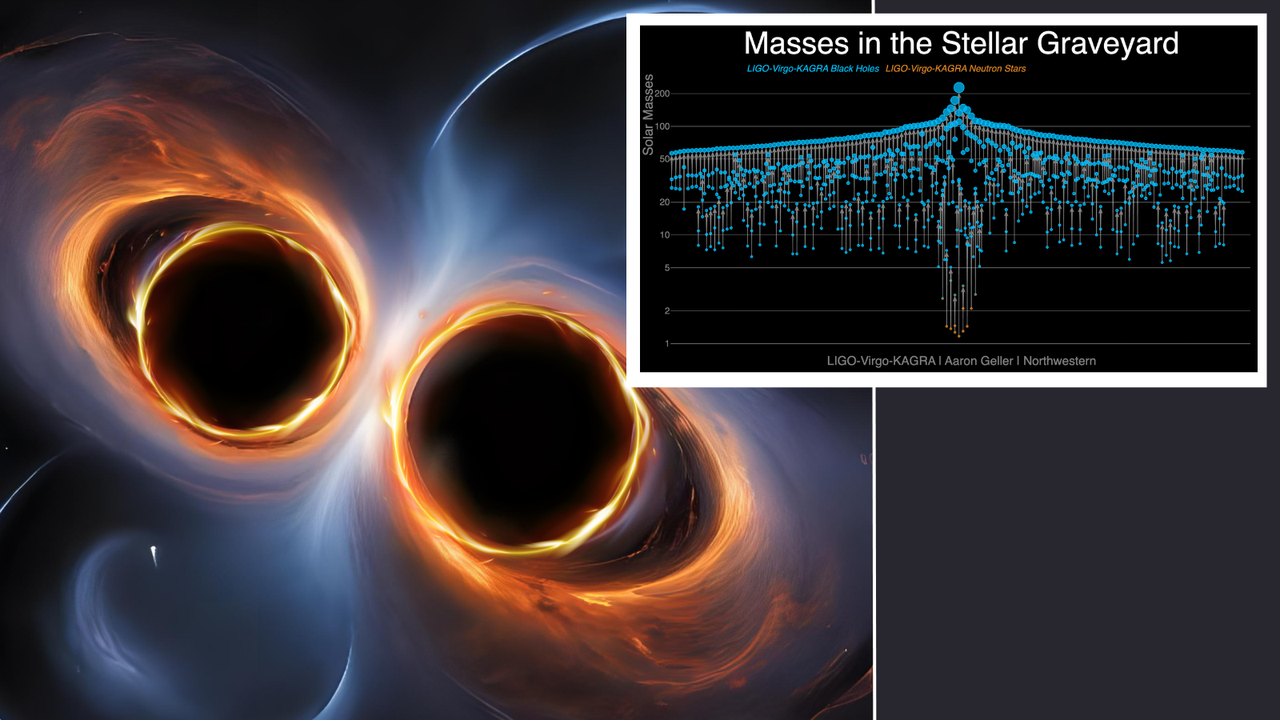
Astronomers have struck "black gold" — a treasure trove of black hole mergers. And the discovery was made by analyzing ripples in the very fabric of space and time, or spacetime, called gravitational waves.
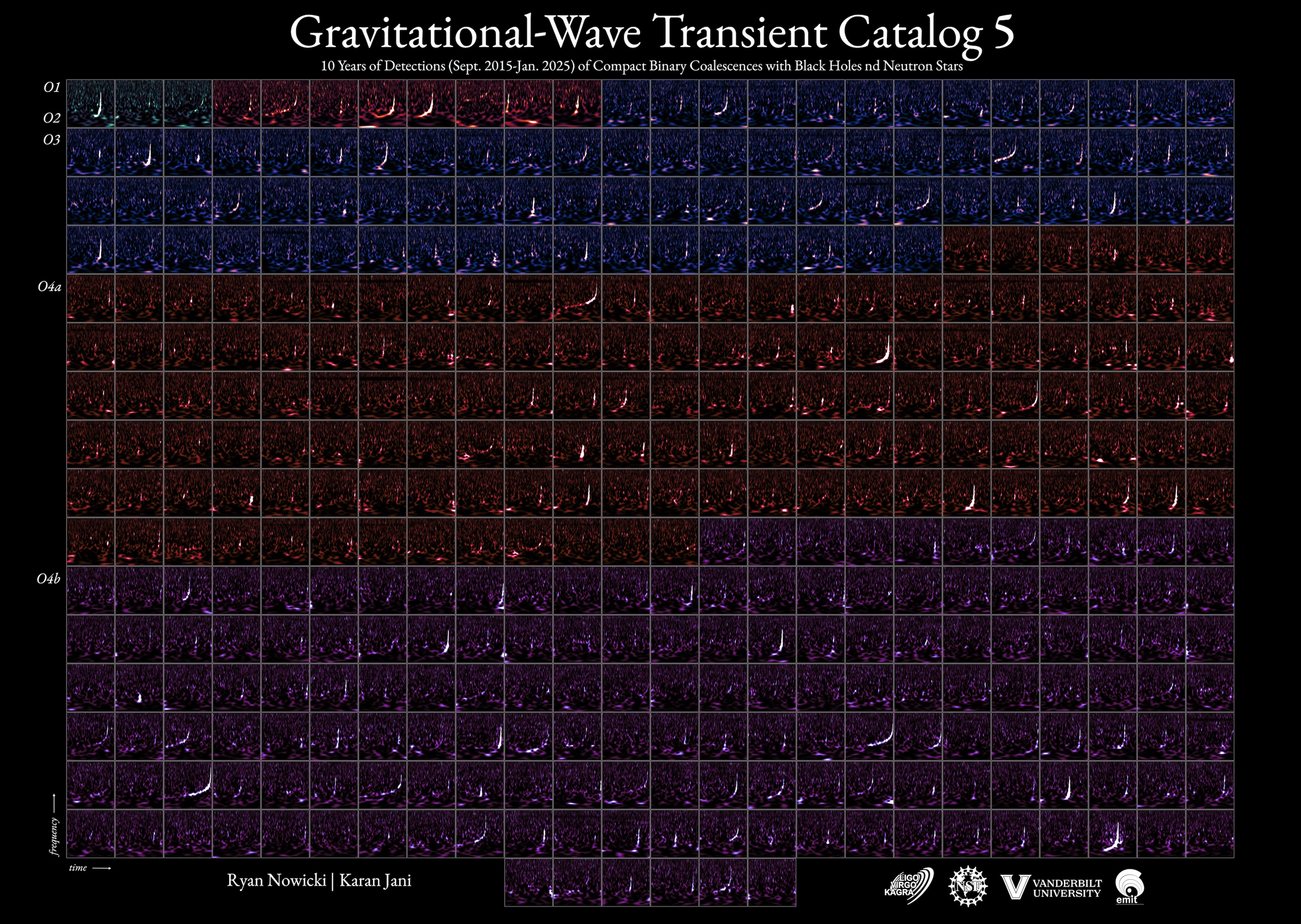
This massive haul of mergers contained within the Gravitational Wave Transient Catalogue-5.0 (GWTC-5), released on Tuesday (May 26), could change our understanding of how black holes meet and collide. The latest catalog contains 161 new gravitational wave signals launched by merging black holes "heard" by iconic gravitational wave detectors LIGO (Laser Interferometer Gravitational-Wave Observatory), Virgo, and KAGRA (Kamioka Gravitational Wave Detector) between April 2024 and the end of January 2025.
It brings the total number of black hole mergers detected via gravitational waves up to 390.
Highlights of GWTC-5 include the detection of "second generation mergers," or collisions between two black holes that had formed in previous mergers, and the most precisely localized merger ever. While the former could help us better understand merger chains that allow black holes to grow to masses millions or even billions of times that of the sun, the latter could help develop a method of using such events and their gravitational wave signals to measure the rate at which the universe is expanding.
"This bumper update has once again broadened and deepened our knowledge of the universe, and given us many more glimpses of its most elusive objects: colliding black holes," Daniel Williams, a research fellow at the Institute for Gravitational Research, said in a statement. "We're now detecting so many of these signals that we're not just learning about individual collisions; it's the astronomical equivalent of uncovering an ancient civilization.
"Today's new results are like finding a previously undiscovered hoard, revealing not just individual lives, but the structure of an entire lost world."
What are gravitational waves?
Gravitational waves were first proposed in 1915 as part of Albert Einstein's theory of gravity, known as general relativity. General relativity suggests that objects with mass cause spacetime (the four-dimensional unification of space and time) to warp. Gravity arises from this warping, meaning the larger the mass, the greater the curvature of spacetime and the stronger the gravitational influence.
General relativity goes beyond this, also suggesting that when objects accelerate in spacetime, they create ripples that radiate outward at the speed of light: gravitational waves. Though Einstein initially predicted this rippling of spacetime, he was wrong about one aspect of gravitational waves: he thought humanity would never detect them.
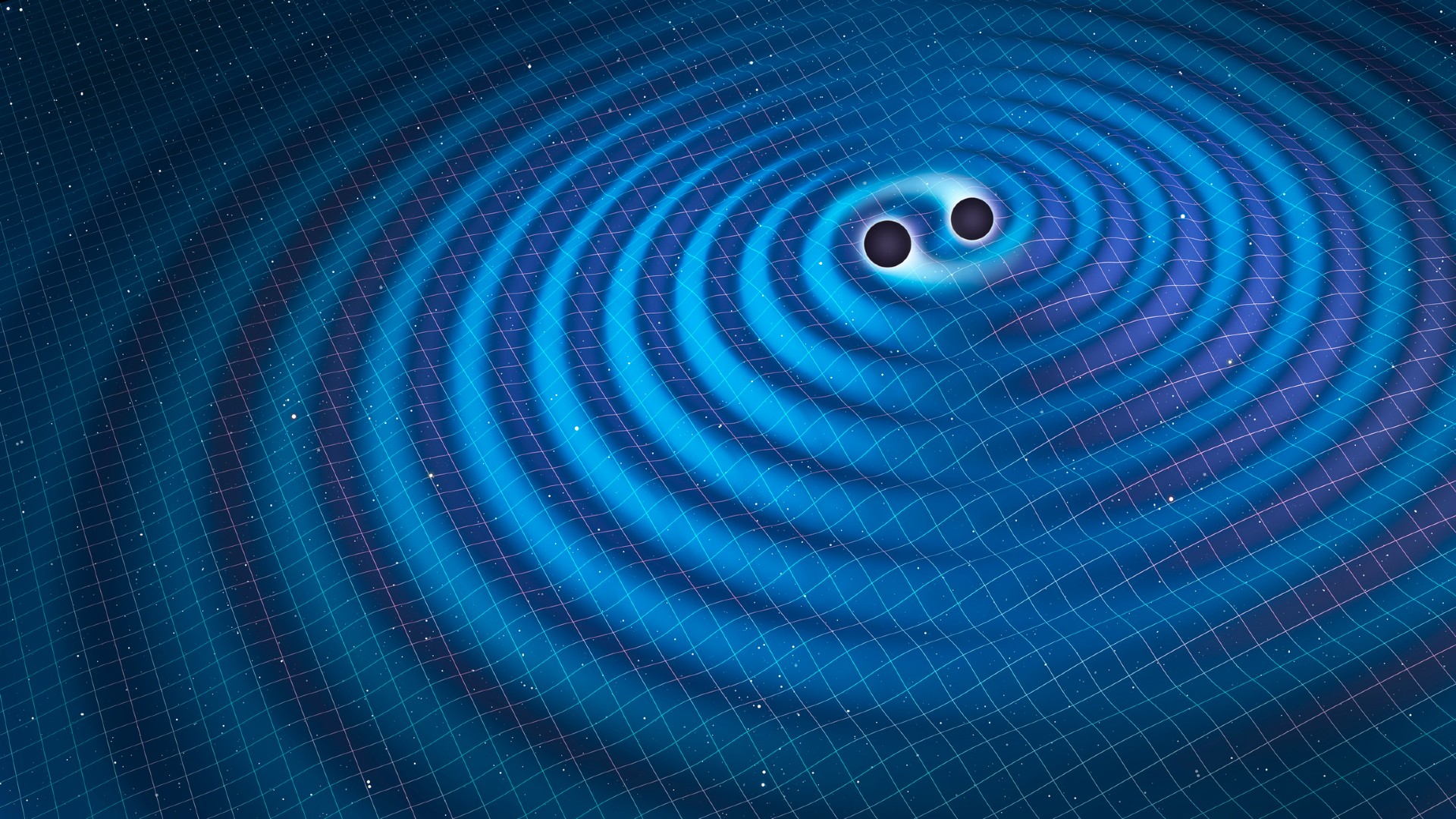
LIGO made the first detection of gravitational waves in 2015; the signal came from the collision and merger of two massive black holes located around 1.3 billion light-years away. Since then, along with its fellow detectors Virgo and KAGRA, LIGO has detected gravitational waves from many mergers between pairs of black holes, pairs of ultra-dense neutron stars — and even mixed mergers between a black hole and a neutron star.
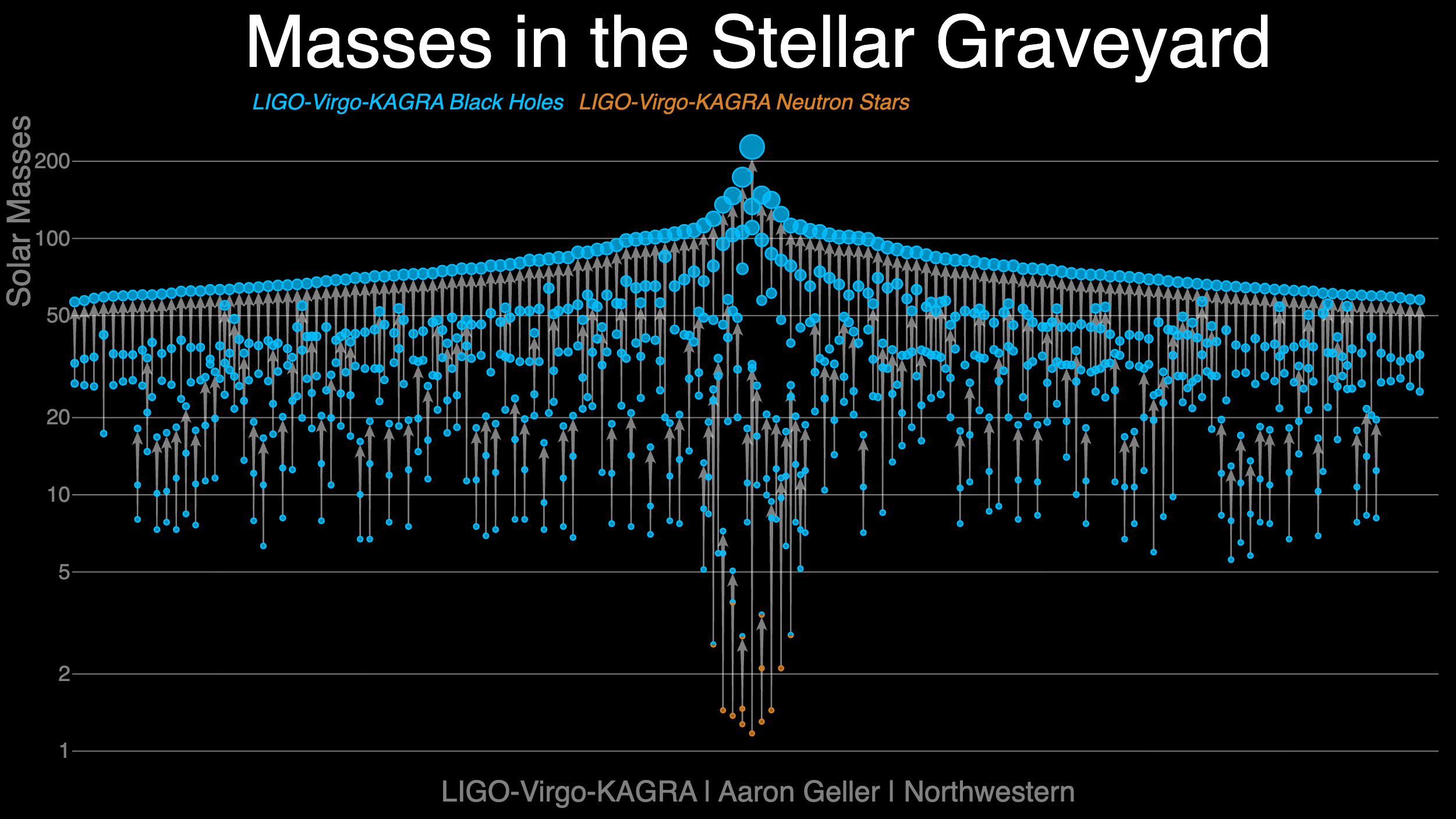
The sensitivity of the gravitational wave detectors has only increased in recent years, with detections currently occurring as frequently as three to four times each week during observational run phases between down periods that allow further advancement of sensitivity.
"Just 10 years ago we made the first detection of gravitational waves from one of these events, and it's a real testament to the work of hundreds of scientists around the world that we're now detecting and analyzing hundreds of them," Williams said.
Gravitational wave detections are making some noise
Two impressive demonstrations of the importance of the data from GWTC-5 are the signals GW241011 and GW241110 detected on Oct. 11, 2024, and Nov. 11, 2024, respectively. They are the result of two mergers 700 million light-years away and 2.4 billion light-years away, and the rapid spin of the involved black holes and the orientation of that rotation implied that these four black holes were second-generation objects, meaning they were created by prior mergers.
"These two observations showed characteristic signs that the larger black hole in each pair was formed not directly from a massive star, but from a previous merger of two black holes," Storm Colloms of the Institute for Gravitational Research said in the statement. "The signatures of black holes formed from previous mergers persist in the population as a whole, indicating that GW241011 and GW241110 are not one-of-a-kind, but trace an underlying trend. Now, we have growing evidence that there are ways that the universe creates merging black holes in addition to those that come from massive binary stars."
This indicates that these two mergers occurred in densely packed stellar environments, something that will be difficult to investigate because it isn't easy to localize a gravitational wave signal back to its point of origin. That isn't always the case, as was demonstrated by the signal GW240615, detected on June 15, 2024.
The result of a 26-solar-mass black hole merging with a 30-solar-mass black hole over 3 billion light-years away, gravitational wave astronomers were able to pinpoint GW240615 to a region of the sky measuring just 6 square degrees. That makes GW240615 the most precisely localized gravitational wave signal to date.
"The updated GWTC-5.0 catalogue gives us a much larger collection of gravitational-wave signals to help answer one of the biggest questions in cosmology: how fast is the universe expanding?" Alex Papadopoulos of the Institute for Gravitational Research said in the statement. "The rate of this expansion is described by a value called the Hubble constant. Gravitational waves allow us to measure this by estimating how far away merging objects are, either directly from the signal itself or by identifying the galaxy where the merger took place.
"Each event contributes a small amount of information, so together these additional signals significantly improve our results. Together, these improvements help us measure the Hubble constant more precisely than ever before using gravitational waves, bringing us closer to understanding one of modern physics’ most important open questions."
Also standing out in this latest catalog is the gravitational wave signal GW250114 detected on January 14, 2025. This is believed to be the result of a 34 solar mass black hole colliding and merging with a 32-solar-mass black hole around 1 billion light-years away. This signal was so clear that it allowed researchers to perform the most accurate test of general relativity ever, in addition to confirming a concept introduced by Stephen Hawking called the black hole area theorem.
"With the loudness of GW250114 we are able to compare the warped space-time before and after the black holes merged, and found that the total area of the event horizons [the light-trapping outer boundary of a black hole] increased in accordance with Hawking's laws of black hole mechanics," John Veitch of the University of Glasgow said in the statement. "After the merger the final black hole rings like a bell, giving off gravitational waves instead of sound. Analyzing these waves confirmed that although energy is given off in gravitational waves during the merger, the total entropy of the black holes increases in accordance with the second law of thermodynamics.
"This shows that even for black holes the laws of thermodynamics still apply, but unlike normal objects, the more energy they hold, the colder they become."
It is very likely that LIGO, Virgo and KAGRA will continue to make gravitational wave discoveries that redefine our understanding of the universe and its most violent events. The detectors are set to begin a six-month intermediate observing run (IR1) later this year. This will bridge the gap between the end of Observing Run 4, which concluded on Nov. 18, 2025, and the beginning of Observing Run 5, which will operate between 2028 and 2031.
The future is bright for gravitational waves — or should that be "loud?"