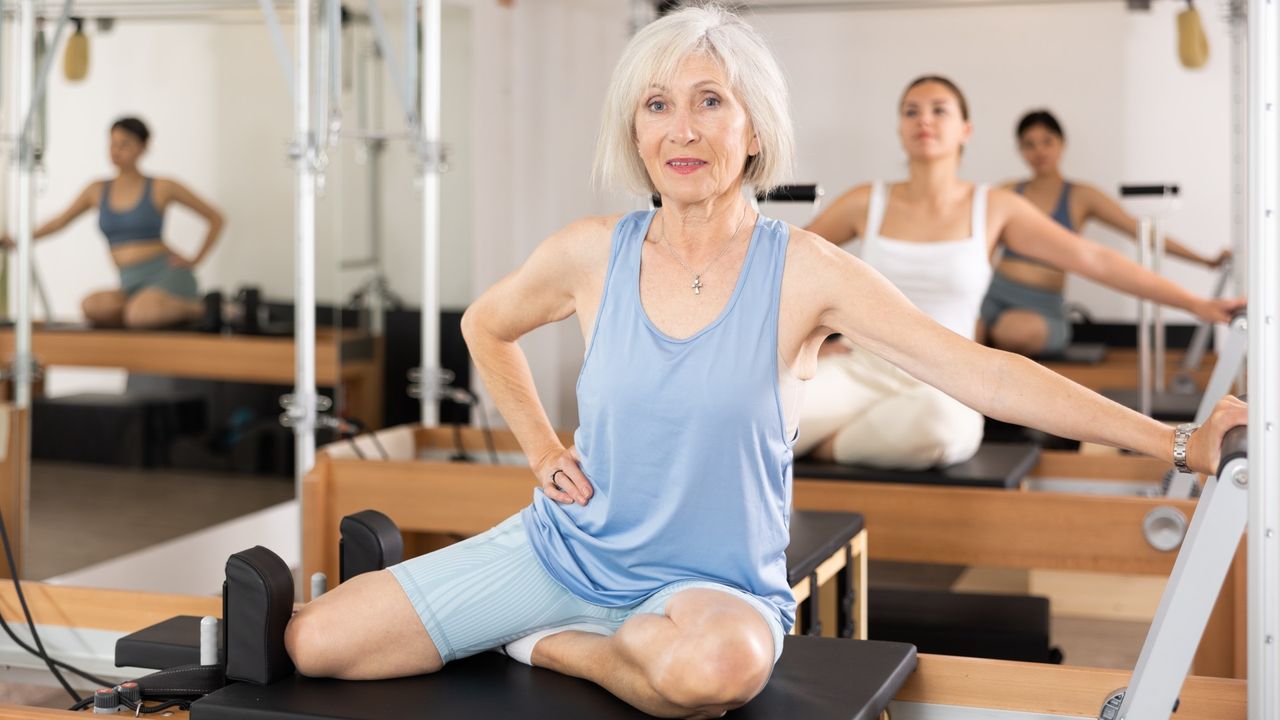
I love Pilates. And the one thing I love more than mat Pilates? A reformer. This style of exercise has helped build a stronger core, improve posture, increase shoulder stability, and feel more balanced and centered over the last year or so.
This six-move reformer Pilates sequence is designed for clients over 60, with an emphasis on safe strength-building, improved balance, joint mobility, and deep core activation.
Another bonus is that it's a beginner-friendly Pilates workout, which means you can keep the pace slow, intentional, and controlled — exactly the way we want Pilates exercises to be performed.
While this routine is performed using a reformer, you can do all of the exercises without one, so I will provide modification guidance below if you don't have a reformer or studio near you. As always, seek advice from a physical therapist or relevant medical professional if you're unsure about an injury, health condition, or similar.
What are the Pilates exercises?
Try the moves below and follow the steps:
A post shared by Tom's Guide Fitness (@tomsguidefitness)
A photo posted by on
Move 1: Footwork
This is a foundational exercise to warm up the body, activate the legs, and establish alignment through the pelvis and spine. It builds lower-body strength and joint mobility. Press evenly through both feet, maintaining a neutral pelvis and soft ribcage. Encourage slow, controlled presses and returns, focusing on stability rather than speed.
- Lie on your back with your head resting on the headrest and your feet hip-width apart on the footbar. Find a neutral pelvis, where your hips feel level and your spine maintains its natural curve.
- Press evenly through both feet to extend your legs, imagining you’re pushing the carriage away with control rather than locking your knees. Keep your pelvis stable and your ribcage relaxed as the carriage moves.
- Pause briefly at the end of the movement, then slowly bend your knees to return the carriage home, resisting the springs and maintaining the same alignment through your pelvis and spine.
- Focus on moving smoothly and evenly through both legs, feeling the glutes, hamstrings and quadriceps working together while keeping the upper body relaxed.
Move 2: Bridges
Bridging supports mobility through the spine while strengthening the posterior chain and improving pelvic control. It builds spinal articulation, glute strength, and pelvic stability. Roll up and down one vertebra at a time. Encourage glute engagement without over-compressing the lower back. Keep your breath steady and controlled.
- Lie on your back with your feet placed firmly on the footbar and your knees bent. Find a neutral pelvis and take a deep breath in to prepare.
- As you exhale, gently tilt the pelvis and begin peeling the spine off the carriage one vertebrae at a time, lifting the hips into a bridge position. At the top, create a long line from your shoulders to your knees while keeping the ribs soft and the glutes engaged.
- Inhale at the top, then exhale as you slowly roll back down through the spine, melting each vertebrae onto the carriage until you return to your starting position.
- Focus on moving through the spine sequentially, maintaining control throughout the movement. Use the glutes and hamstrings to support the lift while avoiding excessive arching or compression in the lower back.
Move 3: Hands in straps
This supine arm series builds upper-body strength while maintaining core engagement and shoulder stability. Keep your shoulders grounded and ribs contained. Move the arms with control, avoiding momentum. Focus on smooth, even resistance throughout.
- Lie supine on the carriage with your head supported and your feet either in tabletop or long through the footbar, depending on your setup. Take hold of the straps with your arms reaching up toward the ceiling, finding a neutral pelvis and steady core engagement.
- Set the shoulders down and wide, keeping the collarbones broad and the neck relaxed. As you exhale, begin the arm series by moving the arms slowly and with control, maintaining consistent spring tension throughout the movement.
- Inhale to return or prepare, and exhale to deepen core engagement as the arms move through their range. The focus is on isolating the movement in the shoulder joints while keeping the trunk completely stable.
- Each rep should feel deliberate and controlled, with equal emphasis on the out and return phases of the movement.
Move 4: Feet in straps/ leg circles
A gentle but effective way to improve hip mobility and strengthen deep core stabilizers. It focuses on stability and lower-body control. Maintain a stable pelvis and avoid excessive tension in the lower back. Move slowly through each range, prioritizing control and alignment as you circle your legs.
- Lie supine with both feet in the straps, arms long by your sides and pelvis in a neutral position. Press the ribs gently down into the carriage and find length through the spine before initiating movement.
- Begin small, controlled circles from the hip joints, keeping the pelvis as still as possible. The movement should originate from the femurs, not the lower back, with the core working continuously to stabilize the carriage.
- Maintain smooth, even tempo in both directions, gradually increasing range only if stability is maintained.
Move 5: Lunges
A supported lunge pattern to improve functional strength and stability. You can build balance and coordination while strengthening the lower body. Keep movement slow and controlled. Encourage alignment through the front knee and a stable pelvis. Focus on balance rather than depth.
- Set up in a supported lunge position with the front foot grounded on the side of the reformer and the back leg supported on the carriage. Organize the pelvis so both hip points face forward and the spine remains tall.
- Lower into the lunge with control, tracking the front knee over the second and third toes. Press back out through the foot, maintaining steady alignment and avoiding any collapse through the pelvis or ribcage.
- The emphasis is on stability, control and coordinated strength through both legs, rather than the depth of the lunge.
Move 6: Half-plank
A modified plank variation to build core and upper-body strength in a safe, accessible position. This focuses on core strength, shoulder stability, and postural control. Maintain a strong neutral spine with steady breath. Avoid collapsing through the shoulders or lower back. Emphasize control over duration.
- Hands on the footbar, thumbs forward, chest away from hands, creating a long line from shoulders through hips to knees.
- Engage the core gently to support the spine without bracing or gripping.
- Hold a steady neutral position, maintaining even weight through both shoulders and avoiding any sinking in the lower back or collapsing through the chest.
- Breath should remain calm and controlled, supporting stability rather than driving movement.
- Gently open the carriage by allowing the shoulders to move slightly away from the line of the hands. Maintain your alignment throughout, core engaged, ribs contained and hips steady.
- Only travel as far as you can maintain full control of the position. The movement should be small, precise, and driven by stability through the core and shoulders rather than momentum.
- Pause briefly at your end range without losing shape, then slowly draw the carriage back in, “zipping up” through the lower abdominals to re-establish full support and control.
How to modify the exercises
- Footwork : You don't really need a reformer for this. Instead, use any stable surface, like the edge of a bed or sofa, a step, or a staircase. You just need to be able to press the balls of your feet into the surface and encourage a range of movement without any limitations for space.
- Bridges: Perform bridges on one of the best yoga mats instead. This might feel easier, as the ground is more stable, but you could also place a Pilates ball or similar beneath your mid-back to challenge stability and balance, working your core and glutes harder.
- Hands in straps: Consider anchoring resistance bands on either side of you instead. This allows you to work through resistance without the reformer to hand.
- Leg circles: Instead, perform using your bodyweight and creating large, controlled circles with your lower back supported on a mat or similar. To increase resistance without a reformer, consider the best ankle weights .
- Lunges: Lunges can be performed anywhere, whether that's at home, stationary, or walking. You could hold a Pilates ball in both hands or consider adding dumbbells or kettlebells to increase resistance. Check out these lunge alternatives , too.
- Half-plank: Planks can also be performed anywhere, whether your knees are supported or not. Perform on the ground or a yoga mat, or consider checking out these plank variations to keep things interesting.
Follow Tom's Guide fitness on Instagram for more workouts, routines, tips, and tricks.
A post shared by Tom's Guide Fitness (@tomsguidefitness)
A photo posted by on
More from Tom's Guide
- Not sit-ups, planks, or crunches: I do this simple Pilates exercise every single day to build a strong and stable core and work on my hip flexor mobility
- I teach people how to be more mobile: 3 low-impact back and shoulder moves that build stability and strength after 40
- I'm training like an elite soccer player using these 4 strength and recovery tips from Man City W.F.C.