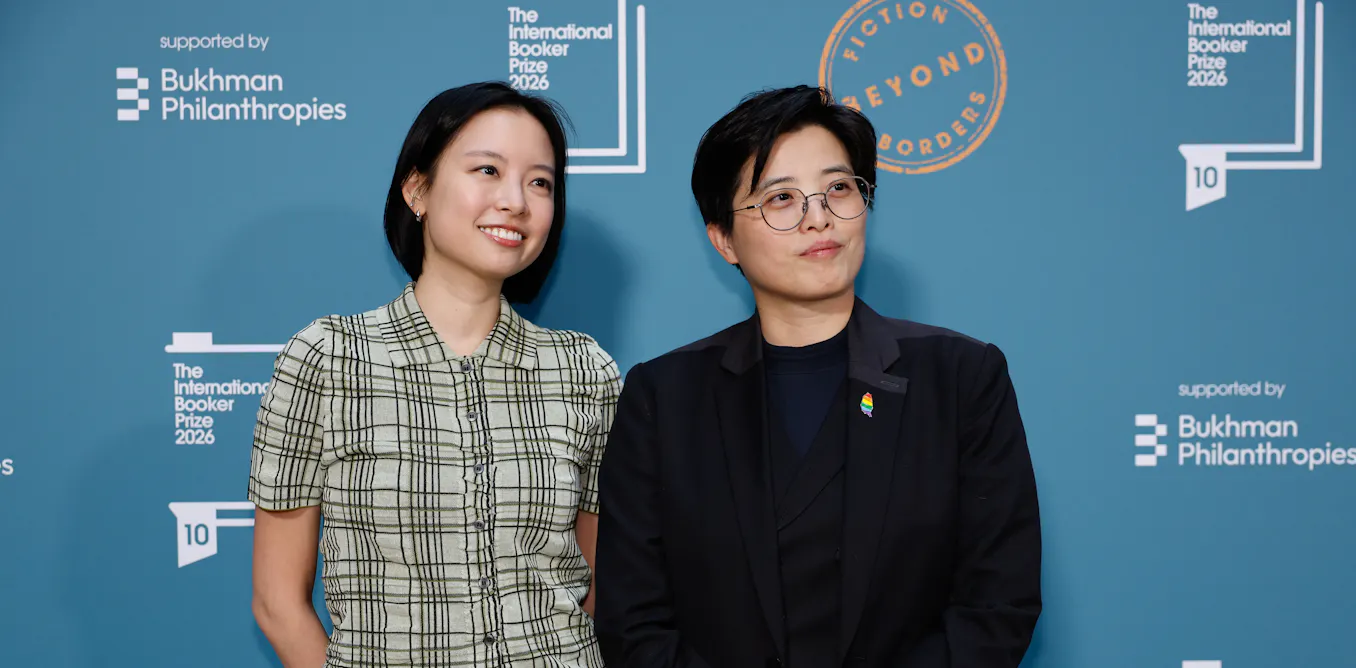
Yáng Shuāng-zǐ and her English translator Lin King have received the 2026 International Booker Prize for Taiwan Travelogue. The novel is the first work translated from Mandarin Chinese to win the award in its ten-year history, and Yang is the first Taiwanese writer to take the prize.
The judges described Taiwan Travelogue as “a captivating, slyly sophisticated novel” that “pulls off an incredible double feat: it succeeds as both a romance and an incisive postcolonial novel”. For Australian readers, it is an introduction to a Taiwan most of them have never encountered.
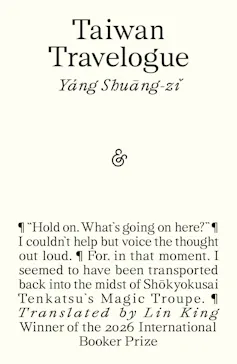
Taiwan Travelogue – Yáng Shuāng-zǐ (And Other Stories)
Australians have not been well served when it comes to understanding Taiwan. The most widely read Australian account of the island remains Frank Clune’s Flight to Formosa, published in 1958 at the height of the second Taiwan Strait crisis. His Taiwan was exactly what a Cold War audience needed: a Chinese island, a democratic outpost, the good guys holding the line.
Clune was a professional travel writer, who went places on his readers’ behalf and came back with exotic dispatches. When he sat down to a Mongolian barbecue in Taipei, he wrote about it as a taste of ancient China. No one told him that the dish had been invented less than a decade earlier and adopted by soldiers and civilians, who had fled the mainland with Chiang Kai-shek after the Chinese Civil War.
Until 13 years before their arrival, Taiwan had been a Japanese colony for half a century. Yet the Taiwan Clune was shown was entirely Mandarin-speaking. Its multilingual complexity – Hokkien, Hakka, Japanese, the languages of the island’s Indigenous people – was made inaudible to a foreign guest.
When Clune visited, there was no such thing as Taiwanese literature. That category had not yet been invented. It would take another generation, and a political struggle Clune did not live to witness, for the island to begin finding its own literary voice.
Taiwan Travelogue is that voice – and the Taiwan it describes could not be more different from the one Clune was served.
A lived society
Taiwan is usually discussed in Australia through geopolitics, but Taiwan Travelogue tells a different story. Through food, language, memory and intimacy, it makes Taiwan visible as a lived society, rather than simply a strategic flashpoint.
The story is deceptively simple. A Japanese woman novelist arrives in 1930s colonial Taiwan and hires a local interpreter, Chi-chan, to guide her across the island. Chi-chan cooks for her, translates for her, arranges everything – and never fully lets her in.
The power imbalance is total, yet it is played out entirely through meals, conversations and small acts of hospitality. Chi-chan’s resistance is not dramatic. It is quiet, precise and completely legible to anyone who has ever had to make themselves palatable to someone with power over them.
This is what the Cold War travelogue could not reach: the view from the other side of the table. The ambivalence is the emotional core of the novel. The food in the novel is Taiwanese food, shaped by Indigenous ingredients, Japanese imperial influence, and the long culinary memory of Fujian and Guangdong.
This Taiwan predates the Chinese Civil War entirely. It is a society with its own interior life, its own hierarchies of intimacy and exclusion – one that Japan imposed and that Taiwan quietly, stubbornly, remade on its own terms.
Language as power
Language in the novel is the primary site of power. In 1938, the national language of Taiwan was Japanese. Taiwanese people spoke Hokkien, Hakka or Indigenous languages at home, and Japanese in schools and workplaces.
Chi-chan’s job is to make two worlds intelligible to each other. The novel asks, quietly and persistently, whether that is ever truly possible – and concludes that translation, however skilled, cannot close the distance that power creates.
Yáng has said that her decision to write about Japanese colonial Taiwan was a response to the question posed by the 2014 Sunflower Movement: what is the difference between Taiwan and China?
The colonial period, she concluded, was Taiwan’s irreducible layer – the history that could not be simplified, appropriated or replaced. She also wanted to write something that only Taiwan could produce: not a story that could be taken, repackaged and claimed by a larger neighbour, but one rooted so specifically in the island’s linguistic and historical texture that it could belong nowhere else.
The novel’s form enacts this argument. Taiwan Travelogue presents itself as a rediscovered Japanese travel memoir – a fictitious pseudo-translation, so convincingly fabricated that when it was first published in Taiwan in 2020, many readers believed it was genuine and felt deceived when they discovered otherwise.
The controversy was, in a sense, the point: a novel about the instability of historical records performed that instability in its own reception.
Literature travels
The novel’s English translation carries these politics into the text. Lin King’s translation deliberately retains the book’s multilingual texture. The same Chinese character can have different pronunciations, depending on whether the speaker is using Mandarin, Taiwanese or Japanese. Translator’s notes, prefaces and layered pseudo-documentary apparatus are kept intact, demanding readers invest effort rather than simply consuming a smooth surface.
King has described this as a conscious refusal to simplify Taiwan’s multilingual and multicultural reality. In her acceptance speech, she reached for a domestic image: in Britain, orange juice comes either smooth or with juicy bits. She wanted her translation to be the second kind – and she wanted that marked on the packaging.
The image is disarming, but the implication is serious. Translation that erases complexity reproduces the same dynamic that Yáng’s novel anatomises: the powerful party makes the foreign palatable, smoothing out what the less powerful have to navigate as the condition of their existence.
Chi-chan’s restraint is itself a translation. It is what you do when someone with power over you needs you to be legible, and you need to survive. Her face smiles or grieves, depending on the light, but reveals nothing of the cost.
What Taiwan Travelogue understands is that the most consequential things pass between people not in formal declarations, but in smaller transactions: a meal prepared, a word translated, a silence maintained.
Chi-chan feeds the Japanese novelist, guides her across the island, renders one world legible to another. She does this with precision and with care. She does not do it without cost.
That dynamic – the labour of making yourself understood to someone who holds power over you, and the intimacy that grows in the space between understanding and equality – is not only a story about colonial Taiwan. It is a story about every asymmetrical relationship in which people have nonetheless chosen connection.
Yáng writes it as a love story because that is what it is. She also writes it as a political novel because the two things, in Taiwan’s history, have never been separable.
And that, it turns out, is also how literature travels. Not through power, but through the willingness to be met halfway. It does not need governments to agree. It just needs someone willing to read.
Yáng Shuāng-zi and Lin King have made a novel that does something politics cannot. Taiwan Travelogue puts you inside a world – its food, its silences, its small daily negotiations of power – and asks you to pay attention.
Taiwan has spent a century being talked about by people who had never bothered to do that. This book is the answer.
Political solidarity has more than one form. Treaties get signed and broken. But the understanding that builds slowly, from a story read carefully, from a meal described so precisely you can almost taste it – that is harder to undo. For Australian readers, Taiwan Travelogue is where that understanding can begin.
This article was originally published on The Conversation. Read the original article.