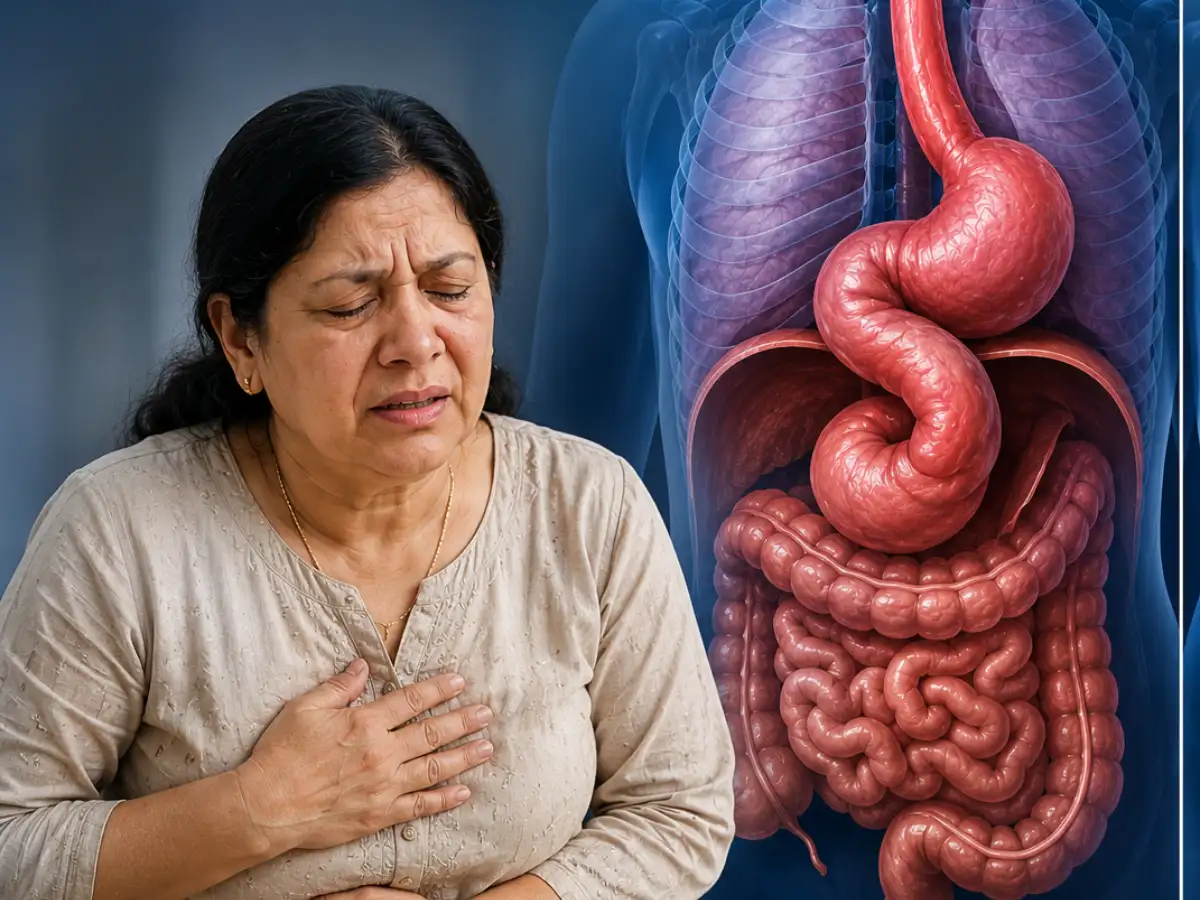
A 61-year-old woman who spent nearly eight months battling severe abdominal and chest pain was finally diagnosed with a rare and potentially life-threatening condition after repeated treatments for acidity failed to provide relief.
According to a report by 'The Times of India', the woman had been suffering from intense upper abdominal and lower chest pain that worsened after meals. The discomfort became so severe that she found relief only after vomiting. Despite multiple emergency room visits and repeated treatment for acidity and acid-peptic disease, her symptoms continued to recur, significantly affecting her daily life and overall well-being.
A detailed medical evaluation eventually revealed the real cause of her suffering — a large paraesophageal hiatus hernia, a rare condition in which a significant portion of the stomach moves from the abdomen into the chest cavity through an opening near the food pipe.
Further imaging uncovered an even more dangerous complication: gastric volvulus, a condition in which the stomach twists on itself. If left untreated, gastric volvulus can obstruct the digestive tract, cut off blood supply to the stomach, cause tissue damage, and in severe cases lead to gangrene.
To treat the condition, doctors performed a robotic-assisted paraesophageal hernia repair with gastropexy under general anaesthesia. The complex procedure involved repositioning the stomach back into the abdomen, releasing dense adhesions between the stomach, oesophagus and diaphragm, repairing the enlarged diaphragmatic opening, and securing the stomach in place to prevent future twisting or migration.
The surgery posed significant technical challenges because a large part of the patient's stomach had migrated into the chest cavity. Dense scar-like adhesions further complicated the procedure.
Dr Vivek Tandon, Director of GI Surgery, GI Oncology and Bariatric Surgery at Medanta, Noida, said symptoms such as persistent acidity, upper abdominal discomfort and recurrent vomiting should not always be dismissed as routine gastric issues. He noted that structural abnormalities like paraesophageal hernias often remain undiagnosed for months and can become dangerous if treatment is delayed.
Dr Deepak Govil, Director of GI Surgery, GI Oncology and Bariatric Surgery at Medanta, highlighted the advantages of robotic surgery in such complex cases. He said the technology provides enhanced precision, superior 3D visualisation and better manoeuvrability, allowing surgeons to safely operate in anatomically challenging areas while reducing postoperative pain and speeding up recovery.
The patient recovered well after the surgery, resumed oral intake successfully and was discharged from the hospital within three days in stable condition.
Doctors also stressed that paraesophageal hernias are frequently underdiagnosed because their symptoms closely resemble common conditions such as acidity and acid reflux. They emphasised that timely investigations, including endoscopy and CT scans, can play a crucial role in detecting these hidden structural abnormalities before serious complications develop.