
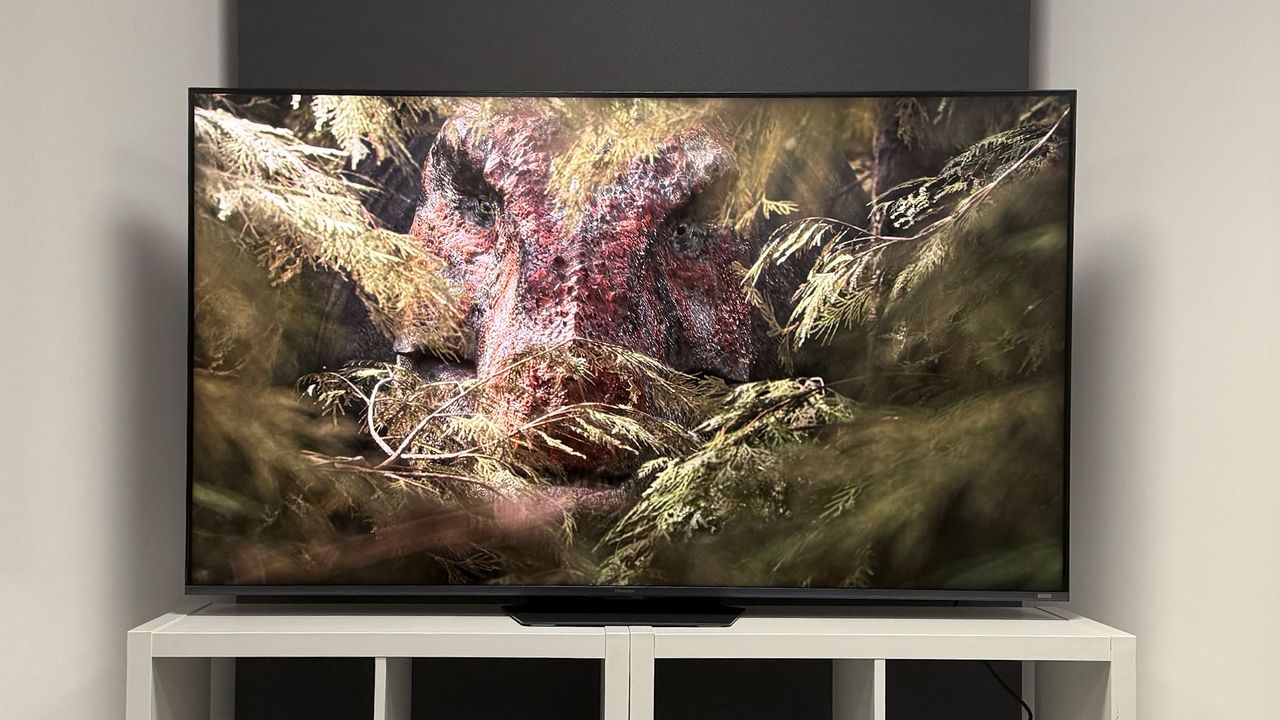
“OLED killer” is a phrase we’ve heard many times before. That's why, when we first saw RGB Mini LED at the Consumer Electronics Show in Las Vegas, we took most of the boasts to that effect with a minor pinch of salt.
After all, for serious movie fans with deep pockets, OLED has been the TV panel tech of choice for nearly a decade despite the sea of “killers” squaring up to it. If you’ve checked our yearly list of What Hi-Fi? Awards winners in the TV category, there’s no denying OLED's dominance in the upper echelons of the market.
But, with our first set with the tech, the Hisense UR9, reviewed and rigorously tested against key rivals, including the Product of the Year-winning Sony Bravia 8 II, we can confirm our scepticism wasn’t entirely merited – and there is a lot to like about the hardware.
A post shared by What Hi-Fi? (@whathifiuk)
A photo posted by on
RGB Mini LED is an evolution of the base Mini LED tech we’ve seen for a while now. The key change is that the new panel creates colours using independent diodes made up of individual red, green and blue LEDs that feed directly into an optical lens behind the LCD panel.
Traditionally, Mini LEDs have done this by passing blue light through a QDEF (Quantum Dot Enhancement Film) sitting between the backlight and LED panel.
Companies, including Hisense, claim the new approach will let TVs offer improved colour accuracy, wider gamut coverage, higher brightness (resulting in improved contrast) and more.
And we definitely noticed improvements in all these areas, using the UR9, especially when playing bright HDR content.
“Extra-bright HDR material suits the UR9 especially well, too. Pan looks spectacular here, with dazzling highlights and bold, vibrant colours that comfortably outgun the Sony Bravia 8 II for outright brightness in many scenes. Sunlight bursting through clouds and glinting off the fantasy scenery of Neverland is delivered with real punch and intensity," wrote TV and AV editor Tom Parsons in our UR9 review.
“Crucially, though, the UR9 generally achieves this brightness without sacrificing balance. Skin tones remain natural, and there’s a pleasing cinematic warmth to the image – and it doesn’t drift into gaudiness.”
But, we're still not ready to call time on OLED's dominance, and the reason is a simple argument we've made before. Despite all its perks, the UR9 still can’t match a top tier OLED’s pixel-level light control.
It’s this ability to control every individual pixel, creating perfect blacks, and a holistically more three-dimensional experience, that still gives OLED its edge, and as Tom said prior to me writing this article, “I don’t see any way that a backlit TV will ever match OLED in those regards.”
And because of that, the team and I all have one question: Is RGB Mini LED’s place really at the top end of the market?
From what we’ve seen so far, it may be that its sweet spot is actually just below OLED, in the upper mid-range.
This was the case with Mini LED sets, such as last year’s Award-winning TCL C7K. Though the TV couldn't match a good OLED on pure picture quality, it proved a performance-per-pound/dollar champion and the best set you could get under £1000 thanks to its competitive pricing.
And we’re not alone with this thought. There are already several companies viewing RGB Mini LED the same way.
Philips Senior Director of Product Strategy, Danny Tack, openly told us OLED is better from a pure performance perspective when we asked where the firm’s new RGB Mini LED sets will sit in its 2026 range, at a press event earlier this year.
TCL, though it has high hopes for the tech, seems to have a similar feeling, already pitching its even more premium, but still backlit, SQD-Mini LED as being superior to RGB Mini LED.
Yes, we’ve only reviewed one RGB Mini LED TV so far. And yes, we’ll be happy to be proven wrong if a better set with it appears. We always advocate the best real-world performer in our advice and are hardware agnostic, after all.
But for now, it looks like OLED’s time in the sun is far from setting, at least in the premium end of the TV market.
MORE:
These are the best Mini LED TVs we’ve tested
Our picks of the best OLED TVs money can buy
We rank the best TVs