

Walmart’s (NYSE: WMT) stock price can hit new highs because the trends driving its long-term success remain in place.
The world’s largest retailer continues to grow, gain share, and drive robust cash flow, enabling dividends and share buybacks.
The net result is ever-increasing shareholder value and an incentive to own, a recipe for rising stock prices. The problem today is in the technicals.
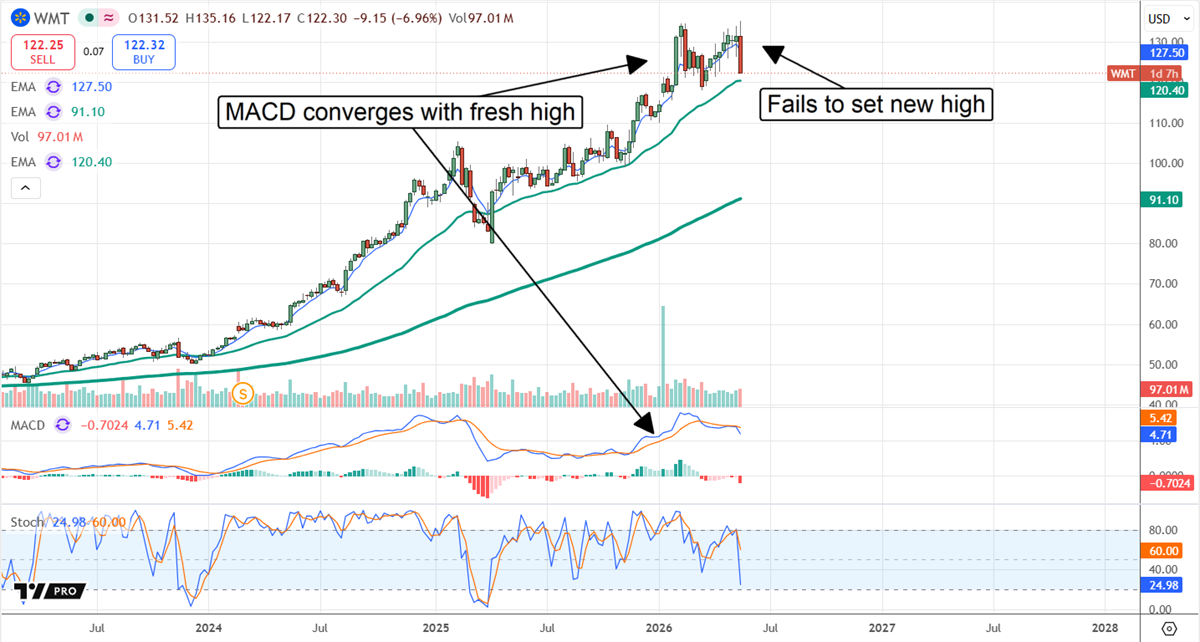
While an uptrend is in play, a top has been reached, and the stage is set for prices to pull back by $10 or more.
Walmart Signals Top in Q2: Pullback Imminent
Walmart’s top begins with a MACD convergence that formed early in 2026. The convergence suggests that fresh highs will be reached or, as in this case, the current highs will be at least retested in the event of a price pullback. Prices did, in fact, pull back following the February high and have since rebounded, retesting the existing high. It was not exceeded, and that is the operational factor in late May. With the Q2 and FY2027 guidance update weaker than expected, the failure marks a market top that is unlikely to be broken until bullish catalysts emerge. That isn’t likely until later in the year, when economic data and subsequent earnings reports are released.
The analyst trends are bullish for WMT stock. The worst-case scenario is that analysts reset their price targets, which is a near-term headwind at best. As it stands, MarketBeat tracks 34 analysts with current ratings; they peg the stock at a consensus Buy rating with a 94% Buy-side bias and see it fairly valued near $139, an all-time high if reached. The risk is that analysts do indeed begin trimming targets, which would be a catalyst for market selling. The question is whether they set a new low target or reaffirm the market floor at $120.
Technically speaking, the analysts' low-end target of $120 aligns with a critical support level, likely the bottom of this correction. A move below that level would signal a shift in market dynamics that has yet to be reflected in analyst trends or institutional activity. Institutions and family holdings account for approximately 80%, and neither group is selling shares. Institutions have been accumulating aggressively and are likely to be buyers on a price dip.
High Valuation Means Walmart Can’t Make Mistakes
Valuation is a concern that may keep Walmart shares range-bound for the foreseeable future. The quality company deserves a premium for its market leadership, growth trajectory, cash flow, and capital return. However, at 44X the current-year earnings forecast and 24X the 10-year outlook, this stock isn’t cheap. The likely outcome is that WMT shares trade within a range until later in the year, or potentially into 2027, when sales trends improve, the company grows into some of its valuation, and the outlook brightens.
Capital return is a factor for Walmart ownership that is not expected to change in 2026. The dividend yields an annualized 0.8% with shares near record highs, which is not a robust figure but is reliable, and payments are expected to increase over time. The company is a Dividend King, pays approximately 35% of its earnings as dividends, and has a healthy balance capable of sustaining operations and capital returns. Buybacks are also at token levels, but reliable and reduce the count each quarter.
Walmart: Hot Results Versus Tepid Guidance
Walmart’s guidance left something to be desired, but it was likely cautious, given Q1 strengths and consumer trends. The company reported nearly $178 million in net revenue, up by 7.3% YOY, and 160 basis points better than expected. Strength was seen in e-commerce (up 26%), advertising (up 37%), membership fees (up 17.4%), and positive comps across categories.
Margin news was the worst of the lot, with gross margin expansion offset by higher fuel costs. The critical takeaway is that earnings continue to grow, albeit at a slightly slower pace than revenue, and guidance wasn’t bad. The company reaffirmed its prior targets, expecting revenue growth to slow by year’s end but for margin to improve.
Walmart’s biggest risk this year is the consumer. Inflation pressures are mounting and, coupled with exhaustion, Walmart may see its traffic and discretionary revenue contract. In this scenario, Walmart may underperform its guidance in the upcoming quarters, causing its stock price to fall to levels below expectations. A move to $100 isn’t out of the question, and even lower lows are possible, assuming oil prices remain high and weakening persists into 2027.
The article "Why Walmart’s Rally May Need a Reset" first appeared on MarketBeat.