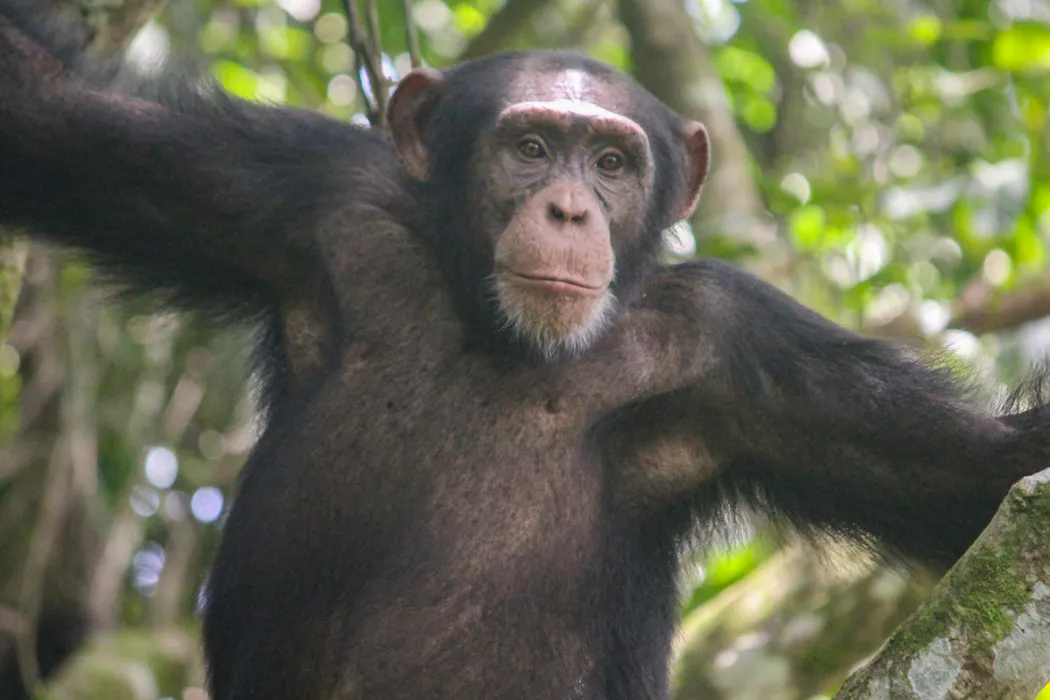
Walking through the savanna-woodland landscape of Boé National Park, Guinea-Bissau, you might encounter a tree covered in gnarled scars, with an accumulation of rocks surrounding its base.
The chimpanzees may have left the area, but you are lucky nonetheless, because you have stumbled upon evidence of a rare — and potentially cultural — chimpanzee behaviour: accumulative stone throwing.
Video recordings show wild western chimpanzees, usually adult males, throwing rocks at specific trees and repeatedly returning to these trees to perform the behaviour.
While throwing, the chimpanzees pant hoot — a loud, long-distance communicative signal — and sometimes repeatedly hit their hands and feet on the tree in a behaviour called buttress drumming.
We have just returned from a field site in Guinea-Bissau where we collected data to help us investigate the social and ecological context of accumulative stone throwing to determine what these chimpanzees are trying to communicate.
Given our evolutionary relatedness to chimpanzees, we hope accumulative stone throwing can help us understand the emergence of complex communication and stone tool use over the course of human evolution.
A cultural behaviour
Pant hooting and buttress drumming are both part of the male chimpanzee display, suggesting that accumulative stone throwing might represent a modification of this common behaviour. It is likely a cultural behaviour due to its limited distribution, and because the availability of rocks and trees does not guarantee the presence of an accumulative stone throwing site.
Previous research suggests that accumulative stone throwing is likely communicative or may even have a symbolic purpose, with sites marking important locations within the chimpanzees’ territory.
However, we still don’t know what accumulative stone throwing sites might mean to the chimpanzees themselves nor why they do it. While some primates use stone tools to access food, for instance to crack open nuts, accumulative stone throwing is a rare example of stone tool use in a social context. It has been observed in only four chimpanzee groups in West Africa to date.
Setting up camp
We travelled to the remote Boé chimpanzee territory in Guinea-Bissau and based ourselves in Béli, a small village where, in collaboration with local people, the Dutch non-governmental organization Chimbo maintains a compound. Visiting researchers and tourists can stay here and use a workspace with solar-generated electricity.
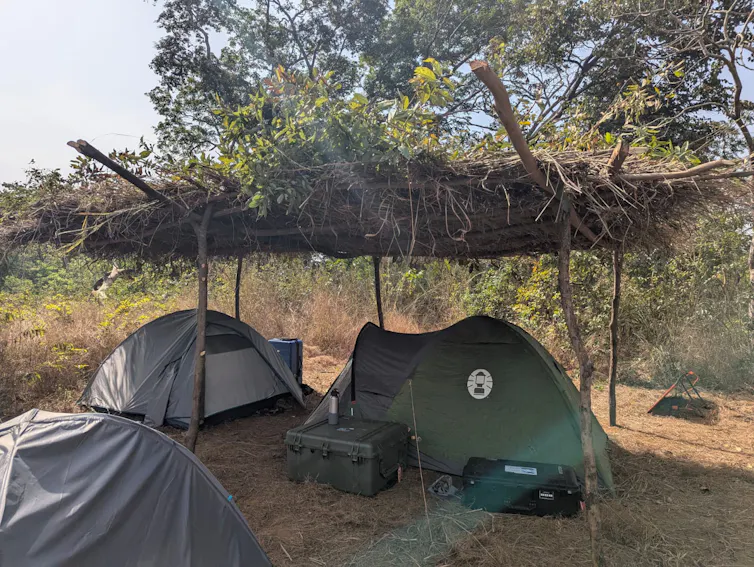
From Béli, we cycled and hiked 22 kilometres into the savanna-woodland to establish a bush camp with our two field assistants, Djei Baldé and Balu Séra, and a master’s student from the Great Ape Behaviour Lab, Taylor Tippett.
The Boé chimpanzees performing the behaviour are unhabituated; they are not used to humans, meaning that we cannot observe individual chimpanzees on foot because they will run away. Instead, we collected behavioural data using camera traps and recording devices.

We set up two video cameras at each accumulative stone throwing site and placed the recording devices strategically to capture audio data from the areas around these sites.
Our campsite bordered the Fefine, a large river that flows even in the dry season. In a landscape like the savanna-woodland where water sources are scarce, rivers like the Fefine are important for wildlife and humans alike. We captured several of our neighbours on cameras set up near the riverbank.
Chimpanzee nests
On an average day, we woke up around 6:30 a.m. and ate a small breakfast before heading to a set of two to five sites. There, we replaced the SD cards and batteries on the cameras, made sure the devices were working well and collected any additional data needed, including measurements of the tree and 3D scans of rocks thrown at the tree for later analysis.
Along the way, we recorded observations of chimpanzee nests, feeding signs, vocalizations and sightings.
The video and audio data we collected will allow us to investigate the social traits of accumulative stone throwing, including the age and sex of the stone thrower and the audience (other chimpanzees nearby who might react to the throw). This information can help us determine what chimpanzees are trying to communicate.
We found that most of the sites first identified by the Pan African Programme, and revisited by our team in 2017, were still in use during our recent trip to the field, meaning that chimpanzees can use these sites for over a decade.
The threat of bauxite mining
As many primate species face threats from human activities, cultural behaviours and the maintenance of rich cultural repertoires can help them adapt to environmental changes and provide support for conservation.
On top of its potential communicative importance and intrinsic value as a cultural behaviour, accumulative stone throwing involves durable primate material culture, the loss of which would constitute the erasure of primate heritage.
Unfortunately, chimpanzee habitat in Guinea-Bissau is threatened by extractive industries, particularly industrial mining. While in the field, we encountered bore holes from bauxite mining exploration.
Bauxite mining represents a significant opportunity for economic growth and development in Guinea-Bissau. It can also cause habitat destruction and pollution with severe detrimental effects for chimpanzees, other wildlife and the local people — as it already has in neighbouring Guinea.
Environmental oversight and regulations are much needed, especially given the added challenges of unstable governance in Guinea-Bissau.

By studying and bringing attention to chimpanzee cultural behaviours like accumulative stone throwing, we hope to support chimpanzee conservation and the maintenance of biodiversity more broadly, as well as the preservation of primate cultural materials for future research and education.
This article was originally published on The Conversation. Read the original article.