
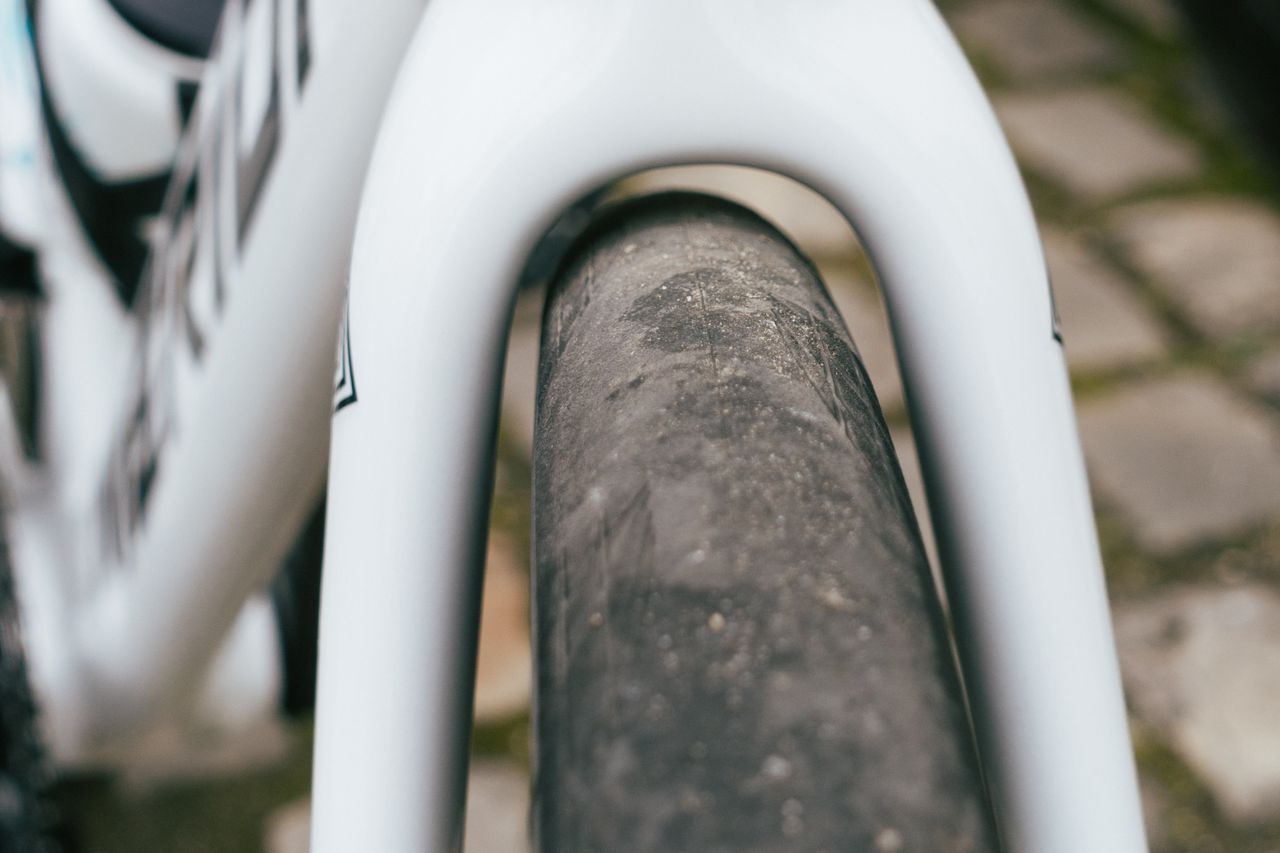
With Paris-Roubaix fast approaching, the one subject on everyone's lips, as always, is tyre width.
Over the years, road bike tyres have been getting wider and wider, and thanks to the bone-shaking cobbled terrain along the course, Paris-Roubaix has always been the race to find the widest, as riders seek the extra cushioning and rolling resistance benefits.
Even back when 23mm was the norm for every other race day, Paris-Roubaix would see riders switch to 28mm. Nowadays, 28mm is the norm elsewhere, and 30mm is becoming more common, but while the UCI limits cyclo-cross tyres to a maximum width of 33mm, road tyres are ironically free to go wider.
We've seen riders use 35mm in recent years, but since then, the major tyre brands have all launched road slicks in sizes as wide as 42mm. So what is the widest we will see at the Hell of the North in 2026?
Our recent lab test showed that 40mm road tyres could save riders as many as 75 watts on cobbles when compared to a 26mm equivalent, but there's a very simple reason why we won't see them at the 2026 Paris-Roubaix: The UCl - cycling's governing body - and its pesky rulebook.
While there are no rules that explicitly specify a tyre's maximum width, there is one which limits the maximum diameter of the wheel and tyre together, and since a wider tyre is also taller, there's a correlative limit that teams must adhere to.
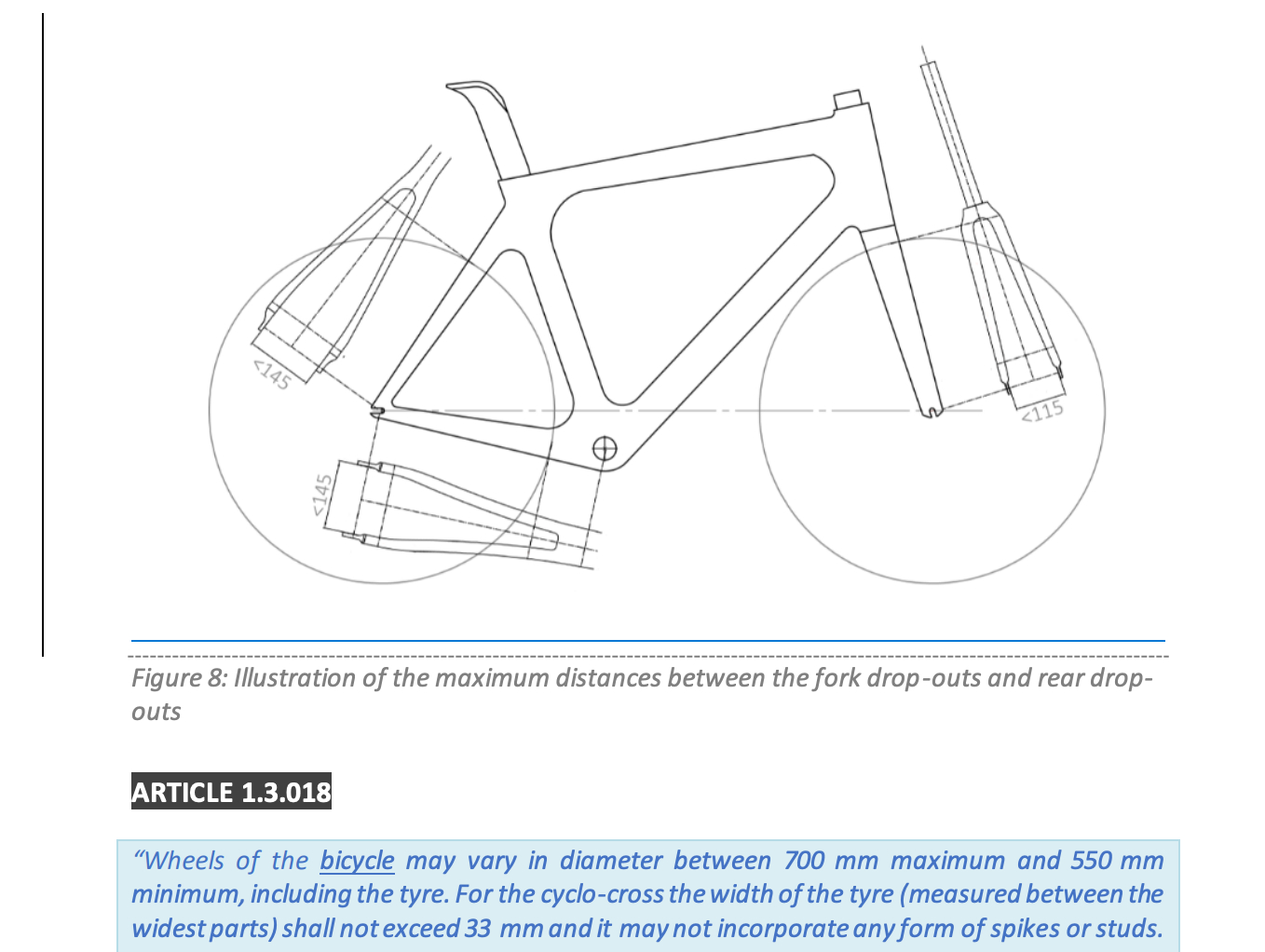
Article 1.3.018 of the UCI's equipment regulations states:
"Wheels of the bicycle may vary in diameter between 700mm maximum and 550mm minimum, including the tyre."
Unfortunately for anyone hoping to run a 40mm this weekend, a 40mm tyre on a standard road wheel (of 622mm diameter) has a total diameter of 701mm.
It will vary from tyre to tyre, and if you put a 40mm tyre onto a wider rim, you might sneak it under 700mm, but the ability for a team to do this will depend on multiple other factors, as we'll get to below.
What is the widest tyre we'll see?
To work out the diameter of a wheel & tyre together, the formula is:
D = Rd + 2(TT)
Where D = diameter, Rd = Rim diameter, and TT = tyre thickness.
But finding the tyre thickness isn’t as simple as finding its width. The two will be similar, since a tyre blown up will become cylindrical, but given part of that sits inside the rim bed, it’s not as simple as taking the 622mm rim and adding 2x the tyre’s width.
Luckily, the internet comes to our rescue, with a variety of resources sharing the circumference of a variety of rim/tyre combinations, and some simple maths (circumference / Pi) allows us to calculate the diameter.
The online resources tend to disagree about the millimetre-exact circumference for each rim & tyre combo, but they’re close enough that when we solve for the diameter, they result in the same conclusions. So, for simplicity and ease, I will refer to Wahoo’s Wheel Circumference chart.
Here, a 700 x 38mm tyre, has a circumference of 2190mm, which equates to a diameter of 697mm.
A 700 x 40mm tyre, meanwhile, has a diameter of 701mm. Access denied.
It doesn’t list a 39mm tyre, but assuming this will sit halfway between the two, we can expect a diameter of 699mm, making 39mm the maximum allowable tyre size.
It’s worth adding that different tyres can shape differently depending on the rim width, so a 39mm tyre may sit taller on a narrower rim and fall foul of the rules. Likewise, a 40mm tyre may fall within that 700mm limit on a wider rim. Without mounting one up onto a handful of different rims and measuring each one, it’s hard to say for sure.
To my knowledge, none of the WorldTour’s tyre sponsors currently make a road tyre in 39mm. Pirelli’s P-Zero Race TLR comes in 35c and 40c, among others, so that leads us to assume its sponsored teams could use 35c, unless of course they can sneak a 40c in on a wider rim, or they instead prefer to stick with a thinner-cased P-Zero Race TLR RS tyre in a narrower size to optimise more for the road sections of the race.
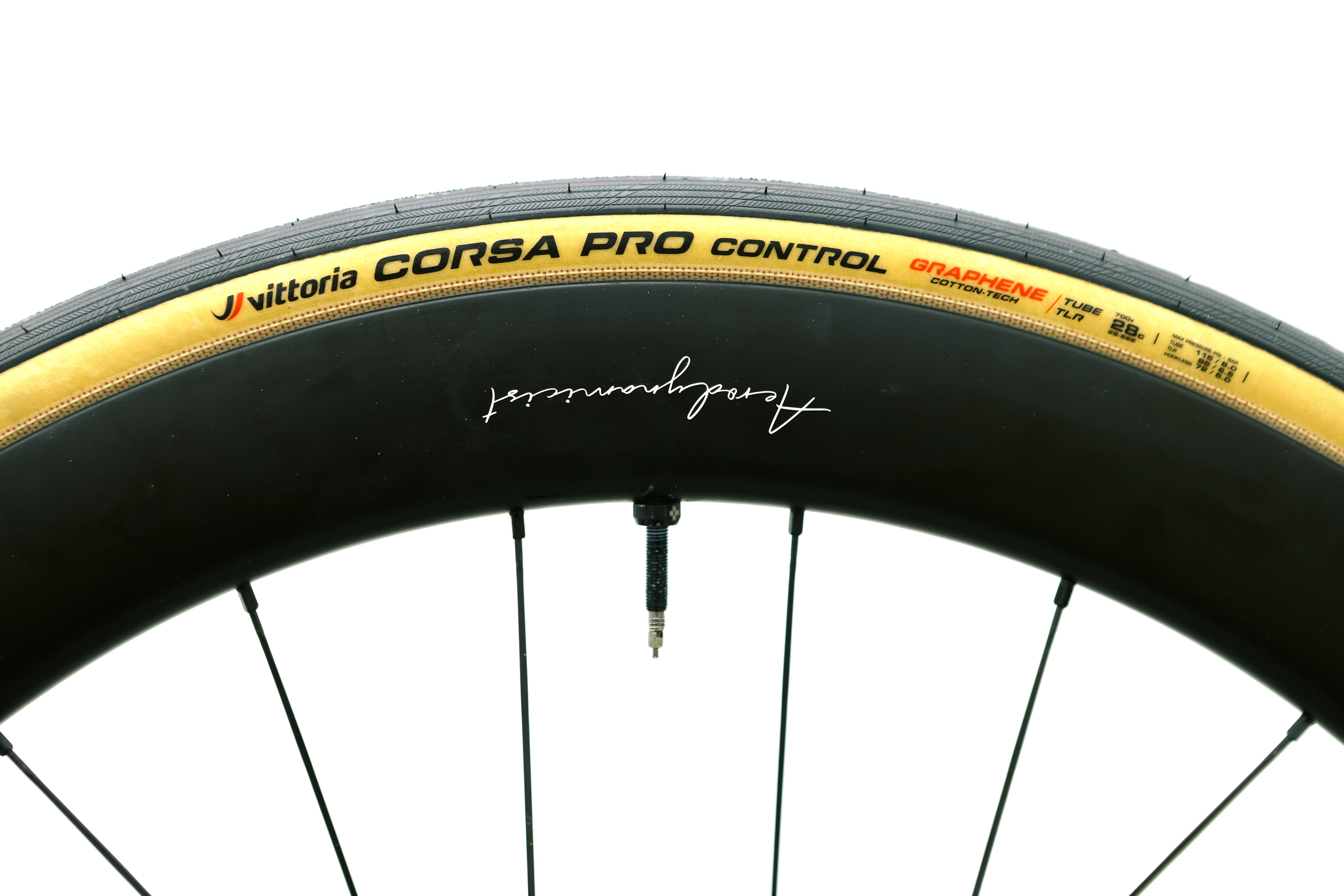
Similarly, Specialized’s Mondo and Continental’s GP5000 S TR also max out at 35mm, while the other common find in the WorldTour peloton, the Vittoria Corsa Pro, maxes out at 32c, but can go up to a 42c in its 'Control' variant, which has a thicker, more puncture-proof construction that will affect its speed.
Other considerations
Even if the UCI rules state 39mm as the de facto limit, there are other considerations that teams must adhere to.
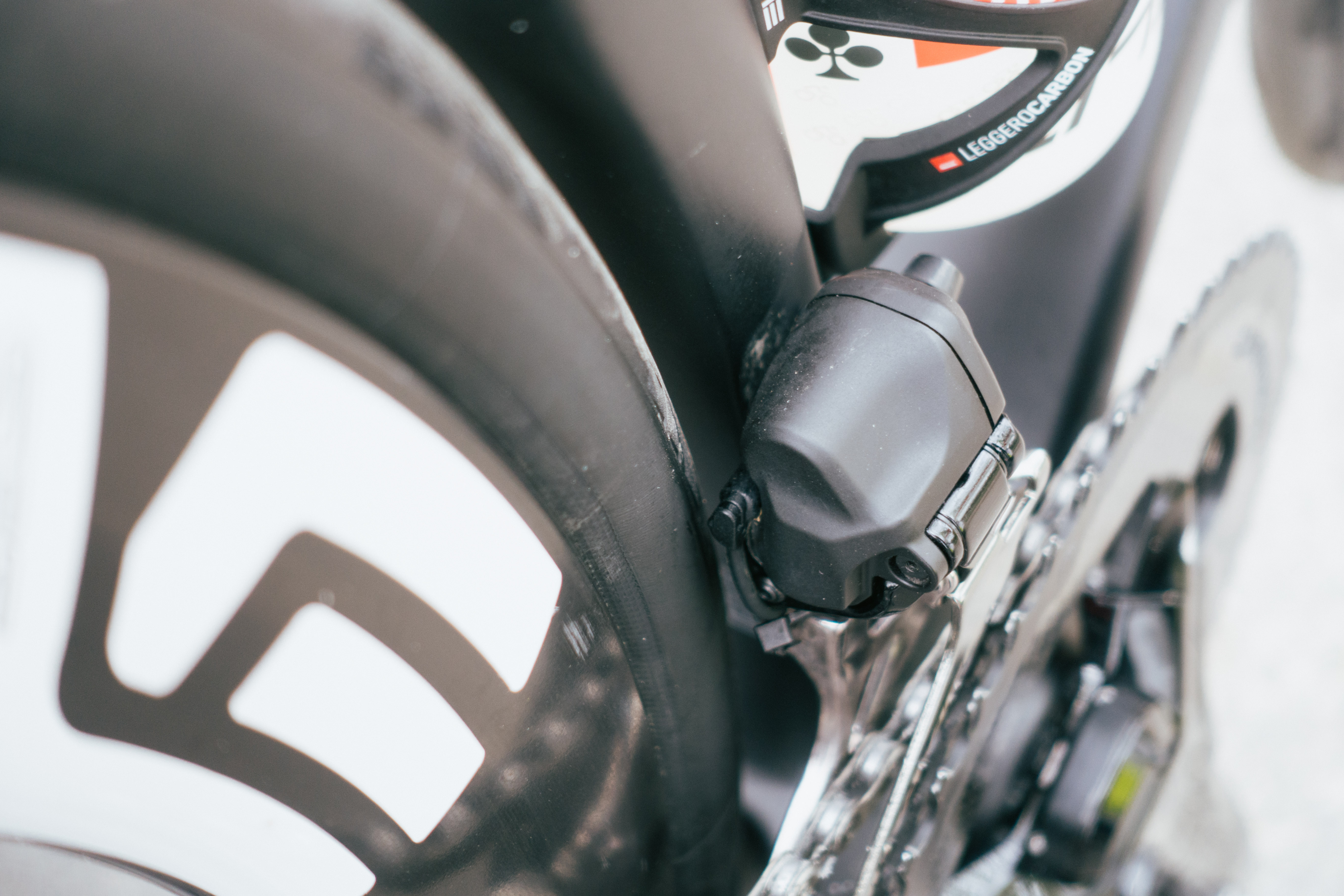
For Shimano-sponsored teams, who tend to run a 2x chainset, anything wider than 35mm has a risk of fouling against the inner face of the front derailleur. This is the case we saw in 2024, with Fred Wright’s tyre having little more than a couple of millimetres to spare.
Tadej Pogačar, among others, have used an aftermarket chainring to run the Dura-Ace groupset set up 1x (using a single chainring and removing the front derailleur), which would add clearance, but given how rarely we see this happen, it doesn't appear Shimano is very keen for teams to do it, and so it might cause friction of a different sort.
The other consideration is the frame’s tyre clearance. Most aero bikes are limited to around 30 or 32mm, and while you can generally get away with squeezing in something bigger (especially if you’re a pro who doesn’t pay for the repair bill that may ensue if you push it too far), the limits are rarely beyond 35mm.
To go any wider, riders would need to switch to a different frame, which would invariably add to the aerodynamic drag of the total system and offset any benefits provided from the wider tyre.
To this point, Mathieu van der Poel rode the recent E3 Saxo Classic on an unreleased Canyon Endurace endurance bike, rather than his usual Aeroad aero bike. They look remarkably similar, and the rumoured aero penalty is small, but we'd be very surprised if the Endurace doesn't have much bigger tyre clearance than the Aeroad's stated 32mm.
That leads us to the final consideration: Aerodynamics. Even with everything else kept the same, a wider tyre is bigger, both vertically and horizontally, and so the aerodynamic drag will also be higher. The differences are small, as outlined in our recent wind tunnel test, but they do exist.
And given Paris-Roubaix is predominantly on road, anyone looking to spend any time ‘in the wind’ - be that on the front of the peloton, in a breakaway, or in a sprint to the finish line - is likely going to want to minimise this drag as much as possible.
With all that in mind, if pressed for a specific answer, the maximum tyre size I think we’ll see used by one of the big hitters - Van der Poel, Pogačar, Van Aert, Ganna, Pedersen et al in the men's race, or Vollering, Kopecky, Vos et al in the women's race - at Roubaix in 2026 is still 35mm.
In fact, I assume the majority of the aforementioned will stick with 32mm like last year.
I'd really like to see someone go all in on wide tyre tech, though. Perhaps Jonas Abrahamsen of Uno-X, Matej Mohorič of Bahrain-Victorious, or even Wout Van Aert of Visma-Lease a Bike.
Each of those teams has a race-focused gravel bike at its disposal to provide the tyre clearance. Perhaps their gravel wheels with wide internal rim beds could stretch a 40mm tyre enough that it drops below the 700mm circumference limit.
That would be nice.
In all honesty, though, if we do see wider, I’m confident we’ll see it in the women’s race, rather than the men’s.
Given the rolling resistance equation is linear with speed, and the aerodynamics equation is quadratic, the watt penalty of an increased CdA is exponentially more severe at higher speeds, while the benefits of improved rolling resistance is not.
As teams look to balance the two, the slower average speed of the women’s peloton will mean that the tipping point lands more on the side of wider tyres.