
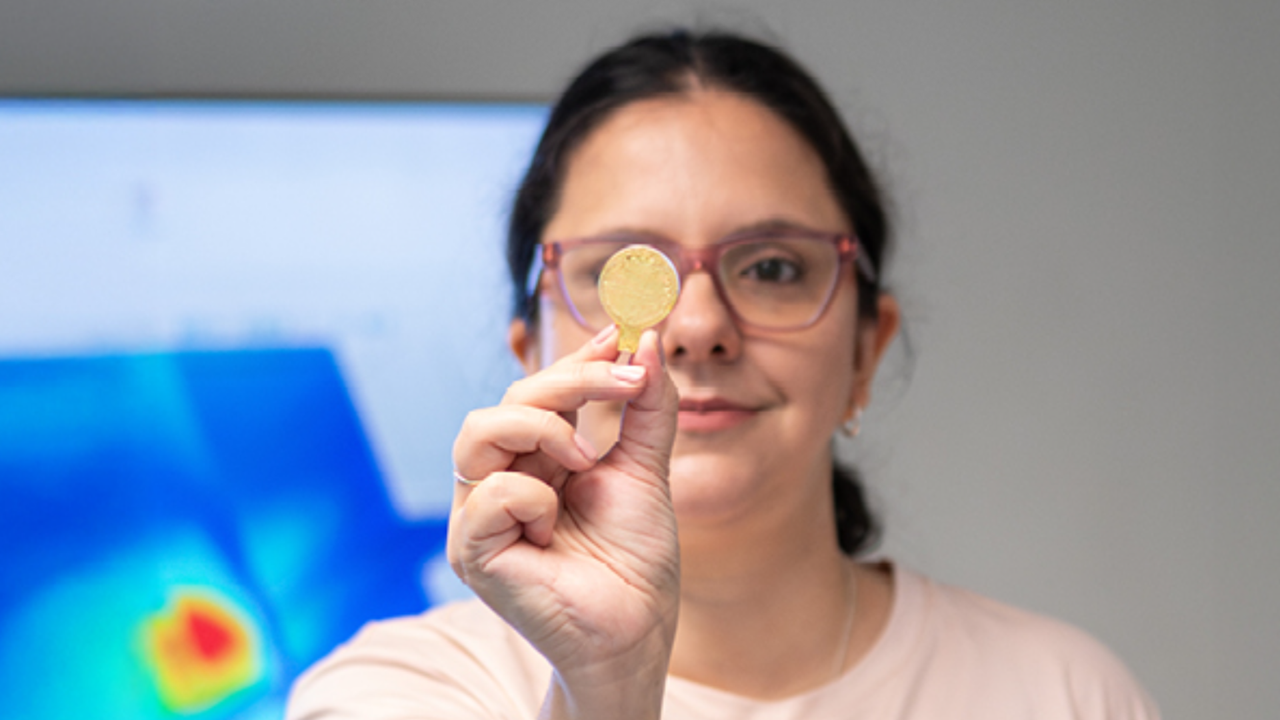
- Lepto develops terahertz filters barely thicker than microscopic viruses for advanced communications
- Satellite companies value lighter terahertz components because launch costs remain extremely expensive
- Terahertz radiation enables faster data transmission across secure short-range communication channels
A one-micrometer-thin foil shimmering in gold, red, and green hardly looks like the next big thing in satellite communications.
Yet this high-tech filter, produced by the Empa spin-off Lepto GmbH, represents a quiet breakthrough in terahertz radiation technology.
The company’s founders, Elena Mavrona and Erwin Hack, spent six years researching at Empa’s Transport at Nanoscale Interfaces laboratory before realizing their invention had commercial potential.
From laboratory curiosity to market reality
“We never actually planned to start a company,” says Erwin Hack, CTO of Lepto.
“But we received many inquiries from other research institutions, and they were very satisfied with our filters’ performance. That's when we realized there was a market for them.”
The researchers realized the filter's demand stretches beyond academic laboratories and government-funded scientific projects.
Terahertz radiation sits awkwardly between visible light and conventional radio waves, a spectral no-man’s-land long ignored by engineers.
With wavelengths ranging from 0.03 to three millimeters, this band remained largely inaccessible until recent decades.
The Lepto filter, barely thicker than a virus at just one thousandth of a millimeter, changes that equation dramatically.
“Our filters are very thin, and we manufacture the frames for them to order using 3D printing,” explains CEO Elena Mavrona.
This combination of extreme thinness and custom fabrication allows the spin-off to produce complex filter systems that are both lightweight and remarkably effective.
Secure satellite links and faster data transmission
Space technology represents a particularly promising market for this technology because every gram launched into orbit carries an enormous cost.
Terahertz rays offer two distinct advantages for satellites: superior material spectroscopy for astrophysics and highly secure communication channels.
According to Hack, the higher frequency of terahertz radiation compared to conventional technologies enables faster data transmission, while its shorter range makes interception more difficult.
“On the one hand, terahertz spectroscopy is an excellent method for investigating many phenomena in astrophysics and geophysics,” notes Mavrona.
“On the other hand, terahertz is also ideal for communication between satellites, as well as satellite-to-ground communication.”
Back on Earth, the same radiation faces limitations since atmospheric scattering restricts its range dramatically.
Nevertheless, industry experts view terahertz waves as a cornerstone technology for the upcoming 6G standard, which promises greater speed and energy efficiency than current 5G networks.
Medical applications appear equally compelling because terahertz radiation penetrates only superficial tissue layers without the ionizing dangers of X-rays.
Researchers are therefore developing these waves for skin cancer diagnosis, examining superficial blood vessels, and even wound assessment.
Airport body scanners represent another security-focused application already in development
Currently, demand for Lepto’s terahertz filters and polarizers comes almost exclusively from the research sector, including spectroscopy and experimental quantum computing projects.
The founders acknowledge that transitioning from academic inquiries to commercial orders remains a substantial hurdle.
“We look forward to bringing our products to market soon,” they say optimistically, though the company is actively seeking pre-seed funding.
Whether this technology can be truly scalable beyond specialized laboratories remains to be seen.