
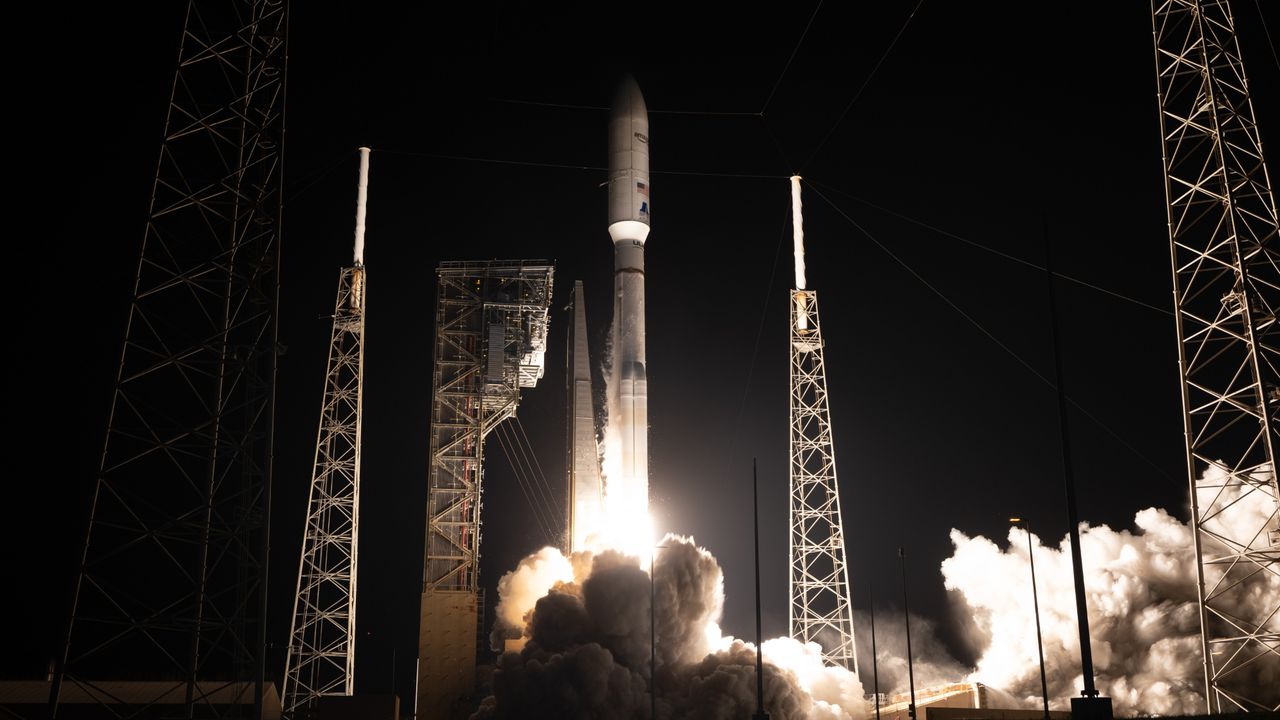
A United Launch Alliance (ULA) Atlas V rocket launched its heaviest-ever payload on Saturday morning (April 4).
The Atlas V lifted off Saturday at 1:46 a.m. EDT (0546 GMT) from Florida's Cape Canaveral Space Force Station, carrying 29 satellites for the Amazon Leo broadband constellation to orbit. Together, those spacecraft weigh 18 tons, according to ULA.
The Atlas V successfully deployed all 29 into their target orbit, according to ULA.
United Launch Alliance advances @AmazonLeo constellation with successful Leo 5 launch. Atlas V precisely delivered 29 broadband satellites dedicated to connecting the world.https://t.co/kop0naHlrH pic.twitter.com/Y7XA0E732JApril 4, 2026
The Amazon Leo megaconstellation, previously known as Project Kuiper, will eventually consist of about 3,200 satellites in low Earth orbit. It's Amazon's answer to SpaceX's Starlink network, which beams internet service down from more than 10,000 satellites (and counting).
Amazon Leo is still in its early stages; just 241 of the spacecraft have reached orbit to date over the course of nine launches (not counting a 2023 liftoff that sent up two prototype satellites).
The Atlas V has now flown five of those operational missions. Three employed SpaceX's Falcon 9, and the other one used Arianespace's Ariane 6 heavy lifter.
Saturday's launch, which Amazon called LA-05, was the first Atlas V mission to loft 29 Amazon Leo satellites; the others carried 27 of the spacecraft.
"The increase is a result of detailed engineering work between Amazon Leo and ULA, and is made possible by a new, higher-performing version of the RL10C engine used on the rocket's Centaur upper stage," Amazon representatives wrote in a mission description. "While the engine has flown on previous missions, LA-05 marks the first time the program has completed the extensive engineering and safety analysis required to use it with our larger payload."
And that payload was larger in a significant way, according to the LA-05 mission description: "With 29 satellites aboard, LA-05 will mark the heaviest payload ever flown on an Atlas V."
Editor's note: This story was updated at 11 a.m. ET on April 4 with news of successful launch and payload deployment.