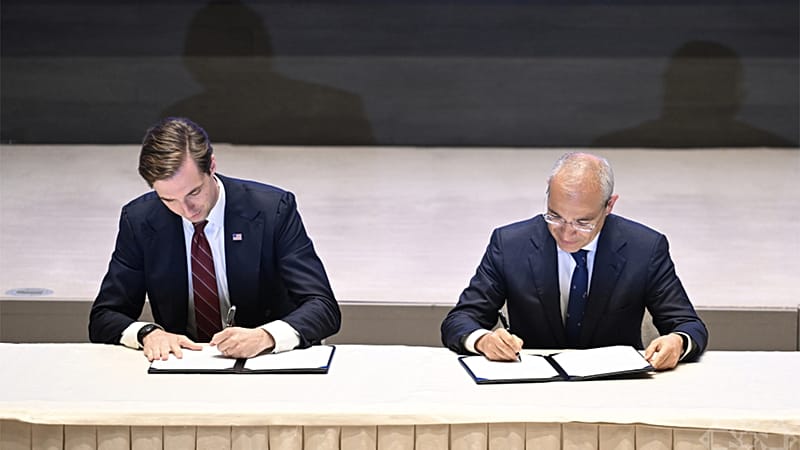
The United States wants a direct stake in Azerbaijan's pipeline and energy infrastructure, a senior US official said on Thursday, signalling Washington's ambitions to deepen its foothold in a region long dominated by Russia and China.
Speaking at the first Azerbaijan–US Economic Dialogue in Baku, Assistant Secretary of State for Economic, Energy and Business Affairs Caleb Orr said the US sees opportunities stretching well beyond traditional hydrocarbons.
"The United States wants a greater role in the pipeline infrastructure and the other energy infrastructure that Azerbaijan is building," he said.
Orr also flagged Washington's backing for Azerbaijan's growing role as a transit hub, singling out the Middle Corridor, the trade and transport route connecting Asia and Europe through the Caspian region.
"We expect to help Azerbaijan grow its role as the central node of the Middle Corridor for energy transit, going to Europe and to the rest of the world," he said.
The US is already embedded in Azerbaijan's energy sector through ExxonMobil and Chevron.
Orr noted that ExxonMobil signed a memorandum of understanding for new exploration activities during last year's Baku Energy Week, while US oil major Chevron signed a new study agreement at this year's event.
"We think that Azerbaijan is a critical producer of energy for the world right now," Orr continued. "And the United States really benefits from this relationship, and it's one that we expect to grow significantly over the next few years."
From peace deal to investments
The event was held in Azerbaijan’s capital Baku, bringing together government officials and business representatives to discuss cooperation across four strategic areas: regional connectivity and transit, energy security and critical minerals, investment, and AI and digital infrastructure.
Asked by Euronews about the importance of the relationship between Azerbaijan and the United States, Azerbaijan's Minister of Economy Mikayil Jabbarov said strong political ties had created favourable conditions for deeper economic cooperation.
"You are right. Due to the leadership of President Aliyev and President Trump, indeed we have very strong and flourishing political relationship," he said.
The economic dialogue follows a landmark moment in US-Azerbaijan relations.
On 8 August 2025, Trump hosted Azerbaijan's President Ilham Aliyev and Armenian Prime Minister Nikol Pashinyan at the White House, where the two leaders signed a joint declaration committing to a peaceful relationship after more than three decades of conflict — a breakthrough brokered in Washington rather than Moscow or Brussels, previously the key political capitals through which the Armenia-Azerbaijan relationship was managed.
As part of the deal, the US said it would help build a major transit corridor, to be named the Trump Route for International Peace and Prosperity or TRIPP, connecting Azerbaijan to its Nakhchivan exclave through Armenian territory.
Priorities going forward
According to Jabbarov, cooperation between the two countries is increasingly focused on four strategic priorities.
The first is regional connectivity, which includes trade, transit and the Middle Corridor. He described it as a natural area for collaboration. He also said the cooperation extends further to energy infrastructure, logistics networks and the Alat Free Economic Zone.
The special economic zone is located at the Port of Alat, south of Baku on the Caspian coast, and is one of Azerbaijan's most ambitious economic projects — essentially a purpose-built business hub designed to attract foreign investment and position Baku as a regional trade centre.
Jabbarov also flagged critical minerals as a growing frontier in the relationship, alongside the long-standing presence of US energy majors in Azerbaijan's sector.
"Critical minerals is a new add-on to our bilateral cooperation," he said, adding that both countries see significant potential in developing supply chains and exploring new discoveries.
AI and digital infrastructure also featured prominently, reflecting Baku's drive to move beyond hydrocarbons and build new areas of technological expertise.
"We believe that AI is a field and an area which has an impact on all fields of economic development," Jabbarov said.
He said Azerbaijan wants not just data centres and digital infrastructure, but a broader ecosystem built around innovation, productivity and human capital.