An Iranian court has reportedly sentenced singer Parastoo Ahmadi and eight members of her production team to 74 lashes after a livestreamed musical performance in which she appeared without a hijab.
The punishment has triggered fresh condemnation from human rights advocates, who say the case exposes the continuing crackdown on artists and women challenging the country's strict social codes.
Court documents reviewed by lawyers and rights groups indicate that a criminal court in Qom province imposed the flogging sentence alongside a two-year ban on leaving Iran and a two-year prohibition on artistic activity.
The charges centre on allegations that the group offended public decency by producing and publishing what authorities described as 'vulgar and immoral content' online.
The ruling has not yet been formally published by Iran's judiciary.
A Performance That Reached Millions
Ahmadi, 29, came under scrutiny after performing the patriotic song 'Az Khoone Javanane Vatan' ('From the Blood of the Youth of the Homeland') during a December 2024 livestream broadcast on her YouTube channel.
Appearing without the mandatory head covering, she performed at a historic caravanserai site in Qom alongside fellow musicians. The video later attracted millions of views online.
Authorities briefly detained Ahmadi and several musicians following the performance before releasing them. Prosecutors subsequently opened a formal case over the publication of the concert footage, arguing that it violated public morality laws enforced under the Islamic Republic's legal framework.
For many observers, the severity of the punishment stands out. Flogging remains a lawful judicial penalty in Iran, but rights organisations have repeatedly argued that its use breaches international prohibitions against cruel, inhuman and degrading treatment.
Rights Groups Condemn Sentence
Bahar Ghandehari, director of advocacy at the Center for Human Rights in Iran, said the reported punishment demonstrates that conditions for artists and women have not improved despite official efforts to project a more moderate image abroad.
'Ahmadi's punishment of 74 lashes for merely singing and appearing without a hijab is yet another reminder that human rights conditions in Iran have not changed, despite the Iranian authorities' wartime propaganda campaign aimed at improving their image,' she said.
Human rights lawyer Moein Khazaeli challenged the legal basis for the case, arguing that Iranian criminal law does not explicitly criminalise women singing, performing music or producing musical works.
'Singing, performing music and producing or disseminating musical works by women are not criminalised under Iranian criminal law. Consequently, such activities cannot reasonably be construed as the "production, distribution or publication of obscene content",' he said.
Khazaeli added that flogging extends beyond a domestic legal issue and raises serious concerns under international human rights standards.
'Numerous human rights organisations consider flogging not a legitimate form of punishment, but rather a form of torture and inhuman treatment.'
Artists See A Wider Warning
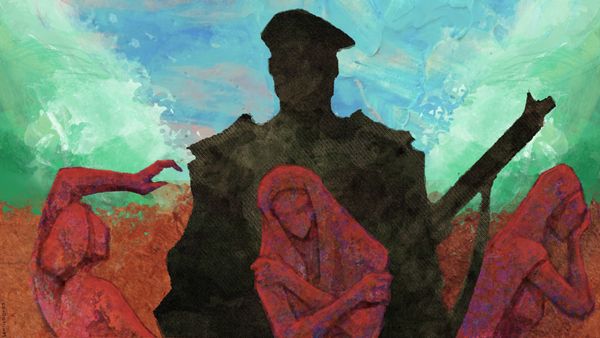
The case arrives against the backdrop of continuing restrictions on cultural expression in Iran, particularly since the nationwide protests that followed the death of Mahsa Amini in 2022.
Female artists, actors and musicians have increasingly used their platforms to challenge mandatory hijab rules despite the threat of arrest, professional bans and prosecution.
Iranian-British actor Nazanin Boniadi described the sentence as evidence that the state's repressive apparatus remains intact.
'The sentencing of singer Parastoo Ahmadi to flogging for the simple act of singing publicly without a hijab is a stark reminder that, despite talk in Washington of a "new regime" in Iran, the Islamic republic's machinery of repression remains unchanged,' she said.
Actor Setareh Maleki, who left Iran after appearing in Mohammad Rasoulof's Oscar-nominated film 'The Seed of the Sacred Fig,' said Ahmadi's performance resonated deeply with many Iranians.
'Knowing all the consequences she would have to face, she still refused to give up her right, as a woman, to live, to sing and to be heard,' Maleki told The Guardian. 'Iranian women never stop fighting against tyranny, not even for a moment.'