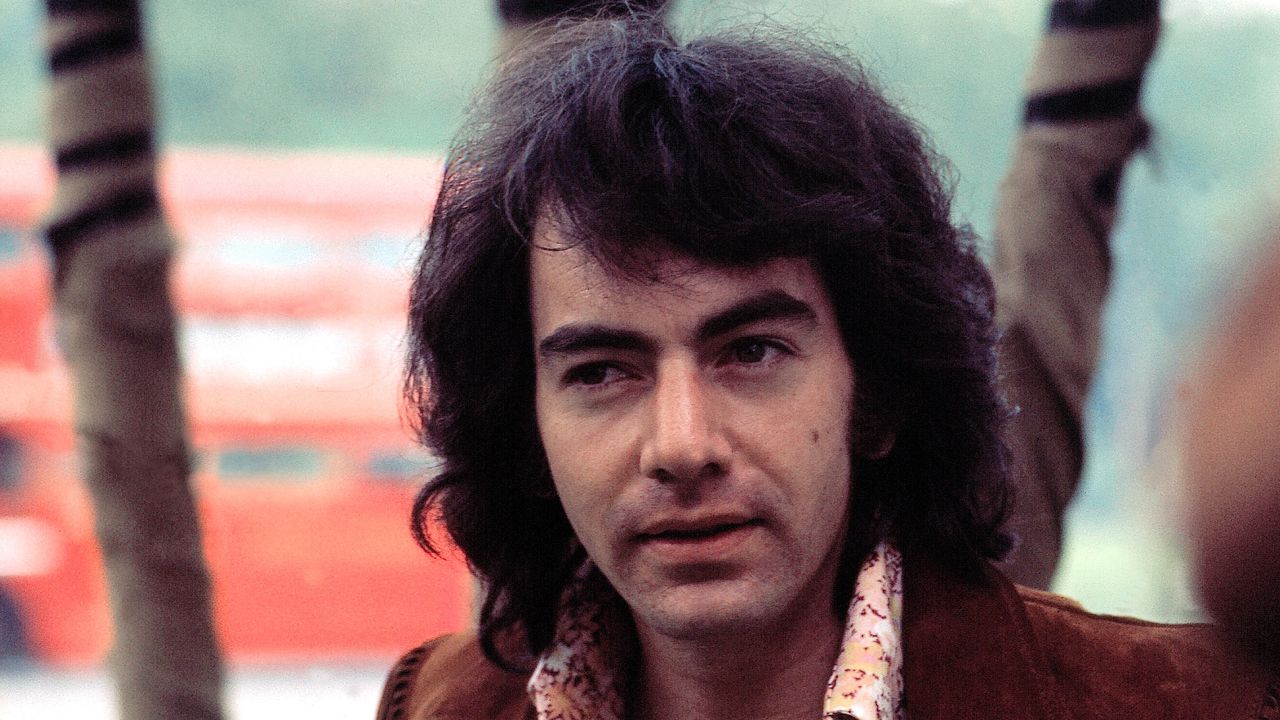
When legendary singer-songwriter Neil Diamond looked back on his career in 2008, he made a surprising comparison between himself and Metallica.
Speaking to Q magazine, Diamond stated: “It’s just music. Different styles, different approaches. But when you get down to it, there’s no great difference between me and Metallica.”
He explained: “I could sit down with the guys from Metallica, like we’ve known each other all our lives. We share the same kind of life.
“So they use an electric guitar. So I use an acoustic guitar. They have words, they have melodies, they have passion. Same as me.”
It was all the way back in 1966 that Diamond had his first hit with Cherry, Cherry.
He went on to enjoy a long and hugely successful career in which he achieved worldwide record sales in excess of 130 million.
He recalled to Q: “I started in music when I was 15 or 16. It started as a hobby. It was something I really enjoyed. My dream was just to be able to sing or to play. I didn’t even think professionally.
“I thought, wouldn’t it be nice if I could do this for my whole life? And I’m amazed that I did. Because once I got that tiger by the tail, I refused to let go.”
Asked what makes a great song, Diamond replied: “If I find a melody that carries me, that sweeps me along, and it’s something that I’ve never heard before, I get emotionally involved with it. A melody that can sweep you up has the potential to be a great song.”
He also stated that the lyrics in his songs were often informed by his own life experiences.
“I haven’t done it intentionally,” he said. “I didn’t try to write about my life, but what else do I know? So you write about what you know, what you feel.
“I’ve never thought consciously that this song is too open, because it’s my nature to give as much as I can, and let the consequences fall where they may. You don’t hold anything back – you just open up and let it come out and let the chips fall where they may.”
Diamond then discussed a handful of key songs from his career, including his first two US No 1 hits, Cracklin’ Rosie and Song Sung Blue, and his longtime onstage encore I Am… I Said.
Cracklin’ Rosie was recorded in 1970 and included on Diamond’s sixth album Tap Root Manuscript. Not only was this his first US No 1, it also held the top spot in New Zealand for five weeks, reached No 2 in both Ireland and Australia and was his breakthrough in the UK, peaking at No 3.
Diamond revealed the origins of the song’s title and lyrics.
“There was a story I heard when I was touring in Canada,” he said. “There are reservations for native Americans in Canada like the ones in the United States, and this particular story was about a reservation in Canada where there were more men than there were women.
“So on a weekend there were a lot of single men there, and they would find comfort in a bottle of very cheap wine called Cracklin’ Rose. That wine became their woman and they called that woman Cracklin’ Rosie. I liked that lot and I had to write a song called that.”
Diamond was backed on Cracklin’ Rosie by The Wrecking Crew, the legendary session musician team based in Los Angeles. This recording featured Hal Blaine on drums, Joe Osborn on bass, Al Casey on guitar, Larry Knechtel on keyboards and Gene Estes on percussion.
Diamond admitted that his second US No 1, Song Sung Blue, was unconsciously lifted from a classical piece:
“It’s Mozart,” he said. “It’s his piano concerto 41. And I didn’t realise it until a year after I wrote it.”
He said that the title of his classic ballad Love On The Rocks came to him right out of the blue.
“It was just a little inspiration that got dropped on my lap,” he shrugged. “It said, ‘Here, take this, now write the rest of the song.’”
He also maintained that the meanings in his songs can be deeply personal or completely open to interpretation.
Referring to his 1976 song If You Know What I Mean, from the album Beautiful Noise, he said: “I think it means what you get from it. For me, it’s talking about something being lost, a time that was shared with great people.”
He continued: “I don’t really intend too much with each song – they just happen. And then usually I’m on to something else, so I don’t really have a chance to study them and think about them too much.
“People are either attracted to them or not. I’m attracted to them, but I don’t delve into them intellectually.
“I’m a little embarrassed because there are a lot of very personal things in these songs, and it’s okay to write them, but you kind of want to move on. I don’t like looking at photographs of myself, and this is the same thing. I don’t like having to examine my own life.”
Diamond discussed the creation of one of his most powerful songs, I Am… I Said. It was featured on the 1971 album Stones, alongside covers of songs by Joni Mitchell, Randy Newman and Leonard Cohen.
“For many years I performed I Am… I Said at the end of the show, used it as a walk-off,” he explained. “It’s a tough thing to follow that song, and also, it’s a tough thing for me to gather myself together to sing another song afterwards.
“It’s a a meaningful song for me. It must have been, because I spent so much time and so much labour on it. It’s maybe 150 words or so but I worked on it for a long time, about four months, every day, every waking hour, for that time. It was as if I had to understand myself.
“There were a lot of things I was trying to understand when I was writing that song. It’s good that I got things off my chest. So it was an important song for me as a songwriter.
“I was no longer a bold young writer – I was no longer just singing songs like Cherry, Cherry and I’m A Believer, which I loved, they were fun to do – but I Am… I Said was different. This was serious stuff.”
At the end of his interview with Q, Diamond made a telling assessment of a life dedicated to the art of writing songs.
“I’m afraid that expression does sum it up pretty well,” he said. “You live your music to the exclusion of a lot of other things.
“It would have been nice to watch your kids grow up. Thankfully they’ve all forgiven me. But I didn’t know that was part of the price.
“When you’re starting out, you only see the fun part of making music, but then you realise that in order to do it and to keep doing it, there are some very subtle and important things that you have to give up.”