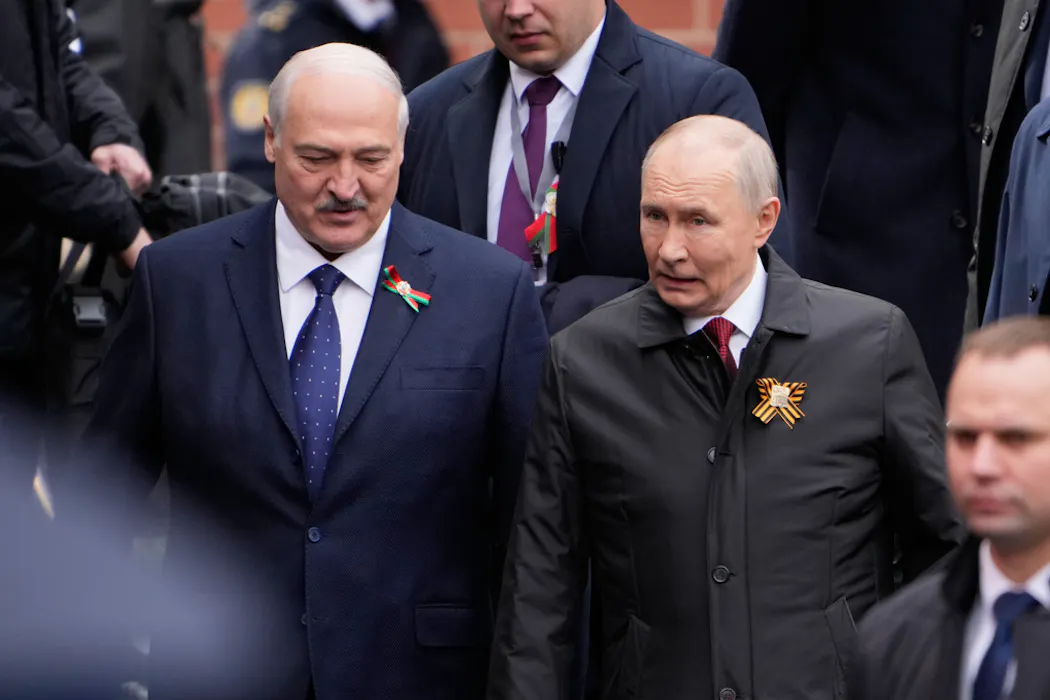
When it comes to relations with Belarus, the Trump administration has been pursuing a dual approach of late.
In May 2026, President Donald Trump renewed the U.S. national emergency on Belarus, noting that the government of longtime Belarusian leader Alexander Lukashenko still posed an “unusual and extraordinary threat” to U.S. security and foreign policy.
The emergency, which in practice underpins the legal basis for targeted U.S. sanctions on the former Soviet republic, has been in force since June 2006, when President George W. Bush imposed it after a Belarusian election widely seen as undemocratic.
But just weeks before the latest renewal, the Trump administration eased U.S. sanctions on Belarus, including those affecting the country’s financial and fertilizer industries, in exchange for the release of 250 political prisoners.
This bargaining logic has history. Lukashenko has ruled Belarus since 1994 and has used political prisoners as bargaining assets with both Europe and the U.S. before, including in 2008 and 2015. The U.S. also tested engagement with the Moscow-aligned nation during Trump’s first term, when his then-secretary of state visited Belarus in February 2020 — the first such visit in 26 years.
But the mixed signals Washington is giving to Belarus stand in contrast to the United States’ allies in Europe.
Amid renewed concerns that Belarus could once again serve as a springboard for Russian attacks on Ukraine, the European Union has taken a harder line than the U.S. The bloc in April adopted a sanctions package aimed at Belarus and its ally Russian, with a strong focus on sanctions evasion, financial channels, trade restrictions and crypto. Not only does this differ from the two-track U.S. approach of sanctions and engagement, but it is also emblematic of the widening gulf of priorities between the U.S. and Europe under Trump.
As a scholar of Eastern Europe, I see the difference between U.S. and European views on Belarus as tactical in form and strategic in effect. Europe wants sanctions to constrain Belarus as part of the threat emanating from Russia. The Trump administration, however, wants sanctions flexible enough to produce visible deals. That mismatch gives Lukashenko more room to bargain and tests how much common ground remains between Europe and the U.S. on Russia.
Europe’s security concerns
Since Russia’s full-scale invasion of Ukraine in 2022, Belarus has become far more central to European security.
In the eys of the EU, Belarus as a neighbor tied closely to Russia’s economy, military logistics and search for ways around Western sanctions.
The EU’s April 2026 package continued the bloc’s alignment of Belarus-related measures with Russia sanctions, especially in regard to enforcement and circumvention.
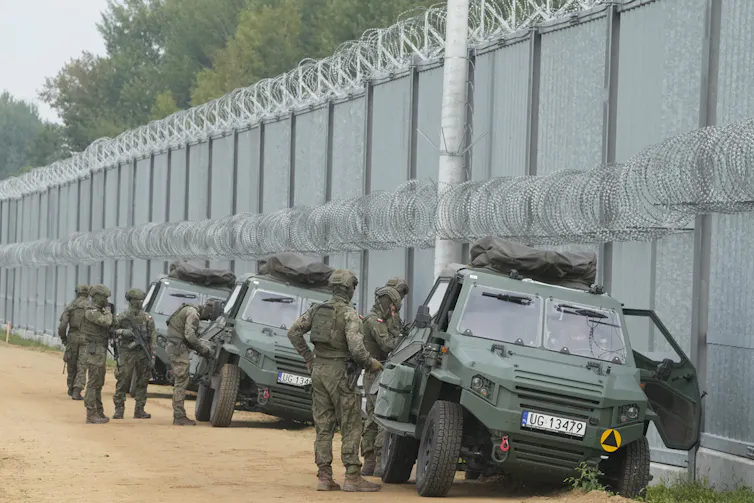
For the EU nations closest to Belarus, this is also about border security.
In 2025, Lithuania took Belarus to the International Court of Justice, accusing the Lukashenko government of organizing large-scale migrant smuggling into Lithuania.
Meanwhile, Lithuania, along with Estonia, Latvia and Poland, has existing or planned defense programs along NATO’s eastern flank, aimed in part at deterring potential Russian or Belarusian military incursions. Poland’s East Shield program commits US$2.7 billion to fortifications and terrain obstacles, while Estonia, Latvia and Lithuania are developing the Baltic Defense Line, which includes bunkers and obstruction elements near Russia and Belarus.
Further, in May 2026, Lithuania’s leaders were moved to bunkers after a suspected drone incursion linked to Russia’s war in Ukraine triggered an airspace alert — a reminder that border security is now a daily governance problem, not just a military planning issue.
That’s why the U.S. request in May for Lithuania, Poland and Ukraine to allow Belarusian potash transit was interpreted as pressure to carve out exceptions to the sanctions regime and reopen export corridors for potash fertilizer producer Belaruskali, rather than keep Belarus economically cut off. For Lithuania, Poland, and Ukraine, reopening transit would revive a revenue channel for Lukashenko through countries already worried about their borders with Belarus and Russia.
The US desire for quid pro quos
For the U.S., Belarus is part of a wider problem involving Russia’s war against Ukraine and the perceived danger that Belarus becomes so dependent on Russia — or China — that Western governments lose influence over its choices.
Europe’s approach continues a policy of keeping pressure on Belarus tied to pressure on Russia in a bid to restrict Russia’s options. Since the beginning of the full-scale invasion of Ukraine in 2022, and even before, Russian President Vladimir Putin has looked to Belarus to advance Russia’s strategic goals, including using the country as a staging ground against Ukraine and a way to force Ukraine and NATO’s eastern flank to devote resources to the Belarusian border.
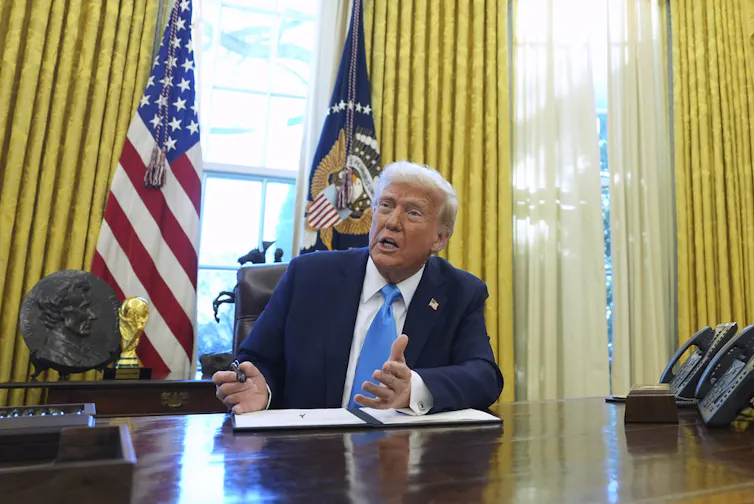
The Trump administration has kept the legal sanctions framework in place. However, it is using it more flexibly than the Biden administration, whose approach was more closely aligned with the EU’s current sanctions-first view of Belarus as both a domestic repression problem and an extension of Russia’s war architecture.
The shift under Trump is driven in part by broader trends. Years of pressure have pushed Belarus further toward non-Western partners. Belarusian trade with Russia doubled from US$29.5 billion in 2020 to $62 billion in 2025. Meanwhile, trade with China rose from $4.6 billion to more than $8.8 billion over the same period.
The same shift can be seen in the potash industry, a major source for fertilizer. Western sanctions began hitting Belarus’ potash sector in 2021, after Lukashenko’s crackdown on the 2020 protest movement, with the U.S. targeting major state-linked potash companies and Lithuania later halting transit of the fertilizer through the Baltic port of Klaipėda.
Before those restrictions on leading Belarusian potash companies, Belarus exported roughly 10 million to 11 million tons of the mineral a year through established routes to global markets. By 2025, the volume had recovered – but via alternative routes, largely through Russia. Belarus exported 11.6 million tons of potash fertilizers through Russian ports, and China became a major buyer, making Belarus Beijing’s second-largest potash supplier after Russia.
That gives the Trump administration a political and economic argument at home. It can say that the Biden-era expansion of sanctions produced few immediate political changes inside Belarus, while targeted relief has produced visible prisoner releases. Trump’s team can also present potash relief as practical at a moment when fertilizer costs are sensitive for U.S. farmers facing fertilizer shortages exacerbated by the war in Iran.
This all means the Trump administration is treating sanctions less as a stable wall of pressure and more as a lever for visible results.
How Lukashenko can exploit the EU-US split
For Lukashenko, the benefit of the transatlantic split is concrete. With the U.S., prisoners become the bargaining asset. If some are released, the U.S. can claim a result. If others remain jailed, Lukashenko keeps something to trade later. The human rights organization Viasna still counts more than 870 political prisoners in Belarus after earlier releases, which shows why the tactic works.
Lukashenka’s leverage with Europe, meanwhile, comes from perceptions of risk. In May 2026, French President Emmanuel Macron called Lukashenko and warned him against deeper involvement in Russia’s war. The call showed that Belarus has become too important to European security for European leaders to ignore.
Amid these transatlantic divergences, Belarus has been increasingly tied to Russia’s war-making capacity. Satellite imagery in early 2026 pointed to a possible Russian Oreshnik missile site in Belarus. Ukrainian officials have also said missile fragments from a May strike contained Belarusian microchips. And finally, more than 500 Belarusian industrial sites are reportedly involved in weapons production, military repairs, ammunition or logistics.
This is particularly where tactical differences between the U.S and Europe begin to harden into a political divide. The U.S. search for leverage appears to undercut Europe’s demand for pressure. Lukashenko gains bargaining power, and the West’s common position becomes harder to sustain.
This article was originally published on The Conversation. Read the original article.