Hello and welcome to another edition of Free Agent! Watch where you're driving this week, and keep an eye out for innocent bystanders, please.
Today's newsletter is a beast, covering the Protect College Sports Act—a 101-page bill just introduced in the Senate that has huge implications for college sports. We've got everything you need to know, everything right and wrong with the bill, and whether it can pass and become law.
But first, if you want to fill out our survey on the NBA and NHL finals, let me know who you're rooting for here.
Locker Room Links
- Steph Curry signed a new decade-long shoe deal— with Li-Ning, a Chinese company that also has a deal with Curry's teammate, Jimmy Butler.
- MLB owners formally proposed a salary cap to the players union. The proposal includes a salary floor , which would have forced 12 teams to spend more if it were in place this season (and 10 teams to spend less). The union obviously said no , especially because the union's executive subcommittee includes high-end players like Tarik Skubal and Paul Skenes who want no cap whatsoever.
- Speaking of MLB, some owners are questioning whether league expansion makes sense right now (good, in my opinion!).
- Shai Gilgeous-Alexander's attorney sent a cease and desist demand to fantasy sports company Underdog, which made a board game poking fun at SGA. Underdog refused to comply, and the whole thing screams of the Streisand effect .
- The South African soccer team's travel to the U.S. for the World Cup was delayed due to visa issues—they eventually left without their assistant coach .
- Elsewhere in Reason : It was a sportsy week, with coverage of the Chicago Bears stadium debacle (which might now be over ) and Nick Gillespie sounding off on private equity and youth sports .
-
Do you like or dislike how different the NBA is every year?
The NBA will have its 8th different champion in the last 8 years. It had never been 7 straight until last year.
???
Thunder
Celtics
Nuggets
Warriors
Bucks
Lakers
Raptors— Chris Vannini (@ChrisVannini) May 31, 2026
We haven't even had a repeat *conference champion* since 2019.
What a fascinating era of NBA hoops.
— Jason Timpf (@_JasonLT) May 31, 2026
Ted Cruz and Maria Cantwell Look To 'Protect' College Sports
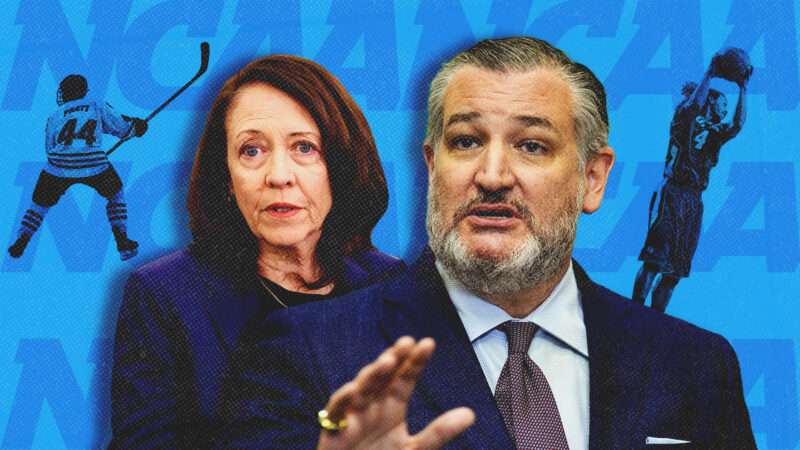
After the failure of the SCORE Act in the House of Representatives, there's a new bill on the Senate side to "protect" college sports. Sens. Ted Cruz (R–Texas) and Maria Cantwell (D–Wash.) introduced the Protect College Sports Act on Wednesday. The bill is the NCAA's best chance yet (if only because every other effort has failed) to get its long-awaited help from Congress in wresting back control of college sports.
It's a wide-ranging bill that covers a lot of things you'd expect (name, image, and likeness [NIL] payments and transfer rules) and touches more aspects you probably wouldn't have thought Congress would weigh in on (conference realignment, coach movement, and scheduling of both college football and NFL games).
On transfers, the bill would only allow student-athletes to transfer schools once (additional transfers would require a season off, unless the athlete is transferring because their coach left or the school eliminated the team). Athletes would have a maximum of five years of eligibility for college sports, with exceptions for pregnancies, missionary work, military service, and any other reason approved en masse by the NCAA. Any athlete who's played professionally would have no eligibility (to oversimplify: prize money is allowed, salaries are not, and the NCAA would have discretion to decide what's allowed).
The NCAA and the College Sports Commission (formed in 2025) would have legal backing to enforce their NIL rules. That includes a "salary" cap, where schools would have $21.3 million to spend on their student-athletes across all sports. The College Sports Commission would basically be able to determine what payments are under-the-table NIL payments designed to go around the compensation cap. As Cruz described it: "If it's fake NIL, if it is a booster just handing an athlete a bag of cash under the table, that is breaking the rules."
The bill also stops conference realignment in its tracks—at least for the Big Ten and SEC. Conferences with $1 billion in revenue in 2025 would not be allowed to merge or add members. (That restriction only applies to 2025 revenue, so even if revenue changes, it still only applies to those two conferences in perpetuity.)
It also includes the infamous "Lane Kiffin rule," where coaches and key staff are not allowed to leave for another team in the same season—not just for gameday coaching functions, but also for recruiting and other off-the-field purposes.
Conferences would be given an antitrust exemption to pool their media rights—if they want to. The smaller conferences would have to placate the Big Ten and SEC to get them involved, though. One thing that would probably stand in the way of a deal big enough to entice the Big Ten and SEC: If a certain basketball or football game is going to be shown exclusively on a streaming platform, the broadcaster would still have to make that game available in a university's market area "without charge" (i.e. on network TV or cable, even though people pay for cable—free content on a streaming platform would be allowed too). The Federal Communications Commission would oversee which local markets each school's games must be shown in. That's going to diminish the financial value of any deal offered by broadcasters to the conferences. Furthermore, any school in a conference that pools its media rights would fall under new rules over "traditional rivalry"—its football team could be required to play a certain team every four years or every year if the teams have played each other often enough in the past.
By law, student-athletes would be allowed to have an agent and wouldn't lose eligibility for hiring one. Agents for student-athletes would have to register with a state government and would have their fees capped at 5 percent.
It's not getting much media coverage, but the bill also requires various safety standards relating to concussions, heat injuries, asthma, and other ailments (by outsourcing these standards to various nongovernmental bodies, usually the NCAA). Medical personnel get "autonomous, unchallengeable authority to determine medical management and return to play decisions" in the bill's text, and "No coach or other nonmedical personnel of an institution may attempt to influence or disregard" those decisions.
If it passed, you could also say goodbye to a few more quirks in the NFL schedule: the NFL would not be allowed to broadcast on the first Friday in September (as of now, it's the second) or the third Saturday in December (as of now, it's the second). The college football season would also be legally required to end by January 8 every year, "to the extent practicable."
One thing the bill doesn't touch on, because movement in either direction would be a poison pill for either side of the aisle, is whether student-athletes are employees. Democrats generally want to see them designated as employees so that the athletes have collective bargaining rights and could form a union, while Republicans (and the NCAA) generally want the law to prevent that. Cantwell insists the collective bargaining debate is not over.
The Consequences
If you read all of that and thought, "Wow, it's kind of crazy that Congress is going to set the governing rules for a major sports entity," I'm with you. A lot of this feels like overreach that people would find crazy in other industries, even if you agree with the aims (like transfer rules—restricting athletes to one transfer is inevitably going to end up challenged in court, or with as many loopholes as Swiss cheese).
Consider, for example, the health and safety standards. Obviously we want healthy athletes (even at your rival college). But giving "autonomous, unchallengeable" power to medical personnel seems like a reach. Perhaps your star running back takes a knock and is only feeling 95 percent ready to play in the national championship game, and there's a minuscule chance of a career-ending injury. If he wants to take the risk, and the coach wants to take the risk, the medical staff can still keep the player out—the coach is not even allowed to appeal and try to "influence" that decision.
The bill is wise to not directly set the safety standards on concussions and other ailments into law. But outsourcing those standards to the NCAA and other organizations doesn't mean we can trust them to stay up-to-date with the latest scientific findings.
Perhaps you hate conference realignment and are sick of the Big Ten and SEC expanding. Consider two possible loopholes to the bill. First, every other conference would still be allowed to merge and expand. In theory, every other conference could join together and start their own superleague without the Big Ten and SEC. Second, the bill doesn't actually stop the current schools of the Big Ten and SEC from forming a superleague—those schools could still leave the NCAA altogether for a newly formed entity.
What about the proposed salary cap? That's just asking for under-the-table deals, like the paper bags full of cash that were rumored to run recruitment in the days of college sports yore. As Ross Dellenger wrote in great coverage of the bill for Yahoo Sports, "Next year, each school has $21.3 million to spend on all of their athletes, but many programs, in order to achieve an advantage in a competitive recruiting environment, have redirected corporate sponsor cash to their rosters disguised as third-party NIL — compensation that doesn't count against the cap." You might think it's wise for a cap to slow down the arms race on NIL payments, but market value always prevails—the cap is just going to move the payments into the darkness.
Likewise, the "Lane Kiffin rule" is obviously unworkable. Coaches will reach under-the-table deals to upgrade to bigger schools that will just get finalized on the first day allowed. They'll zone out of their current job and start backchannel communications with recruits and their agents for their new . The rule is possibly unconstitutional anyway under other employment laws. The NCAA has failed to enforce its own rules for decades. Why do we think it would successfully enforce this one?
I continue to be gobsmacked that someone of Ted Cruz's political background is promoting the idea that the federal government should
dictate the hiring cycle of a non-government entity. It's not only absurd, it's kind of frightening. https://t.co/lH2dvFV0Sf— Dan Wolken (@DanWolken) May 29, 2026
There's also the rule that keeps athletes who have played professionally from returning to college sports. This made a lot more sense when the NCAA had strict amateurism rules—now it's a bit rich considering the payments players are getting to be good at sports. It's essentially saying: "Yes, you got paid to be good at sports. But you weren't paid by us, you were paid by some Italians, so you're banned."
The bill has some good reforms, to be fair, but they're mostly codifying certain things that are already happening anyway (like NIL payments and the right to hire an agent). One major improvement is the antitrust exemption, which allows conferences to pool their media rights together—but even that comes with a ton of restrictions.
Congress should not be managing the NCAA just because the organization failed to manage itself for decades. Imagine if Congress got involved in MLB in the 1960s and said the league couldn't let the American League and National League merge for business purposes, or that they couldn't expand or let teams relocate. What if the NBA said "Our tanking problem is out of control, Congress can you please fix the draft lottery for us?" Congress is trying to micromanage football schedules when it should be trying to assert its authority over trade and military actions. Instead of the economy or life-and-death issues, they're spending their time on what is basically an entertainment industry that exists to promote colleges to prospective students.
Will the Bill Pass?
I'm not saying you should disregard all of this, but the bill probably won't pass, at least not as it currently stands. Even if it fails, another effort to reform college sports will come up in the future that will include many of these ideas.
Sportswriter Jesse Dougherty talked to sources on Capitol Hill for insights on whether the bill can pass. Many were waiting to see how Sen. Chris Murphy (D–Conn.) weighed in, since he often sets the tone for progressives in the Senate. Murphy eventually released a statement that said: "We are all still reading this bill…but this seems like a great deal for the NCAA and the rich guys who run college sports, and a bad deal for athletes." It seems like a safe bet the Congressional Black Caucus will agree with him, since gerrymandering is still a thing.
Combine progressive opposition with the fact that most of the powerful schools don't want it. The SEC came out strong against the bill (at least on the pooling of media rights), and only a few people affiliated with Big Ten and SEC schools have come out in support. If the athletic departments, administrators, alumni, and boosters for the biggest, most powerful schools in the South and Midwest are all yelling at their members of Congress to oppose the bill, it's going to be an uphill battle.
If you were looking at this issue from a purely left-right perspective, though, Republicans might want to take this deal. It accomplishes much of what they want, and it seems unlikely that congressional Republicans will have more power after the 2026 midterm elections, and probably not after the 2028 elections either. (I shudder to think of what a Democratic trifecta under President Alexandria Ocasio-Cortez would do to college sports.)
On Wednesday morning, Cruz and the Senate Commerce Committee will hold a hearing about the bill featuring testimony by Nick Saban, Notre Dame's athletic director, former president of Ohio State and other universities Gordon Gee, the Pac-12 commissioner (yes, it still exists!), and a Utah football player. It will be interesting to see what each senator says about the bill and to parse the questions they ask witnesses.
Who You Got?
Now for the fun part: Who are you rooting for in the NBA and Stanley Cup finals? Fill out this survey here and let me know. I'll share the results next week.
I, for one, am extremely begrudgingly rooting for the San Antonio Spurs. I hate draft lotteries, as I've said before, and I hated them even before the 2023 lottery balls fell in favor of the Spurs and sent Victor Wembanyama to Texas when he should have been drafted by my Detroit Pistons, who just sucked (Detroit was founded by the French, after all!). But I find the celebrity and mass support for the Knicks too cloying, and it remains very funny to me that the Knicks haven't won a title since 1973 and the city hasn't won an MLB, NBA, NFL, or NHL title since 2012 (and that team, the Giants, play in New Jersey). Funny enough, I remember a young Jason avidly rooting for the Knicks over the Spurs in 1999, and being very sad when Latrell Sprewell missed a last-second shot that clinched it for the Spurs.
As for the Stanley Cup Finals, I am much more pleased to root for the Carolina Hurricanes. Coach Rod Brind'Amour played at Michigan State, who I root for. They've won the Stanley Cup once, but it was 20 years ago. Lately they've made the playoffs eight years in a row but have no Cup to show for it, so I feel like they've earned it thanks to consistency. Vegas, meanwhile, I hold a grudge against for doing so well in their inaugural season, has a coach I don't like (plus I'd rather not set a good example for other teams thinking about firing their coach in the closing weeks of the regular season), and in the past has taken advantage of some sketchy injured reserve usage and salary cap tactics.
Whoever you're rooting for, take 2 seconds to vote in the survey, and feel free to explain why.
Replay of the Week
I won't have many opportunities to brag about Detroit sports for a while, so please indulge me for some back-to-back-to-back home runs.
That's all for this week. Enjoy watching the real event of the weekend—who needs college sports when you've got the American Cornhole League's Fort Worth Signature Open?
The post The Protect College Sports Act Trades NCAA Chaos for Federal Overreach appeared first on Reason.com.