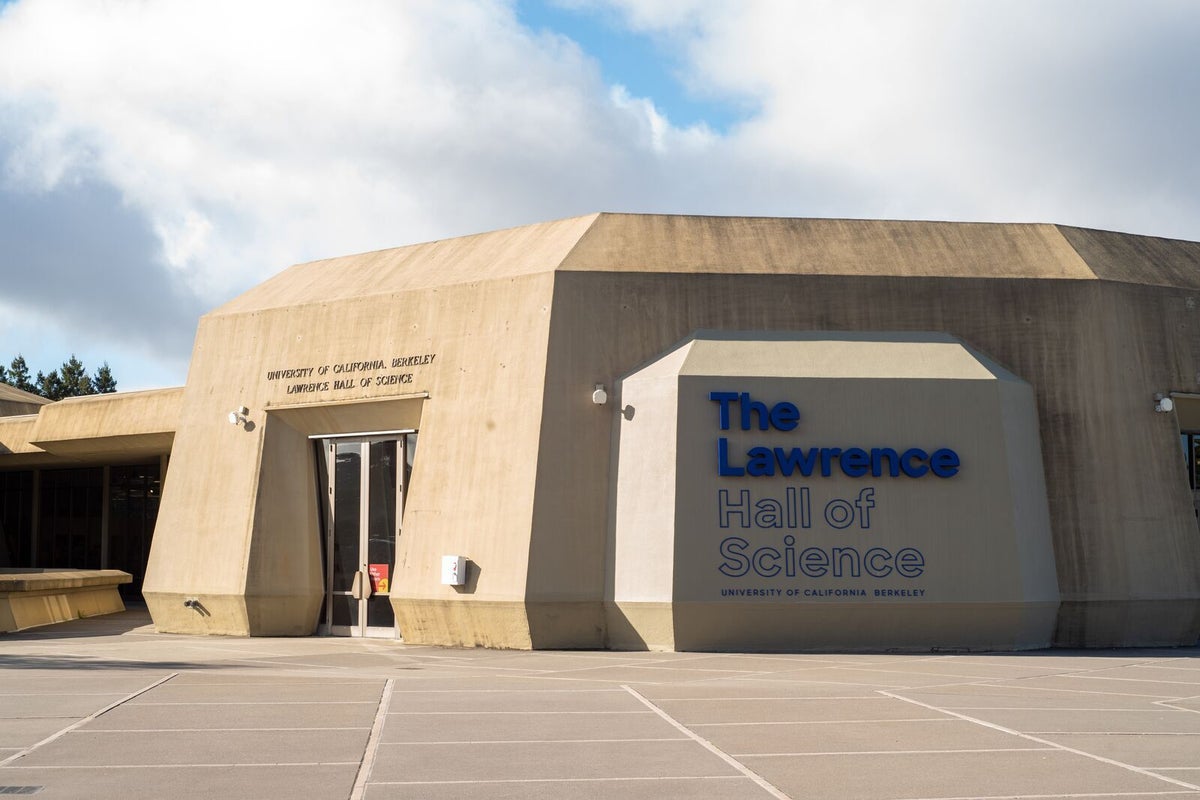
A group of local Indigenous leaders and Lawrence Hall of Science researchers strolled through the lobby of the discovery-based UC Berkeley museum last week as workers put the finishing touches on its latest exhibit, “Yuutka” (The Place of the Acorn).
Replicas of black oak trees towered overhead, while California poppies, wild roses, yarrow, and black sage plants were projected on the floor and a creek and bridge were under construction nearby. A cartoon version of East Bay Ohlone matriarch Dolores Lameira smiled encouragingly from one wall as she coached visitors to the mixed reality experience on how to gather virtual acorns using baskets equipped with 3D sensors.
“It really looks like her,” commented Vincent Medina, her great-nephew and one of the project’s creators.
Yuutka is both the first mixed-reality display in the Lawrence’s history and the first to be designed in a novel collaboration with young people from the Ohlone community, whose traditional homeland the museum sits on.
And it almost didn’t happen.
Armed with a $1.4 million grant from the National Science Foundation, the museum in 2023 embarked on a series of exhibits aimed at both showcasing the Ohlone’s understanding of the natural world and sparking interest in science among Indigenous young people. Then last year, the Trump administration abruptly terminated their funding, part of a mass cancellation affecting more than $1 billion in NSF grants that officials said didn’t align with agency priorities.
The researchers and the youth, however, persevered – eventually winning a major battle in court. The story of their first exhibit, which opened Sunday, is a tale of both University of California scientists’ success in pushing back against federal grant cancellations, and of a community that chose not to give up.
Folding Ohlone knowledge into the scientific canon
There’s a line in “ There There,” Tommy Orange’s celebrated novel about a Native American powwow in Oakland, that mentions the Lawrence Hall of Science.
“Only rich people or monitored kids on field trips went to that place,” Orange writes, channeling the voice of one of his teenage Indigenous characters.
By working together, museum researchers and Ohlone leaders hoped to challenge that notion. One of the questions they aimed to answer: Would sharing their community’s knowledge help Ohlone youth to feel more connected to the museum — perhaps to pursue careers in STEM?
Medina, an educator and culinary activist, was inspired to tackle the project in part by his own experience growing up in the East Bay and rarely seeing his culture represented in school or museum curriculum.
Ohlone people were spoken of “almost always in the past tense,” said Medina, who with his partner and collaborator Louis Trevino leads an effort dubbed the ’ottoy, or repair, Initiative, to highlight Ohlone culture and improve UC Berkeley’s relationship with the community.
“Ohlone knowledge was dismissed by institutions most of the time as being myth or folklore, instead of uplifting the knowledge as being scientifically based,” he said.
Staff at the Lawrence Hall of Science, where the mission is to bring science education to the public, say they saw a wealth of possible lessons in Ohlone practices, from the mathematics of basket design to the biochemistry of leaching harmful tannins from acorns so they can be easily digested. Many of those traditions are passed down orally rather than in scientific papers, but that doesn’t make them any less important to our understanding of the world, they said.
The exhibits would make clear that “we are considering community knowledge and Ohlone ways of knowing as part of that umbrella of what science means and looks like,” said Jedda Foreman, an associate director at the museum.
Working with Medina and Trevino, the museum invited a group of Ohlone youth ages 7 to 22 to participate in the project. In a series of gatherings with museum researchers and Ohlone elders, the young people learned about their community’s traditions, then worked to turn some of the themes into exhibit prototypes with the help of a professor at UC Berkeley’s School of Information.
The exhibits would be mixed reality, to emphasize that Ohlone knowledge was not just part of the past, but planted firmly in the present and looking towards the future. The group of young science ambassadors took on the name tappenekšekma, which in Chochenyo, the language of the East Bay Ohlone, means both teachers and learners.
Some of the youth were already steeped in the traditions they would be sharing with the public. Albert Bojorquez, 15, had traveled the state with his father to participate in Ohlone ceremonies and learned how to build boats from tule reeds. His brothers, 16-year-old Victor and 12-year-old Carlos, were less familiar but eager to learn.
“For me it was learning about how to communicate and collaborate with people to kind of, like, not reconnect with the past but be together and move on with one another,” Carlos Bojorquez said.
Many of the youth were more savvy about interactive technology than the museum researchers, Foreman said.
“We were talking about one of our exhibits, and this one kid was like, ‘Is this an open world design or a closed world design?’” she said. “It was like, here’s this 11-year-old kid teaching me about video game design.”
As the project went on, some young people who initially expressed little interest in STEM started to get curious about how they could continue to participate in museum design and science more generally after the project completed, Medina said. They also started to feel more at home at the museum, Foreman said.
“After a couple meetings some of the youth were like, ‘I think we should have nametags because we work here. And we’re like ‘Yeah, you should have nametags!’ ” she said.
Research funding slashed by National Science Foundation
Then in April 2025, about two weeks before the Lawrence Hall of Science team was set to hold an event to share the exhibit prototypes and get feedback from Ohlone community members, the bombshell dropped: The NSF was terminating their grant, along with eight others to the museum. It was part of a nationwide purge of projects “including but not limited to those on diversity, equity, and inclusion (DEI), environmental justice, and misinformation/disinformation,” according to an FAQ on the agency’s website.
The move caused consternation throughout the scientific community. At the Lawrence, researchers found themselves at a crossroads: Would they press forward with the work?
“It’s very hard to ever tell anybody that their work wasn’t valuable,” Medina said. “The way that the rescinding of the grant was being presented was they were trying to eliminate waste. How do you tell a group of young people, who love their culture and wanted their culture to be represented here, that all of the work they were doing to amplify their knowledge was waste?”
The researchers met with the Ohlone youth ambassadors, who were undeterred.
“We still decided to keep working, to keep trying to get our vision of this out, to show people about us and that we’re not gone and that we’re here,” Carlos Bojorquez said.
They held the community event, and chose the first exhibit they would build. Centered on the acorn, a staple of the Ohlone diet, it would allow visitors to use baskets to gather virtual acorns, Pokemon-style, while learning about the food’s role in the local ecosystem. An avatar of the 95-year-old Lameira, a retired tribal leader also known as Auntie Dottie, would guide the visitors through the process.
Museum staff started looking into foundation grants. The Bojorquez boys’ father, Isaac, met with leaders of other California tribes to see if they might donate funds. The team had used the NSF money to help cover travel costs for Ohlone families who were coming from far-flung corners of the Bay Area to participate in the project. Now, some of those families began paying out of pocket, Isaac Bojorquez said.
A judge rules for researchers against the Department of Justice
Meanwhile, on the UC Berkeley campus, a legal fight was brewing to reverse some of the grant cancellations, which were taking place not just at the National Science Foundation but also at the National Institutes of Health and other federal agencies.
Claudia Polsky, a clinical professor at UC Berkeley School of Law, had been following the news as wave after wave of grant cancellations was announced. She suspected at least some of them could be challenged in court, though the University of California as an institution had so far declined to directly do so. Unable to get the university to share much information about the terminations, she said, she began reaching out to UC researchers herself.
“I would go to faculty meetings and put cards on chairs saying, ‘If you have a grant that’s been terminated, could you write me a sentence?’” she said.
Soon, the well-known plaintiffs’ law firm Lieff Cabraser Heimann & Bernstein got involved. The dean of the UC Berkeley law school lent his support.
In June 2025, Polsky and the rest of the legal team filed a class-action lawsuit on behalf of UC researchers whose previously approved grants had been terminated by the Trump administration.
The complaint called the grant terminations “a disaster for the future of science in the United States” and argued that agencies were unlawfully ignoring their congressional mandates in favor of pursuing the political objectives of the Trump administration.
Foreman, one of the named plaintiffs in the suit, said in a declaration that the termination of the grant with nearly $500,000 left to be paid would cause an “enormous setback” for the collaborative work the museum was doing with the Ohlone community.
The Department of Justice countered that federal law gives agencies discretion to refuse to fund activities that don’t align with the government’s policy priorities.
Judge Rita F. Lin agreed with the researchers.
Later that June, in a preliminary injunction, she ordered the restoration of the Lawrence Hall of Science grants along with all other NSF, Environmental Protection Agency and National Endowment for the Humanities grants that had been revoked with either a form letter that lacked a specific explanation or because of executive orders related to diversity, equity and inclusion.
Attorneys for the UC researchers have since won a similar injunction reversing grant cancellations at the National Institutes of Health, Department of Defense and Department of Transportation while the case continues. Originally slated to go on sabbatical to write a book, Polsky decided focusing on the case was more important. Fourteen attorneys are now working on the case, which Polsky estimates has led to the reinstatement of about 1,000 grants.
Every week, she says, she gets calls from researchers at other universities looking to replicate their work or find their own pro bono attorneys.
UC spokesperson Rachel Zaentz said the researchers’ class action suit has restored more than $500 million in funding to UC, complementing the university’s own efforts to fight a proposed cap on the percentage of federal grants that can be used for facilities and administration, and lobby the state of California to set up its own science fund.
“Our community has also played a key role in protecting UC,” she said.
Stacking virtual acorns
At the exhibit walk-through last Wednesday, Medina gazed up at the black oak trees in the museum’s lobby, while other team members grabbed baskets to try picking up acorns as they fell. On the wall, the acorns stacked up in a virtual Ohlone granary (the real-life version can preserve the acorns for up to 10 years).
Once the exhibit was fully activated, the Auntie Dottie avatar would urge visitors to leave the first drop of acorns for the animals, and to avoid the wormy ones, which would spoil the granary.
“To see it all come to be — it’s going to go a long way teaching about culture, building understanding and respect,” Medina said.
Elsewhere in the museum, evidence abounded of the ongoing partnership between Ohlone communities and the Lawrence Hall of Science. Through the ’ottoy Initiative, Medina and Trevino are infusing Ohlone perspectives into multiple aspects of the museum, from the native plant garden to the sign at the front door welcoming people to “the home of the resilient East Bay Ohlone people.” The Chochenyo language will be incorporated into all future exhibits — which will also be fully translated into Spanish — and the duo recently opened a new cafe at the museum serving Ohlone-forward cuisine.
Sprouting in the shadow of the university’s troubled relationship with Indigenous communities — it was a UC Berkeley anthropologist who erroneously announced in 1925 that the Ohlone people were extinct, and despite steps toward repatriation, the university’s anthropology museum still holds thousands of Native American remains — the partnership strengthened in the wake of the federal grant cancellation and the project’s continuation, Medina said.
“We found out by talking to our colleagues at the Lawrence that the support that they show for the culture was not wavering, that it was going to be present whether or not the grant was there,” he said.
Trump administration suspended grant again as exhibit neared
The threat to the project’s federal funding has not completely abated.
Last month, while presenting about the Ohlone-focused exhibits at a conference, Ari Krakowski, the project’s principal investigator, got an email from the university letting her know that the NSF had once again suspended the project’s grant. The email referenced “foreign funding,” though the Lawrence researchers said the project has not received any money from outside the U.S.
It was one of 18 grants to UC Berkeley researchers suspended by the NSF since the court injunction barring further terminations. While most of the project’s funds have already been spent, researchers hoped to use the remainder to analyze their findings about the impact of participating in exhibit design on Ohlone young people. They think their work could be a model for other museums looking to build bridges with Indigenous communities. And they’re planning another co-designed exhibit for September 2028 — this one focused on tule reed boats, as part of a larger display on the future of transportation.
“It’s strange that something like this would be threatening to anyone,” Krakowski said as she and her colleagues clustered below the tree canopy. “You can label it all these things and it just gets so politicized and polarizing. But I think anyone that came to this exhibit would be like, ‘Of course this belongs here.’”
___
This story was originally published by Berkeleyside and distributed through a partnership with The Associated Press.