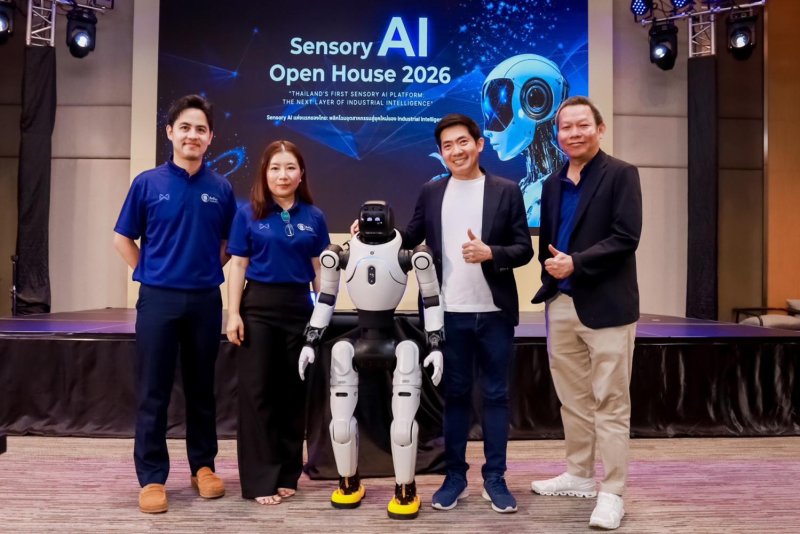
MUI Robotics Co Ltd, a Thai deeptech startup, is developing a sensory artificial intelligence (AI) platform designed to transform sensory perception into digital intelligence, aiming to position Thailand as a global leader in what it calls the next layer of industrial AI.
"The world is entering the era of the AI economy, where data has become a critical resource. A layer of data yet to be fully utilised is sensory data," Wandee Wattanakrit, co-founder and chief executive of MUI Robotics, told a recent seminar on sensory AI.
"We believe smell and taste represent a new data layer of AI, enabling intelligent systems to understand the real world more comprehensively," she said.
Local deeptech research in this area can evolve into real industrial applications capable of creating economic, social and environmental impact, Ms Wandee said.
Teerakiat Kerdcharoen, co-founder and chief scientific officer of MUI Robotics, said the evolution of AI technology can be divided into three eras.
The first was the "pattern" era, focused on pattern recognition such as facial recognition systems at airports, but lacking any contextual understanding or reasoning behind the identified individual.
The second era is the current "reasoning" phase, where AI has begun to demonstrate reasoning capabilities and can interact conversationally to assist with planning, reporting and analytical tasks.
The third phase of AI technology, which society is now beginning to enter, is the era of emotional perception and human-like interaction.
In this stage, AI is expected to develop perceptual and emotional understanding closer to that of living beings, he added.
However, this phase still requires substantial foundational research and interdisciplinary collaboration extending beyond technology into the humanities and behavioural sciences.
He said the existing AI has learned primarily from massive amounts of images, audio and text. But in the real world, there is another category of information humans use every day to make decisions -- sensory data.
SENSORY INTELLIGENCE
In the food industry, smell is used to determine product quality. In environmental management, odours can indicate pollution problems. In healthcare, breath odour may serve as a biomarker for disease.
"Once AI can understand these forms of data, it will improve decision-making, reduce inaccuracies, and create intelligent systems that more closely resemble human perception," Mr Teerakiat said.
Today's global AI systems already possess capabilities equivalent to human vision and hearing, but still lack chemical sensing capabilities comparable to taste and smell, he noted.
"MUI is developing a sensory AI platform that transforms smell and taste into digital data," Mr Teerakiat said.
The company aims to build Thailand's first platform capable of completing the missing sensory layer, forming a critical foundation for enabling AI systems to perceive and understand the physical world in ways similar to humans.
MUI is focusing its commercialisation strategy on the food industry, one of Thailand's strongest sectors and a rich source of sensory data.
Sensory AI can significantly shorten food innovation cycles by shifting experimentation from physical testing environments into virtual taste simulations.
This helps accelerate research and product development while reducing time-to-market.
The platform is also expanding into environmental management applications, including odour pollution monitoring in industrial factories to reduce community impact, as well as replacing human judgement in quality control processes.
This can improve accuracy, consistency and transparency in inspections -- increasingly important factors for exports and international trust.
After collecting food-related sensory data for more than five years, MUI has accumulated around 200 million data points.
Looking ahead, the company aims to scale this to hundreds of billions of data points in order to build what it believes could become the world's strongest and most accurate smell-and-taste database, positioning Thailand as a global standard setter in sensory intelligence.
Charnwit Boonchuay, president of the AI Entrepreneurs Association of Thailand, said Thailand is entering a critical transition phase for AI -- moving from experimental adoption towards real-world deployment across businesses and industries.
Mr Charnwit, who is also chief executive of Synapes Thailand, said Thailand's AI market is growing at around 30% annually and is projected to reach 50 billion baht in 2026.
Despite the country's readiness, the market share captured by Thai AI operators remains below 5 billion baht, which he described as a concerning issue.
"It is crucial to accelerate the development of local AI entrepreneurs, which currently number only around 200 companies," he said.
"Thailand does not necessarily lack AI personnel, but rather highly specialised talent capable of competing regionally and globally in real-world deployment."
Mr Charnwit said sensory AI could become the next competitive advantage that allows factories and businesses to understand the real world more deeply.