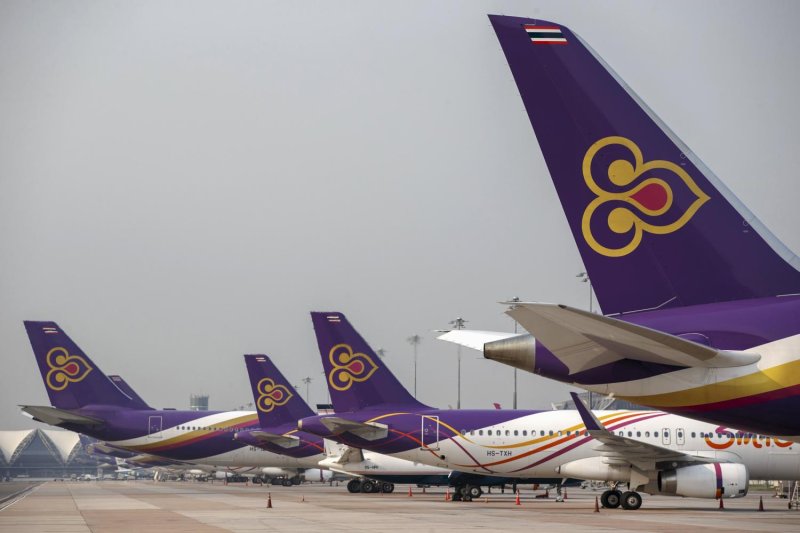
Thai airlines, which reported mixed financial results in the first three months of 2026, will remain under pressure in the second and third quarters from the oil price spike as the uptick in airfares and fuel surcharges are insufficient to cover the surge in costs.
The tourism and aviation outlook this month reflects the impact of the US-Israeli war with Iran, with elevated jet fuel prices continuing to weigh on airlines, particularly low-cost carriers, which face the highest risk, said Dithanop Vattanawakin, aviation analyst at Krungsri Securities.
Nationwide passenger and flight volumes contracted by 7% year-on-year in early May, deteriorating from a 1% contraction in April, dragged down by domestic routes, which shrank by more than 11%.
Airports of Thailand (AoT) reported passenger volumes dropped by 5% in early May, worsening from a 1% decline in April, with the downturn driven by a 10% dip in domestic routes, consistent with nationwide aviation statistics reported by the Civil Aviation Authority of Thailand.
"We believe the primary driver of the decline in domestic passenger volumes and flights is the capacity reduction policy adopted by low-cost carriers, as elevated fuel prices mean domestic routes are no longer profitable for this segment," Mr Dithanop said.
International routes, which are predominantly operated by full-service carriers with higher profit margins, are less affected by elevated fuel prices.
"We have a negative view of May aviation statistics, which showed a steeper year-on-year contraction than in April, more clearly reflecting the impact of the US-Iran war," he said.
The primary impact stems from the surge in jet fuel prices, which prompted airlines to raise fares, which dampened travel demand, and reduce flight frequencies to protect margins, thereby constraining supply, Mr Dithanop said.
RISING COST PRESSURE
SET-listed Asia Aviation (AAV), the operator of low-cost carrier AirAsia, said war in the Middle East introduced significant cost pressures and volatility.
"The conflict has had a profound impact on the global aviation industry via the energy market," AAV said in a filing to the Stock Exchange of Thailand (SET), adding jet fuel prices went from around US$80 per barrel to a peak of around $240 in early April.
Phairat Pornpathananangoon, chief executive of AAV and Thai AirAsia, said the impact of rising fuel costs will become more evident in the second quarter, presenting greater management challenges.
"For the second quarter, the company anticipates continued challenges in the global aviation industry stemming from geopolitical tensions and aviation fuel costs that have surged more than threefold," he said.
In response, AAV strategically restructured its pricing to better reflect operational costs and preserve financial liquidity. Seat capacity for May and June were optimised, reduced by 20% year-on-year to align with the low season and softening travel demand, noted the filing.
The airline said it is preparing to issue up to 4 billion baht worth of debentures next month to strengthen its capital position as the carrier remains focused on preserving liquidity and maintaining financial stability.
"Should the conflict persist and fuel prices remain elevated in the second half of the year, fares are expected to rise to better balance seat supply and demand," noted AAV.
According to Mr Dithanop, jet fuel prices eased to $150-160 per barrel this month, though this remains more than 80% above pre-war levels.
While the near-term impact was limited, airlines face increasing headwinds in the medium to long term from the Iran war, with the effects expected to become more pronounced in the second quarter, he noted.
"We anticipate certain companies may swing to a loss as surging jet fuel prices continue to weigh on sector earnings," Mr Dithanop said.
Parin Kitchatornpitak, an analyst with KGI Securities (Thailand), said he expects the second quarter to be AAV's weakest quarter of the year, attributed to higher jet fuel prices and softer tourism.
The carrier is projected to realise a net loss of 3.72 billion baht this year as a result of fewer passengers and pressure from higher jet fuel prices, which "could result in unprofitable fare levels", he said.
FRAGILE DEMAND
According to Bangkok Airways, Thailand's tourism industry contracted by 2.4% year-on-year in the first quarter, with foreign arrivals totalling 9.32 million. Tourists from East Asia, particularly China, grew by 11.8%.
However, arrivals from the Middle East declined by 20%, while those from Southeast Asia dipped by 18.5%.
Tourist arrivals from several regions moderated slightly in March as a result of the conflict in the Middle East, with arrivals from Africa decreasing by 6%, Europe by 4%, and the Americas by 2%, the carrier said in its filing to the SET, citing data from the Tourism and Sports Ministry.
"The company continued to focus on routes aligned with its network strategy and profitability potential in order to match travel demand, seat capacity constraints and significantly higher operating costs following the war in the Middle East," said Bangkok Airways.
Boonyakorn Amornsank, an analyst with Maybank Securities (Thailand), projects traffic growth during the summer schedule, which runs from April to October, to remain subdued.
The pace of flight cancellations resulting from fuel shortages has persisted, with no sign of deceleration in the near term, he noted.
The brokerage expects passenger numbers in the second quarter to remain flat or contract slightly as the war in Iran continues.
For the third quarter, AoT predicts a slight contraction in flight traffic, aligning with flight slot bookings for the summer schedule that declined by 6% year-on-year.
For the fiscal year ending September 2026, AoT maintains a conservative passenger target of 126 million, flat from last year, as rising fuel prices are expected to affect traffic in June and July, Mr Boonyakorn said.
RESILIENCY TESTED
Suwat Sinsadok, managing director of Globlex Securities, said a solid first-quarter performance demonstrated Thai Airways International's (THAI) operational efficiency.
THAI continued to efficiently manage its fleet and routes, adding two new A321NEO aircraft to its fleet as planned, bringing the total number of aircraft in service to 80. The airline carried 4.18 million passengers for the period.
The flag carrier now serves 61 destinations in 27 countries, including eight domestic destinations.
This year THAI plans to add 20 new aircraft, mostly in the second half of the year.
"While THAI's share price could face short-term pressure from investor concerns over rising jet fuel prices and weaker demand caused by the US-Iran war, we believe the airline's strong operational efficiency and resilience, supported by high operating leverage, will enable THAI to generate strong net profit growth momentum once the Middle East war ends," he noted.