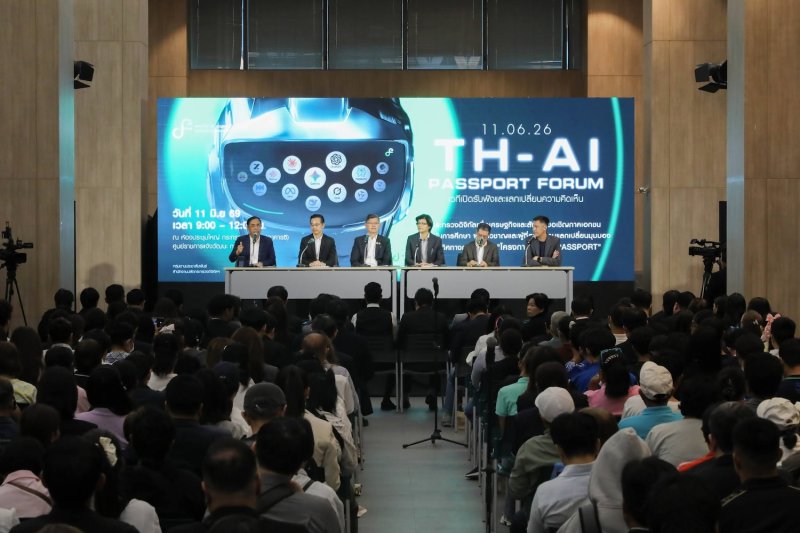
The government’s 1.6-billion-baht TH-AI Passport project could become a focus of a no-confidence debate, according to the People’s Party, which says other projects overseen by the Bhumjaithai Party have followed a similar pattern.
The opposition alleges irregularities in procurement, pricing and project design, but the Ministry of Digital Economy and Society has insisted the scheme complies with regulations and offers value for money.
Pawoot Pongvitayapanu, a People’s Party list MP with a background in technology and online entrepreneurship, questioned the origins of the project, which aims to expand public access to artificial intelligence tools through funding from the Digital Economy and Society Development Fund.
He said the project’s scale appeared to have been determined by the amount of money remaining in the fund rather than by real public demand.
Mr Pawoot said the government first allocated the entire 1.6-billion-baht budget and then calculated a target of five million users based on estimated annual AI usage costs.
“The target did not originate from an assessment of what people actually need,” he said on Wednesday.
The MP also raised concerns over the project’s terms of reference, claiming specifications appeared tailored to benefit certain businesses.
Although the scheme focuses on AI services, he questioned why the terms included requirements related to advertising systems in about 1,500 convenience stores and roughly 6,000 display screens nationwide.
Mr Pawoot said companies involved in setting reference prices and participating in the bidding process had links to the retail advertising sector, raising suspicions that the procurement process may have been designed to favour specific operators.
He said a similar pattern had emerged in projects managed by ministries previously overseen by the Bhumjaithai Party, citing programmes under the Ministry of Higher Education, Science, Research and Innovation and the Ministry of Education.
The lawmaker also criticised the procurement timetable, noting that invitations for bids were announced on Dec 24 during the Christmas and year-end holiday period. He said the process moved unusually quickly, with bidding closing only weeks later.
“The project was opened and closed in just 34 days,” he said, suggesting potential bidders would have needed prior knowledge of the project to prepare proposals in time.
Reports have circulated online that SET-listed Plan B Media Plc developed an Android app called AI Passport, which appeared briefly in the Google Play store before being taken down in October last year.
People who had a chance to review the app said its features were very similar to the TH-AI Passport that was first proposed to the economic cabinet on Nov 8.
Plan B subsequently issued a statement clarifying that it is not involved in the government’s project, nor was it a contracting party or participant in the procurement process.

Direct procurement
Mr Pawoot also questioned why the government did not purchase AI services directly from global providers.
Rejecting claims that direct procurement was impossible, he said governments in countries such as Singapore and Malta had secured AI services directly from technology companies.
Further concerns were raised after comparisons with a similar AI platform developed by the Office of Knowledge Management and Development, which reportedly cost only 2.4 million baht.
Mr Pawoot said the disparity raised questions about why the TH-AI Passport carried a budget of 1.6 billion baht and argued that the difference warranted closer scrutiny.
He also disputed claims that users would receive premium-level AI services, saying the terms of reference suggested the system offered only standard capabilities.
Mr Pawoot also questioned the project’s technical specifications. Although the terms require the system to support 500,000 users per hour, he said this equated to only about 140 per second, which he argued was disproportionately low for a programme targeting r million users.
He also claimed the structure of the terms could allow the winning contractor to generate profits exceeding 1 billion baht. According to Mr Pawoot, AI usage costs would remain relatively low if actual user numbers fell below projections, creating a substantial gap between operating costs and project revenue.
The MP said the issue had already been raised through parliamentary questions and committee inquiries, including discussions by a committee on anti-money laundering.
He said opposition lawmakers would continue scrutinising the project and warned that evidence gathered during investigations could eventually be used in a no-confidence debate against the government.
“There is much more information than what has been disclosed so far,” Mr Pawoot said, adding the project appeared to fit a broader pattern seen in several state programmes.

Chaichanok’s reaction
The allegations were rejected by Digital Economy Minister Chaichanok Chidchob.
Speaking at Government House on Wednesday, he said the opposition was free to seek an investigation immediately and did not need to wait for the project to begin.
He said the ministry’s permanent secretary and state agencies had already reviewed the procurement process and found it complied with all applicable regulations.
The minister said the project represented good value for taxpayers and said negotiations were under way to ensure the government paid only for actual usage if registered users failed to make use of the service.
While welcoming scrutiny from the opposition, Mr Chaichanok insisted ministers should not interfere in procurement procedures, which are handled by responsible agencies and civil servants.
He rejected suggestions that ministers should be held accountable for every stage of procurement, saying his role was to set policy, monitor implementation and ensure projects delivered benefits to the public.