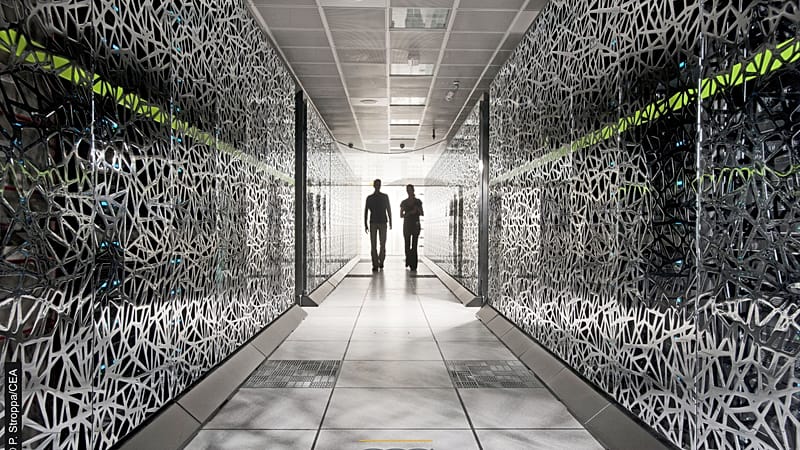
Spain has unveiled its third quantum supercomputer, a 9.8-million-euro investment aimed at speeding up research and artificial intelligence (AI). The Barcelona Supercomputing Center (BSC) has added a third quantum computer, which will be integrated into the MareNostrum 5 system, capable of combining classical supercomputing, artificial intelligence and quantum computing.
The new machine has been designed and built by Barcelona-based company Qilimanjaro Quantum Tech and funded by the European Commission and Spain’s Secretariat of State for Digitalisation and Artificial Intelligence. It is an analogue quantum computer, unlike the two previously installed quantum computers, which are digital.
While classical computers work with bits – which at any given moment can only be 0 or 1 – quantum computing uses qubits, which can represent both states at once. This capability makes it possible to develop far more powerful algorithms and tackle problems that conventional computers can barely solve.
MareNostrum Ona: 53 research projects
The BSC’s three quantum computers are housed in the chapel of Torre Girona, the same space that hosted the first four versions of the MareNostrum supercomputer between 2005 and 2023.
The quantum partition of MareNostrum 5 is known as MareNostrum Ona. Its first two machines, brought online in February 2025, have already clocked up 4,200 computing hours since their launch. This time has been shared among 53 research projects selected through official calls by the Spanish Supercomputing Network (RES).
100% European technology
This new quantum computer will be integrated into the European quantum computing network promoted by the European High Performance Computing Joint Undertaking (EuroHPC JU), the programme through which the European Union aims to strengthen its supercomputing capabilities and develop its own technological infrastructure.
To date, EuroHPC JU has acquired six quantum computers distributed across different European countries. Three of them, installed in Poland, the Czech Republic and Germany, have already been inaugurated and form part of a future network of interconnected systems for scientific research and technological development.
The Catalan government’s Minister for Research and Universities, Núria Montserrat, stressed that the project “reinforces the idea of European technological sovereignty in the face of US ‘big tech’ companies”. “With technologies developed here, in the supercomputer, backed by Catalan and Spanish public policies and major partnerships with Europe, we are able to produce our own European technology in pursuit of strategic autonomy so as not to depend on third countries,” she concluded.
The new computer thus marks a milestone for the Spanish and European tech ecosystem and represents another step on the path towards European technological sovereignty being pursued by EuroHPC and the BSC, in line with the European Commission’s strategy to reduce reliance on key infrastructure from third countries.
This text was translated with the help of artificial intelligence. Report a problem : [feedback-articles-en@euronews.com].