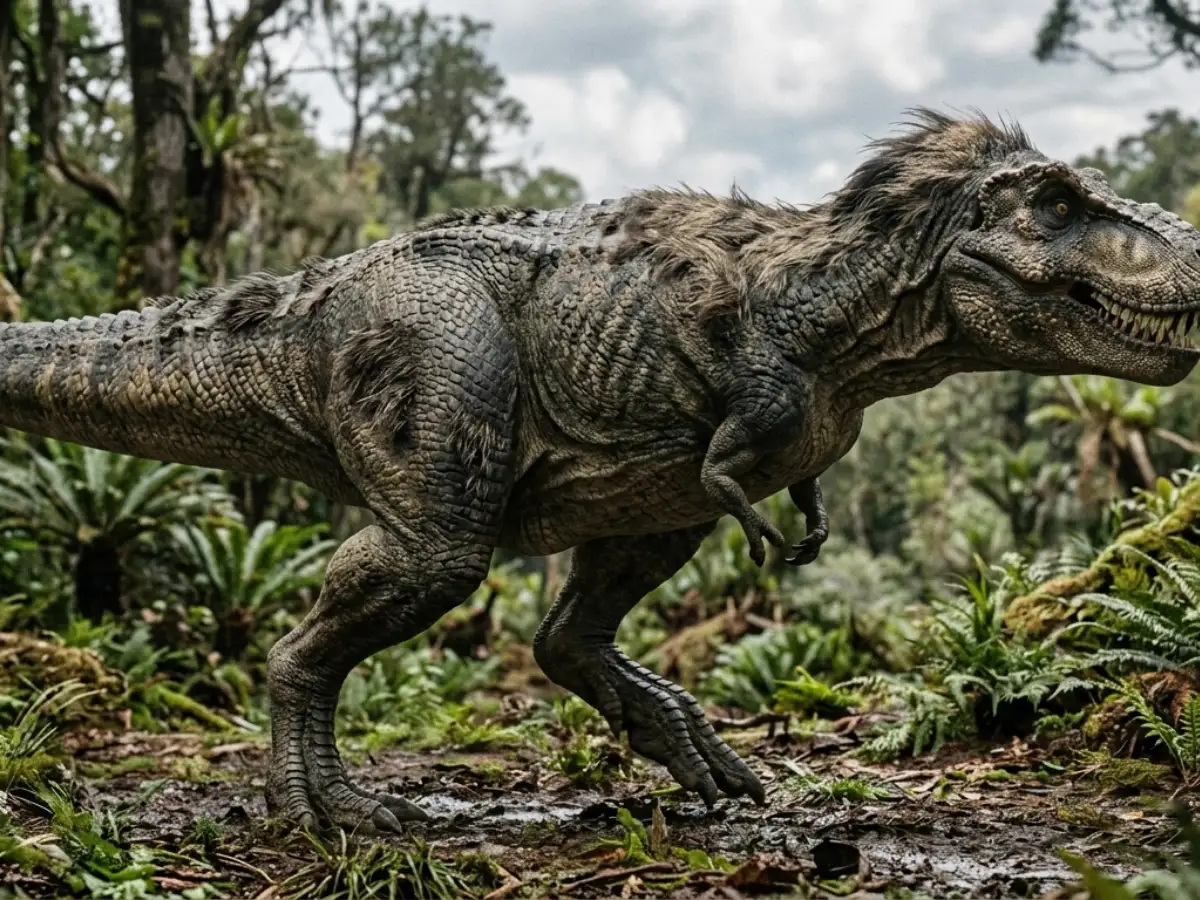
In previous decades, the iconic images of the tyrant king portrayed him either as a classic reptile-like monster, entirely enveloped by scales, or as a huge creature entirely coated in feathers, following the revelation of feathered dinosaurs in China. According to the findings in the fossil records and various modern studies, this is quite far from the truth.
The most recent investigations indicate that the adult T. Rex probably did not possess feathers over its entire body. Rather, the skin impressions discovered reveal that much of its body had scaly skin. Although there may be some exceptions to the rule, where some regions of its body possessed feathers or feather-like structures, the image of a fluffy tyrant remains questionable.
The fossils that reshaped the debate
The most convincing evidence is provided by a 2017 study on tyrannosaur skin fossils published in Biology Letters. The article states that the fossilized patches of skin found in various body locations had pebbly, non-feathery skin texture, as opposed to feather marks. Skin impression samples from the neck, pelvis, and tail areas suggest that the dinosaurs likely had scales and not feathers.
The significance of these fossils is that they provide direct evidence of skin and not inference based on similar creatures. In paleontology, such evidence holds great value since a single skin patch could cause scientists to completely reconsider their decades-long drawings.
The authors note that the findings do not mean that T. Rex had scaly skin everywhere. Instead, they challenge the assumption that a full-grown T. Rex had feathers covering its body. The difference between the two statements is critical since paleontologists tend not to be entirely certain about their conclusions unless they have full-body fossils.
Why feathers once seemed likely
Feathered T. rex was not a completely new concept. Feather-like structures have been found in many theropods, a larger group that contains both birds and tyrannosaurs. Some of the smaller tyrannosauroids, like Yutyrannus, had filamentous coverings, leading some illustrators to envision feathers in all of the tyrannosauroids.
This notion was debunked by another review in Nature Ecology & Evolution, where it was stated that even though feather-like structures could be seen in many dinosaur groups, Tyrannosaurus skin fossils always showed scale-like textures. This means that the theory of feathers in tyrannosaurs is plausible, yet feathers may not be the primary body covering for adult tyrannosaurids.
This is vital information. Fossils do not prove that feathers were fictional creatures or an invention; however, they might have depended on the individual dinosaur's genus, age, habitat, and size.
Why size may have changed everything
There are many reasons why the adults of this species were probably less feathery than previously thought, one of which is biological facts. In general, large creatures tend to differ in thermoregulation. Excess insulation becomes a liability with the size of an organism that achieves great body weight.
According to a recent study dedicated to the topic of tyrannosauroid gigantism, there was likely an evolutionary advantage in discarding an excessive insulating layer since it might result in overheating. While feathers served as good insulation for smaller animals, a nine-ton predator inhabiting the temperate environment of the Cretaceous period did not need such a feature.
One should note the case of elephants. This modern mammal had its ancestors covered with fur but lost it due to evolution. As mentioned above, it seems that the same thing happened to giant tyrannosaurs as well.
Nevertheless, we are still speaking about sparse filaments possibly present on specific areas of a giant or juveniles. For example, it might be the tail or legs.
Why scientists remain cautious
With all these facts, even paleontologists are careful about their interpretations. Impressions of T. rex skin are very rare and provide only small parts of the creature's anatomy. One part of the scaly impression does not equal the whole dinosaur.
As several analyses of the evolution of dinosaur skin show, lack of evidence does not imply that there was no evidence. Hence, paleontologists are very precise when interpreting their results. The best explanation for all known evidence is that skin impressions prove scaling and disprove dense feather covering in adults.
This wording clearly demonstrates the methods used by paleontologists. They first reconstruct extinct organisms using the information obtained through the study of their impressions. Later, after new data emerge, the previous reconstruction can be modified.
A more complicated dinosaur picture
The controversy over T. rex, therefore, also holds important lessons for how dinosaurs evolved. Feathers and scales need not be considered mutually exclusive characteristics. It is likely that different dinosaur species combined aspects of both.
New research on the microstructure of dinosaur skin indicates that there is no reason why scales resembling those found on reptiles should not have coexisted with feather evolution throughout the theropod lineages. Some dinosaur species would have had scales covering their bodies in all places save certain regions where feathers had evolved. In other dinosaurs, it is possible that feather development occurred over millions of years through changing physical conditions and body sizes.
The present state of science regarding T. rex indicates that the dinosaur was neither a completely feathered beast, as previously thought, nor just a lizard-like dinosaur that never evolved to acquire any other kind of body covering. Instead, based on fossilized remains, the most likely scenario is that T. rex was a massively scaled predator with possibly some remnants of filaments in particular parts of its body.