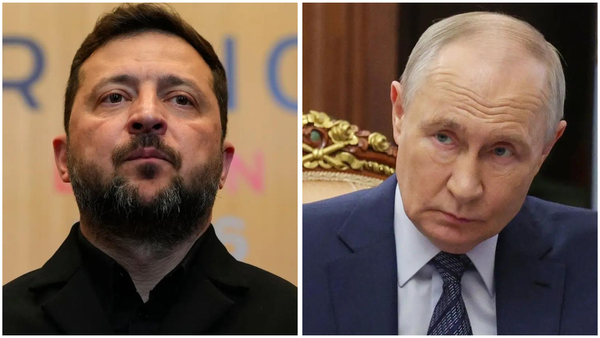
Last week, ambassadors from the so-called E3 — France, Germany and the UK — made a rare visit to Moscow to discuss ending its invasion of Ukraine. Sergei Lavrov, Russia’s pugnacious foreign minister, didn’t deign to receive them; his deputy instead lectured them with “an objective assessment of the destructive policies of the West.”
Objectively, Russia is doing the destroying. Objectively, Lavrov — let alone his deputy — is out of the loop when it comes to the Kremlin’s negotiations on Ukraine. Objectively, once again, the ambassadors’ delivery of Ukrainian peace terms and call for direct Moscow-Kyiv talks was never going to work. This was a doomed mission that seemed only to provide further evidence of Europe’s geopolitical incapacity and irrelevance. But the ambassadors and their leaders did the right thing: We need more such visits.
Solving the war between Russian and Ukraine won’t be quick or easy, to say the least, given President Vladimir Putin’s apparent illusions about the progress his troops are making and the deep clash of world views that his 2022 invasion reflected. Europe cannot possibly be the mediator, because it is a participant in the war — one thing the Kremlin is right about — so this conflict is therefore Europe’s problem, and the Old World must be involved in negotiating its end. Finding a stable place for Russia in Europe’s political and security architecture will be the ultimate test of Europe’s bid for strategic autonomy in a post-American world.
The void in European diplomacy has been filled by the E3 before, in the early years of international nuclear negotiations with Iran. And neither Europe’s wealthy markets, nor Russia’s plentiful energy and mineral resources are going anywhere. They will find each other again and in many ways, for skeptics such as myself — and certainly for Putin — Europe’s conduct in this war has been as surprising as Ukraine’s.
Russia’s invasion of its smaller neighbor has now lasted longer than both World War I and the Soviet Union’s role in the World War II. This feat is a tribute to Ukraine’s people and soldiers, but it would not have been possible without European (and US) support for Kyiv. In the latest reminder of this fact, Britain’s Royal Marines on Sunday boarded and seized an oil tanker from Russia’s sanctions-busting shadow fleet, as it tried to pass through the English Channel. So when will the right time come for Ukraine to negotiate peace if not now?
The hard part is getting Putin to the point where those talks can be productive. No one can be sure where that point lies, but lately Ukraine has been delivering on the military incentives that are a minimum requirement to make it happen. The rest can only come from Kyiv’s allies, because for Russia this conflict was never just about Ukraine.
This is vital for both Kyiv and Europeans to recognize, because Moscow’s responses will become less predictable should Putin begin to sense a strategic defeat. For a parallel, just look at President Donald Trump’s erratic behavior as he faces a similar frustration of his goals by another weaker foe, in Iran.
Over the past few months, Kyiv’s drones and soldiers have stopped Russia’s summer offensive before it could begin. They’re also inflicting an increasingly brutal price on Russian personnel and supply lines, while a rapid expansion of long-range strikes brings the reality of Putin’s so-called Special Military Operation home to ordinary Russians.
As Hal Brands wrote in a Bloomberg Opinion column on Friday, that isn’t to say Ukraine is winning the war, or that Russia won’t again catch up with Ukraine’s technological innovations. This is a cycle we’ve seen before. What’s different this time, though, is that the pressure comes as Putin’s remarkably resilient economy has hit the bumpers, more Russians say they want a peace deal than continue the war, and a much higher proportion of Ukraine’s offensive arsenal is today built at home, making it less dependent on foreign aid and whims.
Taken together, these changes have allowed Kyiv to dictate the narrative again, which can at times be just as consequential as what’s happening on the ground. Russia had ownership of the story since early in 2024, persuading much of the world that every day fighting continued could only mean more losses for Ukraine; Kyiv now aims to persuade Russians that continuing to lose 35,000 dead and wounded per month is pointless.
Putin still refuses to acknowledge he can fail in Ukraine, but a debate has begun among Russia’s elite that is simultaneously promising and worrying.
The hopeful part is that some in the Kremlin’s approved foreign policy community have begun to discuss publicly how to end the war. They know this has to be framed as victory, so the main question is how to sell it as such. A year ago, even this would have been unimaginable.
Dossier Center, an investigative nonprofit founded by the exiled Russian oligarch Mikhail Khodorkovsky, said last month it had seen a presentation on the subject, which allegedly was put before top officials in the Kremlin’s administration earlier this year. The line that Dossier cited from the purported Kremlin briefing read: “WE MUST KNOW WHEN TO STOP. Too much is a defeat; continuing the SVO (Special Military Operation) would be a Pyrrhic victory.”
This would be less plausible if it didn’t echo other Russian commentary. Vasily Kashin, a Moscow-based China expert once vocal in his support for the war, has sparked a fierce debate among top Russian analysts in the Kremlin’s orbit by writing that the war should stop because it cannot realistically be won and is eating up resources that should be preserved for a coming fight with Russia’s true enemy, Europe.
And that’s the concerning part. First, even the analysts making the case for halting the war argue for the Kremlin to accept a Russia-friendly proposal Ukraine already rejected for compelling reasons, as though this were a concession. Second, they do so with the explicit goal of keeping Moscow’s powder dry for a coming conflict with Europe.
In the most extreme form of this argument, former Putin adviser Sergei Karaganov continues to tell anyone who’ll listen — most recently the perpetually gullible Tucker Carlson — that this is a war Europe launched against Russia, and can end “only when Russia achieves the total defeat of Europe — hopefully without eliminating Europe.” He described the other half of his continent as “the source of all ills and all evil in the history of humanity,” and went on to argue that unless Europe backs off its support for Ukraine, Moscow should attack Germany and the UK, first conventionally and then with “waves of nuclear strikes.”
Karaganov’s views are longstanding. They’ve gone unheeded, because the risks and costs of using nuclear weapons for offensive purposes outweigh any potential benefits. That has long made Moscow’s threats a bluff best ignored, as I’ve argued before. But with a strategic defeat now in the realm of possibilities for Putin, the temptation to attack Ukraine in its European logistical rear will rise sharply. That’s an escalatory ladder that has many rungs, from cyberwarfare to cutting undersea communications cables, before reaching its nuclear top. Every step, however, is damaging and tends toward the next.
Fyodor Lukyanov, the more cautious and thoughtful chairman of Russia’s Council on Foreign and Defense Policy, writes in the current issue of the country’s main foreign affairs journal that it is an anomaly of the way the Cold War ended that the West believes today a nuclear superpower can be defeated without it resorting to the use of its most potent weapon. “Such confidence is dangerous, as lessons from the previous confrontation are drawn not only by the winners, but also by the losers,” writes Lukyanov. “And the latter now recognize that circumvention of the nuclear factor must be made impossible.”
I can no longer interview Lukyanov or Kashin, but I know them well enough to believe their goal is to keep Russia’s feet off the nuclear-escalation ladder. The Russian complaint is that its interests cannot be ignored in Europe just because it is weaker than its Soviet predecessor.
The Western counter argument is, in essence, that Moscow’s current leadership confuses Russia’s legitimate 21st century rights and interests with those of the 20th century Soviet Union and 19th century Russian Empire.
Yes, Europe and the US alike have been guilty of negligence and strategic incompetence in dealing with Moscow since the Soviet collapse, but the decision to invade Ukraine was Putin’s alone. He, Karaganov and many others in Russia remain trapped by the historical delusions and resentments that tend to come with loss of empire. The combination is indeed dangerous, as the current bloodshed proves. So there’s a discussion much broader than Ukraine that Europeans must at some point have with Moscow, if Russia is to give up on war.
This is not a matter for European mediation in Ukraine. It’s about Europe first deciding, collectively, how to accommodate Russia’s legitimate interests, and then negotiating that deal without again dividing the continent — or feeding Moscow’s revisionist ambitions. It isn’t clear how that can be achieved, only that it must be done.