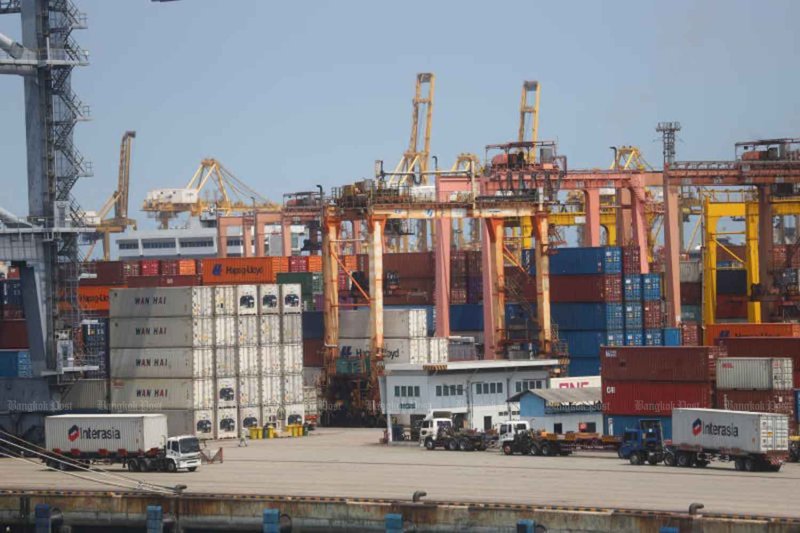
The trade deficit hit an all-time high in April of about US$10 billion, as imports surged 45% year-on-year to $41.6 billion, driven by shipments of raw materials, semi-finished products, capital goods, and energy, according to the Trade Policy and Strategy Office (TPSO) under the Ministry of Commerce.
Exports in April surged 23.1% to $31.5 billion, while imports grew 45% to $41.6 billion, both marking all-time highs. This resulted in a trade deficit of $10.02 billion, said Nantapong Chiralerspong, director-general of the TPSO.
During the first four months of 2026, exports jumped 19% to $127.7 billion while imports increased about 36% to $147.2 billion, resulting in a trade deficit of $19.5 billion.
In April, Thailand posted a trade deficit of $7.68 billion with China, and a deficit of $29.2 billion in the first four months. The deficit was mainly driven by imports of electrical machinery and components, and machinery.
Meanwhile, the country recorded a trade surplus with the United States of around $4.65 billion in April and $21.5 billion in the first four months of the year.
In April, imports of raw materials and semi-finished products totalled $17.6 billion, up 39% year-on-year. Key imports included electrical circuit boards and transistors.
The country also imported capital goods valued at $10.3 billion, a 32.8% year-on-year growth and energy of $8.39 billion, a 128.6% increase.
Kasikorn Research Centre (K-Research) raised concerns that escalating imports at twice the growth rate of exports could lead to Thailand recording a trade deficit for 2026.
Following the release of export-import data for the first four months, the think tank sees the possibility that Thailand might turn from a trade surplus to a deficit this year.
“Last month’s figures showed that imports surged two times higher than exports. If this trend continues, meaning imports grow at a significantly higher rate than exports, the trade surplus could be very slim at the end of the year or even turn into a deficit,” Nuttaporn Triratanasirikul, deputy managing director of K-Research, told the Bangkok Post.
EXPORTS TO KEY MARKETS SURGE
The TPSO revealed that exports to key markets rose 24.8% year-on-year in April. Shipments to the US surged 44.2%, while exports to China grew 21.9%.
Exports of industrial products expanded by 27.5% year-on-year in April with strong growth in computers and peripherals, phones and components, machinery and parts, and gems and jewellery.
The agricultural sector has returned to growth, supported by Thailand’s fruit harvest season and continued demand for agricultural products.
In terms of export growth, Ms Nattaporn said it is partly driven by companies accelerating their overseas shipments after the US ruled that President Donald Trump’s sweeping global tariffs are unlawful and the new proposed taxes are not yet in place.
Overseas shipments, however, are only concentrated in the electronic component sector in line with the surging global trend of artificial intelligence. Vehicle exports also improved slightly.
EXPORT OUTLOOK
The TPSO projected three scenarios for Thai exports.
In the worst-case scenario, exports could decline by 3% to $329.4 billion, pressured by the ongoing energy crisis, shipping route disruptions, rising costs, container constraints, uncertain US tariffs, and a slowdown in the technology cycle goods sector.
Under the base case, exports are projected to grow by 3%. While the global economy remains sluggish, the electronic technology goods sector is still expanding. For 2026, the export value is projected at $349.8 billion.
In the best-case scenario, exports could grow by 8% to $366.8 billion, supported by strong front-loading activity in the first half of the year and sustained growth in electronic products. A resolution of shipping and container issues would further boost performance.