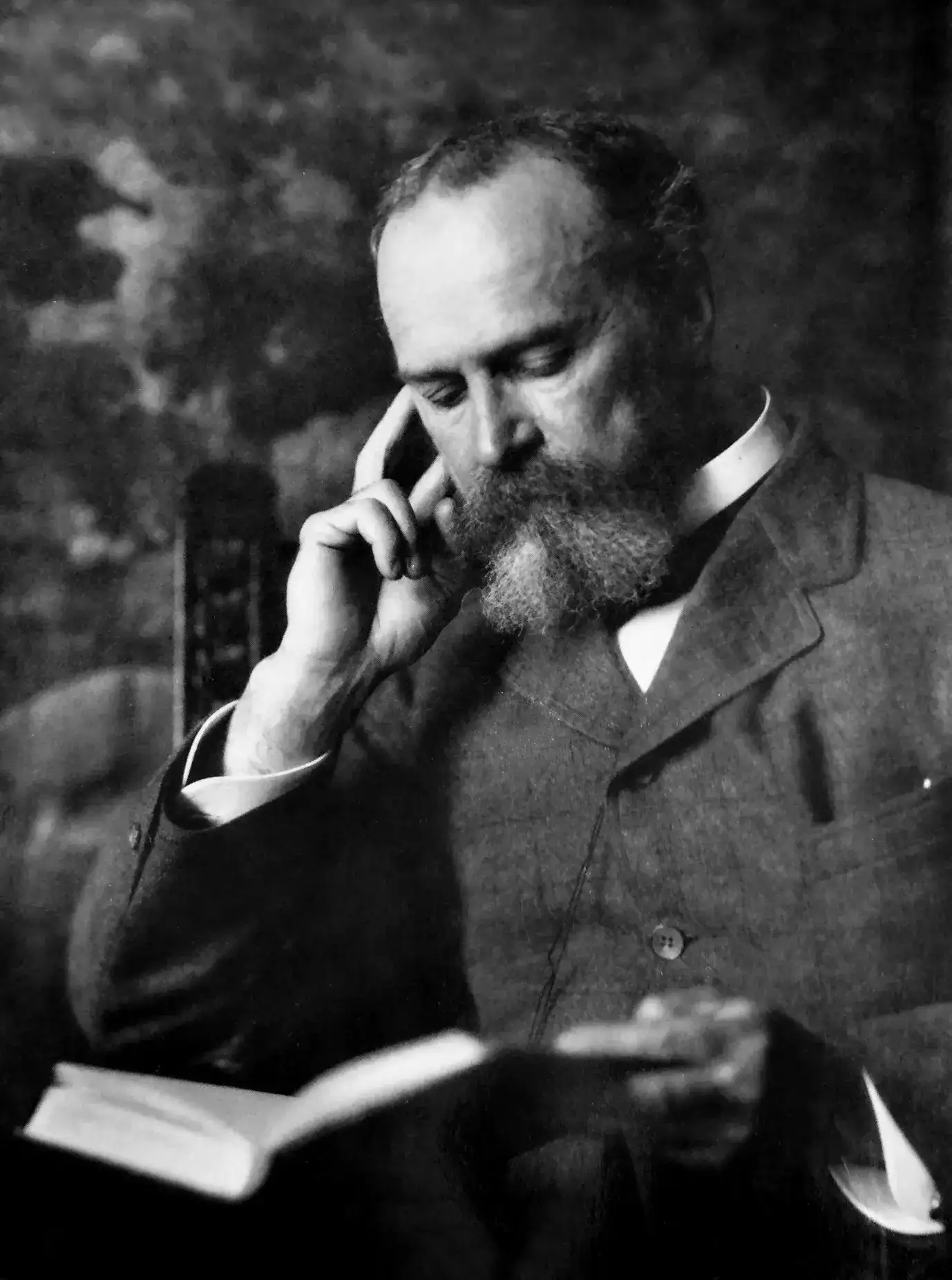
Quote of the Day by William James: The year was 1898. A man named William James stood before a packed auditorium at Harvard, not just as a professor, but as someone who had fought his own demons — depression, chronic illness, and a near-suicidal crisis in his twenties — and come out the other side with a radical conviction. He believed that the human mind was not a passive receiver of life. It was, instead, the sculptor of it. And nowhere did that truth cut deeper than in how we handle conflict with the people we love.
His words still echo today: "Whenever you're in conflict with someone, there is one factor that can make the difference between damaging your relationship and deepening it. That factor is attitude."
Most people read that quote and nod. Few truly understand what William James meant. This was not motivational fluff. This was the conclusion of a man who had studied the architecture of human consciousness for decades.
Attitude, in the philosophy of William James, was not a mood. It was a decision — a deeply intentional act of will that shapes not just how we feel, but what we see, what we do, and ultimately, who we become in the presence of others. Attitude shapes relationships in ways that therapy, apology, and good intentions alone never can. It determines whether conflict becomes a wall or a door.
Quote of the Day on Philosophy of Mind by William James: Why Attitude Is the Hidden Architecture of Every Relationship
William James spent years studying what he called the "stream of consciousness" — the living, breathing, ever-moving current of thought that runs through every waking moment. What he discovered was unsettling in the best possible way: we do not experience the world as it is. We experience it filtered through the lens of our prevailing attitude.
Think about a real argument between two people who love each other. One person enters the room having already decided the other is unreasonable. Every word spoken confirms what they already believe. The other enters genuinely curious, wondering what they might have missed. The same words land completely differently. Same conversation. Two entirely different realities. William James would say that attitude shapes relationships precisely because attitude shapes perception — and perception, not reality, is what human beings actually respond to.
This is why attitude in conflict is not a secondary concern. It is the primary one. A wrong attitude makes every right word land wrong. A right attitude makes even a clumsy apology feel sincere.
James witnessed this in his own marriage to Alice Howe Gibbens, where the friction of two strong-willed minds was navigated not through silence or submission, but through a determined posture of goodwill. That posture — that attitude — was what kept curiosity alive between them for decades.
The Real Lesson William James Taught About Conflict Resolution and Human Psychology
In 1890, James published The Principles of Psychology , a 1,400-page masterwork that changed the way the Western world understood the human mind. In it, he wrote something that most people overlook: "The greatest weapon against stress is our ability to choose one thought over another." This was not poetry. This was psychology. Attitude shapes relationships because thought — which attitude governs — is where all human behavior begins.
James had a close and legendary friendship with the philosopher Charles Sanders Peirce, a man of extraordinary brilliance and equally extraordinary personal chaos. Peirce burned bridges, fell into poverty, and alienated nearly everyone around him. James never abandoned him. He quietly arranged academic lectures for Peirce, funneled money to him, and advocated for his work. When people asked why, James said something simple: he chose to see the mind, not the mess. That was attitude in action. That choice — made again and again across decades — is what made the relationship last. It is what deepens relationships while others dissolve.
There is also the story of James and his student, the philosopher George Santayana, with whom he had deep intellectual disagreements. Santayana later recalled that James never made him feel wrong for thinking differently. He made him feel heard . That is the alchemy that attitude produces in conflict — it converts disagreement into dialogue, and dialogue into depth. Attitude shapes relationships not by eliminating friction, but by changing what friction produces.
William James, His Life, and the Other Wisdom That Shaped a Generation
Born in New York City in 1842 into one of America's most intellectually restless families — his brother was the novelist Henry James — William James did not follow a straight path. He studied painting, then medicine, then drifted into a crisis of meaning so severe he described one period as feeling like a man who could not trust the ground beneath his feet. He recovered not through willpower alone, but through a philosophical breakthrough: he decided to act as if free will were real. That decision changed everything. It became the seed of Pragmatism — the distinctly American philosophy that says the truth of an idea lies in what it does to your life.
That same philosophy underlies his insight on attitude and relationships. Attitude shapes relationships not because it is always accurate, but because it is always productive . A suspicious attitude produces guardedness. A generous attitude produces openness. And openness is where real conflict resolution lives.
His other famous quotes are worth sitting with. "Act as if what you do makes a difference. It does." This is the man who believed that our smallest daily choices ripple outward into the shape of our character. "Pessimism leads to weakness, optimism to power" — not because the world is always good, but because the mind that expects possibility will find it. And perhaps most relevant here: "The art of being wise is the art of knowing what to overlook." In conflict, that art is everything. Knowing what to overlook is not weakness. It is the highest form of relational intelligence. It is attitude exercised with precision.
How Attitude Resolves Conflict and Transforms Lives: What Modern Research Confirms
Decades after James, psychologist John Gottman spent forty years studying couples in conflict. His findings aligned almost eerily with the philosophy of William James. Gottman found that the single biggest predictor of whether a relationship survives conflict is not the topic of the argument, but the emotional posture each person brings. He called it the "positive sentiment override" — the tendency, rooted in attitude, to interpret ambiguous actions charitably rather than suspiciously. Attitude shapes relationships, in Gottman's data, with more predictive power than communication skills, shared values, or even love.
What this tells us is that attitude in conflict is not a soft skill. It is a survival skill for relationships. James would not have been surprised. He wrote in 1902, in The Varieties of Religious Experience , that the deepest transformations in human life come not from changed circumstances but from changed perspectives. People who survive the hardest conflicts — the betrayals, the losses, the long silences — are almost never those who had the easiest circumstances. They are those who carried a certain attitude into the hardest rooms. Attitude shapes relationships because it shapes the person doing the relating.
The practical lesson is this: before you walk into the next difficult conversation, ask not what will I say , but who will I be when I say it . Will you be someone arriving to win, or someone arriving to understand? The answer to that question — that single choice of attitude — is the factor William James identified more than a century ago. It is the factor that determines whether conflict becomes a wound or a turning point. In the end, attitude is not what you feel. It is what you choose. And that choice, made consistently, is what transforms not just your relationships, but your life.
William James (1842–1910) was an American philosopher, historian, and psychologist — widely regarded as the father of American psychology. His major works include The Principles of Psychology (1890), The Will to Believe (1897), and The Varieties of Religious Experience (1902). His philosophy of Pragmatism continues to influence psychology, education, and philosophy worldwide.