In 2011, I spent an entire week after school trying to pair an ancient Samsung Galaxy tablet with a Chromecast plugged into the back of a brand-new six-foot interactive whiteboard at my school in Thailand.
I genuinely believed technology was about to revolutionise education. The dream was glorious in my head. I would roam the classroom with a tablet, photographing student work, annotating it live with a stylus and instantly projecting it onto the board like some futuristic teaching pioneer.
In reality, it was a disaster. The Chromecast refused to cooperate. The tablet lagged constantly. Nothing worked properly. But I persisted because I believed I was standing at the cutting edge of teaching. For a long time, many of us believed that.
Then came Covid-19 pandemic. I returned from a ski trip in Japan just as whispers of a new virus began circling the globe. At Narita Airport, everyone wore masks. A week later, our school sent us home midway through the day because we had recently been in Japan. Soon afterwards, schools around the world attempted the impossible: moving education online.
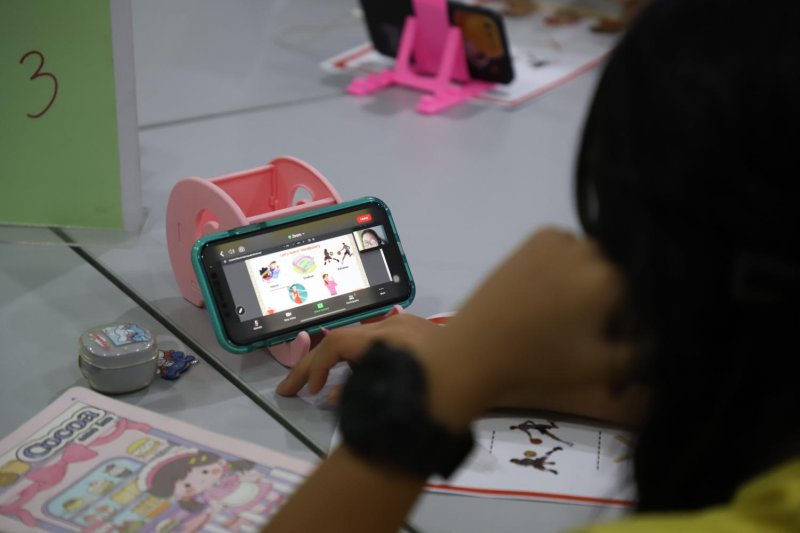
Like most teachers, I tried. We all tried. But beneath the flood of online meetings and enthusiastic LinkedIn posts about "reimagining learning", many of us quietly knew the truth. Online learning was largely performative. Schools were trying to preserve the appearance of education while parents continued paying fees. My own daughter was 11 at the time. She spent hours alone in her bedroom attempting online PE lessons while heroic teachers tried to become fitness influencers through a webcam. Nobody's fault. But also: not real school.
More importantly, Covid normalised something that has never truly gone away. Every child suddenly needed a device at all times. Once every child had a device, the devices never left. Now, in 2026, many schools still insist children need screens permanently attached to their learning experience. I recently read about a school in the UK charging parents £600 (26,293 baht) for compulsory school-managed iPads. One parent objected and, reportedly, their child lost their place because they were considered "incompatible with the learning environment".
Ten years ago, I would have loved this vision of the future. Every student connected digitally. Instant collaboration. Infinite resources. The reality is less inspiring. Many classrooms now resemble open-plan offices for exhausted middle managers. As a science teacher, I am expected to teach lessons where every student has an iPad open on their desk, but the first thing I now say in most lessons is: "Put them away. You don't need them." Instead, students write the title and date carefully into their books. They underline them with a ruler. They complete a short "Do Now" task. If a diagram is untidy, they redo it. Some people hear that and think it sounds antiquated. I think it sounds human. Because classrooms need rhythm and ritual. The physical act of opening a notebook, writing carefully and beginning deliberately creates something technology rarely does: presence. A lesson should feel different from scrolling TikTok in bed.
About 18 months ago, I stopped routinely using devices in my classroom. The difference was immediate. Before that, I spent huge portions of lessons policing screens. Apple Classroom, admittedly an impressive piece of software, allowed me to monitor every student device in real time. At one point I even projected miniature live previews of every student screen onto the interactive whiteboard. Think about how absurd that is. Children sat staring at screens while a giant screen at the front displayed more screens showing what everyone else was doing on their screens. Even with notifications disabled, the temptation remained irresistible. Students developed lightning-fast reflexes for flicking between apps: Snapchat, Spotify, YouTube, Netflix. Endless tiny digital dopamine machines humming away beneath every worksheet. And the worst part was that I gradually became less of a teacher and more of an air traffic controller for distraction.
Eventually, after nearly 20 years in Thailand, I interviewed for a role in Spain. During the interview, the principal asked me about educational technology. Ten years earlier, I would have delivered an evangelical TED Talk about innovation. Instead, I said this: "I'm an early adopter. I love technology. But enough is enough." Our children deserve eight hours a day without devices. Not because technology is evil. Quite the opposite. Good technology is astonishing. Recently, I was welcoming students into class when one pointed out of the window. "What's that?" "Is it a rat?" "No," another student laughed. "It's a Pokémon." It was a squirrel.
These students attended a beautiful rural campus in Thailand surrounded by extraordinary biodiversity, yet many could not identify a squirrel. They did not know the trees around them or the birds outside their classroom windows. So I told them to go and get their iPads. In pairs, we went outside and used iNaturalist to identify species around the campus. Within an hour, students had catalogued nearly 40 different species. Suddenly they were crouching beside insects, debating leaf shapes and pointing excitedly at birds. This time, the technology was not replacing reality. It was revealing it. That is what classroom technology should do. It should augment wonder, not replace attention. It should deepen reality, not compete with it. An iPad should not merely become a very expensive worksheet dispenser. It should help children see the world more clearly. Pens, pencils and rulers may seem old-fashioned in comparison, but perhaps they are the educational equivalent of life vests: simple, unfashionable tools that stop children disappearing beneath the waves of permanent digital distraction.
Paddy Mckenna is Head of Experential Learning at Regents International School Pattaya.