
Michael Schumacher’s Formula 1 career was made legendary by his fantastic racecraft and record-breaking success, but also some questionable moves – one of which occurred on 27 May 2006.
Going into the 2006 Monaco Grand Prix, Schumacher was already facing a 15-point deficit to championship leader Fernando Alonso, with a race win worth 10 points at the time.
This was the consequence of the reigning champion’s extremely strong start to the season, with three victories and as many second places in six races, while Schumacher finished a lowly sixth in Malaysia and crashed out of the Australian GP.
Monaco’s free practice sessions, albeit obviously not fully representative of the pecking order, showed Renault’s speed again as Alonso topped two sessions and outpaced his title rival in all three.
McLaren’s Kimi Raikkonen was fastest from Alonso in Q1 and Q2, with Schumacher down in 13th and fifth respectively – which heralded a tough race for the seven-time world champion on a track where overtaking is harder than anywhere – albeit less than a tenth away from the Spaniard in the second segment.
As was the case when the new Q1-Q2-Q3 format was introduced, the somewhat shortsighted new regulations meant the first part of Q3 was dedicated to fuel-burning.
Raikkonen eventually set the first competitive lap time in 1m14.140s, which Schumacher improved upon with a 1m13.898s. Alonso couldn’t match that benchmark, settling for a 1m13.980s on his first attempt.

After changing tyres, drivers had time for one final flying lap. But Schumacher was 0.190s adrift coming into sector three. At La Rascasse, the Ferrari veered straight towards the wall, stopping inches away from the barrier. The consequent yellow flag meant Alonso failed to surpass his rival by 0.064s.
“The first try was good, not perfect,” Schumacher commented in the post-qualifying press conference. “I saw my sector times just basically on the same area [on the second run].
“It was unfortunately just a touch too much. I came into, I think it’s called Rascasse the second-last corner, I locked up the front and then went wide. I wasn’t sure what was going on after this, because, positioning of the cars and so on, I was not aware.
“In the end, I checked with the guys, ‘What’s the situation, where did we end up?’, because obviously I didn’t expect to be sitting here right now in this position, and they said ‘P1’, so obviously I was glad with all this… what happened.”
This did not convince journalists, who pressed Schumacher further. “No, I didn't cheat – and I think it is pretty tough to be asked if I did,” he retorted.

“It was a touch too much going into that final corner. I didn't know I was fastest, so I was really pushing on that lap.
“I came into the bend hard, locked up the front and went wide. I checked with the guys what position I was and they said P1.
“At the start I hadn't stalled the car but it was impossible to reverse because of the traffic behind me. There were cars coming behind me, I knew it, but I couldn't see them well enough to judge when to pull out. Then the engine stalled.
“Whatever you do in certain moments, your enemies believe one thing and the people who support you believe another.”
But the move still raised suspicions in the paddock, especially at Renault.
“It wasn't like he hit the barriers – he just parked the car. I can't believe it,” team principal Flavio Briatore fumed.
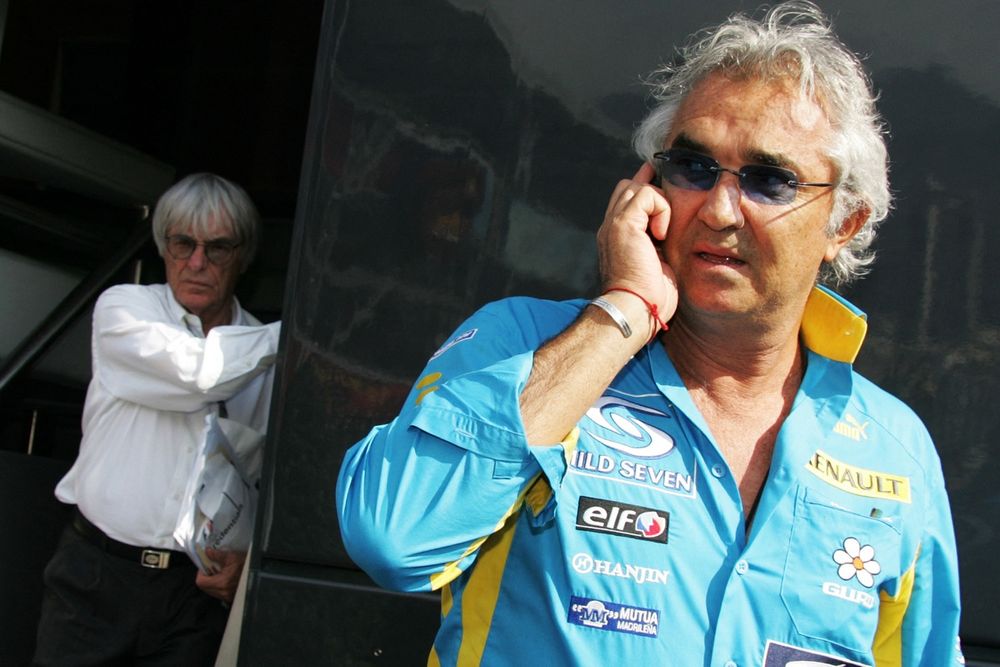
“I don't know why he needed to do it. I think he is taking everyone for a ride. Someone who was seven times a world champion wants us to believe that he didn't do it on purpose – it's fairyland.”
After an eight-hour inquiry, stewards disqualified Schumacher from the session, with Ferrari team principal Jean Todt furious about the decision.
“We totally disagree with it,” Todt said. “Such a decision creates a very serious precedent, ruling out the possibility of driver error.
“Michael was on his final timed lap and was trying to put his first place beyond doubt, as could be seen from the fact that his first split time was the best.
“With no real evidence, the stewards have assumed he is guilty.”

Schumacher never openly admitted guilt, but Sky Sports documentary The Race To Perfection, released in 2020, cast a new light on the incident.
“We had a meeting with the team, we were talking about the qualifying,” Felipe Massa, Schumacher’s Ferrari team-mate in 2006, then related. “Then you had two sets of tyres for the qualifying. And Michael said something: ‘Yeah but, I mean, if we are quicker straight away and then we go in for the second set…’
“And Ross Brawn said: ‘Maybe we can create a yellow flag’. And I said: ‘For fun. Not seriously, for fun’.
“It happens, exactly that. So Michael used that funny thing for him to do.
“I remember [after] that meeting, I said ‘I can’t believe he did it’. He did it. And then the only thing is he was not able to say that he did it.”

Massa added: “It took one year for him to tell me that he did it on purpose. One year. I said, ‘How can you do that?’
“It shows that everybody makes mistake in life, and this was, definitely.”
Then Ferrari’s technical director, Brawn added in the documentary: “Michael had occasional aberrations, things that you could never give a logical explanation for. He had this incredible competitiveness that drove him. And sometimes it would short-circuit.
“Monaco pole, it’s normally a given you want it. But on that occasion, with the strategies that we had and the tyres we had and the car we had, there was actually no need for it. It was just a stupid move. And one of those little glitches, short-circuits that Michael had two or three times in his career.”

Alonso went on to comfortably win the race, as Schumacher fought his way through the pack from 22nd to fifth.
The Renault driver’s 21-point lead after Monaco, which he increased to 25 in the next two grands prix, was eventually made up by Schumacher with two rounds remaining – but Alonso still prevailed.