
/NVIDIA%20Corp%20logo%20on%20phone%20and%20AI%20chip-by%20Below%20the%20Sky%20via%20Shutterstock.jpg)
Artificial intelligence is moving at a pace that would have seemed impossible just a few years ago. New models arrive every few months. Computing requirements keep rising. Companies across health care, finance, manufacturing, and software are racing to adopt AI before competitors gain an edge. But what happens when the technology advances faster than the infrastructure supporting it?
That's the question investors should be asking about Nvidia (NVDA). The AI leader has spent the last three years setting the pace for the industry. Yet as CEO Jensen Huang unveils increasingly powerful products, a new concern is emerging: Nvidia may be accelerating faster than memory suppliers, electric utilities, and even customers can keep up.
Nvidia Keeps Expanding the AI Frontier
Nvidia's latest announcements show a company operating at full throttle.
Speaking recently about the upcoming Vera Rubin platform, Huang said the next-generation AI system is already in full production. He also noted that Nvidia's supply chain supporting Vera Rubin is roughly twice the size of the one built for Grace Blackwell. Just as important, assembly efficiency has improved dramatically. What previously took two hours to assemble a Grace Blackwell rack now takes approximately five minutes.
Those numbers tell investors something important. Nvidia isn't preparing for demand growth. It's preparing for an explosion in demand.
The company is simultaneously pushing AI beyond the data center. Nvidia and Microsoft (MSFT) recently unveiled RTX Spark systems designed to bring agentic AI directly onto personal computers. The goal is ambitious: desktops, laptops, workstations, and enterprise PCs capable of running advanced AI agents locally rather than relying entirely on cloud infrastructure.
In short, Nvidia isn't just building chips anymore. It's attempting to create an AI ecosystem that reaches every layer of computing.
The Bottlenecks Are Starting to Appear
Granted, technological leadership has been Nvidia's greatest strength. But every technological leap creates new pressure points. One of the most obvious is memory.
Agentic AI workloads require enormous amounts of high-bandwidth memory. Yet the memory industry is already struggling to keep pace with current AI demand. Prices for advanced memory products have risen as supply remains constrained. If AI-enabled PCs become mainstream, memory demand could rise even further.
Power presents an even larger challenge. Each generation of Nvidia hardware delivers more computing capability, but it also requires more electricity. Data centers are already becoming one of the fastest-growing sources of power demand globally. Utility companies across the U.S. have warned that AI-driven data center growth is forcing revisions to long-term electricity forecasts.
Every input must expand alongside Nvidia's technology roadmap. From compute demand, HBM supply, and electricity needs to data center construction and consumer electricity costs, they are all rapidly rising but the infrastructure is straining to keep pace.
Success Could Create Its Own Problems
Surprisingly, Nvidia's biggest risk may not be competition from rivals such as Advanced Micro Devices (AMD), Intel (INTC), or custom AI chips from Microsoft and Amazon's (AMZN) AWS. The bigger challenge could be whether the surrounding ecosystem can scale quickly enough.
A shortage of memory can delay system deployments. Insufficient power generation can slow data center expansion. Rising electricity costs can reduce the economic benefits of AI projects. Even if Nvidia delivers every chip customers want, those customers still need the infrastructure to use them.
That doesn't mean Nvidia's growth story is broken. Far from it. The fact that the company is doubling supply-chain capacity for Vera Rubin suggests management sees demand extending well beyond today's levels.
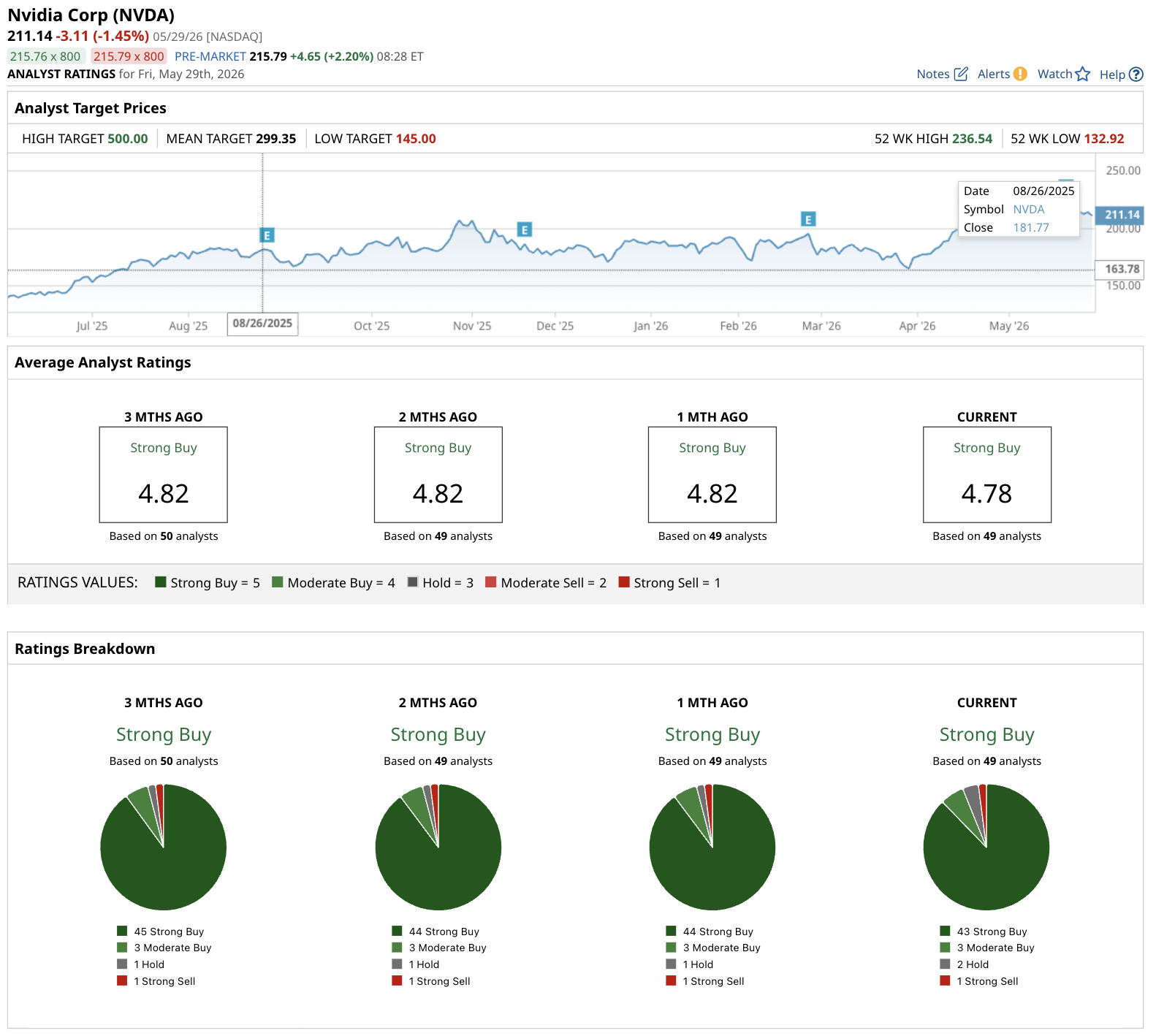
Wall Street is fully on board with a “Strong Buy” recommendation. Of the 49 analysts rating the stock, fully 43 have a “Strong Buy” recommendation, three have a “Moderate Buy” rating, and two recommend to “Hold.” Only one brave soul says “Sell.” The mean price target set of $299.35 implies 33% upside potential from current levels over the next year.
Key Takeaway
Nvidia's problem isn't a lack of demand. It's almost the opposite. Huang and his team continue pushing AI hardware forward at a remarkable pace. Vera Rubin promises more performance. RTX Spark aims to bring agentic AI to millions of PCs. Manufacturing capacity is expanding faster than ever.
Yet, investors should pay attention to the bottlenecks forming around memory, electricity, and infrastructure. AI is transforming industries so quickly that shortages seem to emerge at every intersection.
For shareholders, that's an unusual position to be in. Nvidia isn't waiting for the future to arrive. It's building it. The question is whether the rest of the economy can catch up quickly enough.