Closing summary
-
Donald Trump is disappointed that Nato allies refused to become more actively involved in attacking Iran, the US secretary of state has said, setting up what could become a fraught summit of the alliance in July. Marco Rubio, meeting with foreign ministers of the military alliance, emphasised that he expected the rift would be discussed at the July meeting in Ankara, making the summit “one of the more important” in Nato’s 77-year history.
-
Nato allies and defence officials expressed bewilderment on Friday at US president Donald Trump’s announcement that he would send 5,000 troops to Poland just weeks after ordering the same number of forces pulled out of Europe. Earlier this month, the Trump administration said it was reducing levels in Europe by about 5,000 troops, and US officials confirmed about 4,000 service members were no longer rotating into Poland from Germany . The dispatch to Germany of US personnel trained to fire long-range missiles was also halted, AP reported.
-
A Romanian F-16 Nato jet shot down a drone over Estonia on Tuesday in what appears to be the latest case of Russian electronic jamming diverting long-range Ukrainian drones into the alliance’s territory. A local resident told the Estonian public broadcaster, ERR, that he had seen two fighter jets – part of a Nato force policing the skies over the Baltic states – flying in the area before a loud bang that brought the drone down.
-
Diplomatic efforts to end Russia’s war in Ukraine should be reinvigorated, president Volodymyr Zelenskyy said on Friday after talks with leaders of Britain, France and Germany. Zelenskyy added in his evening address that he expects proposals from the United States on new formats of diplomacy, stressing that the frontline situation was favourable to Ukraine.
-
Nordic and Baltic foreign ministers in a joint statement said they firmly rejected what they called “Russia’s blatant disinformation campaign and false allegations, supported by Belarus, regarding airspace violations in the Nordic and Baltic region”. Russia’s ambassador to the United Nations said on Tuesday (Europe Live, Tuesday) Moscow had information that Ukraine planned to launch military drones from Latvia and other Baltic states, warning membership in Nato would not protect those countries from retaliation.
That’s all for the Europe Live blog for today. Thanks for following along.
You can read our lead story from the day’s events here:
Diplomatic efforts to end Russia’s war in Ukraine should be reinvigorated, president Volodymyr Zelenskyy said on Friday after talks with leaders of Britain, France and Germany.
Zelenskyy added in his evening address that he expects proposals from the United States on new formats of diplomacy, stressing that the frontline situation was favourable to Ukraine.
Kyiv’s troops liberated 590 square kilometres in 2026, he added.
An imprisoned Belarusian journalist has fallen seriously ill, relatives say, and his family and media rights advocates urged authorities on Friday to quickly release him from custody to save his life.
Kiryl Pazniak, 49, has been in custody since his arrest in September on extremism charges, accusations widely used by authorities to stifle critical voices. Pazniak, who hosted a popular show on YouTube, faces a prison sentence of up to seven years if convicted.
Pazniak’s 20-year-old daughter also has been arrested on extremism charges. Both have been named political prisoners by human rights defenders.
Pazniak’s ex-wife Elena said that he was suffering from pneumonia and Covid-19, and was placed earlier this month in a prison hospital in grave condition. She argued that he hadn’t been given proper medical treatment and his life was in jeopardy.
Belarusian authorities didn’t immediately comment on Pazniak’s condition or accusations that he wasn’t being provided with adequate medical care.
Nato allies and defence officials expressed bewilderment on Friday at US president Donald Trump’s announcement that he would send 5,000 troops to Poland just weeks after ordering the same number of forces pulled out of Europe.
Earlier this month, the Trump administration said it was reducing levels in Europe by about 5,000 troops, and US officials confirmed about 4,000 service members were no longer rotating into Poland from Germany . The dispatch to Germany of US personnel trained to fire long-range missiles was also halted, AP reported.
But in a post on Truth Social on Thursday, Trump said he would now send “an additional 5,000 Troops to Poland,” citing his strong ties with Polish president Karol Nawrocki, whom Trump endorsed in elections last year.
“It is confusing indeed, and not always easy to navigate,” Swedish foreign minister Maria Malmer Stenergard told reporters Friday at a meeting she was hosting of her Nato counterparts, including US secretary of state Marco Rubio.
Ministers from the Netherlands and Norway were relaxed about Trump’s latest move, as was Latvian foreign minister Baiba Braže, who said allies knew the US troop “posture was being reconsidered, and now there is no change of posture. For now.”
Nordic, Baltic ministers reject Russia's 'blatant disinformation campaign'
Nordic and Baltic foreign ministers in a joint statement said they firmly rejected what they called “Russia’s blatant disinformation campaign and false allegations, supported by Belarus, regarding airspace violations in the Nordic and Baltic region“.
Russia’s ambassador to the United Nations said on Tuesday (Europe Live, Tuesday) Moscow had information that Ukraine planned to launch military drones from Latvia and other Baltic states, warning membership in Nato would not protect those countries from retaliation.
It was repeatedly and strongly denied by regional leaders, the EU and Nato.
In a statement published by the Estonian foreign ministry, the Nordic and Baltic foreign ministers said they strongly condemned Russia’s threats to use force against Latvia and other countries in the region, adding that recent drone incidents involving NATO airspace were a direct consequence of Russia’s war in Ukraine.
“Russia seeks to divert attention from its illegal war and to intimidate NATO Allies. This will not succeed and must stop immediately.”
Russia's campaign against Baltics is 'concerning' with 'worries about escalation,' Rubio says
Rubio also gets asked about Russia’s repeated allegations against the Baltics with Moscow suggesting – despite repeated strong denials – that they are preparing to work with Ukraine to launch drone attacks against Russia.
He said it was “concerning” as “you always worry about escalation.”
“We understand these countries feel threatened by it, obviously, for obvious reasons. So, it’s a concerning thing, because you always worry that something like that can spark into something bigger, and that’s always a possibility.”
He says the US is “watching it carefully” and “engaged” with Nato on this point.
“We’re concerned about it, because we don’t want it to lead to some broader conflict that can really lead to something far worse.”
And that ends the briefing.
Rubio does not offer details on US troops deployment to Poland
On the overnight announcement of 5,000 US troops being deployment to Poland, Rubio declines to answer specific technical questions on what it means for the total number of US troops in the country or where they will come from (the reporter’s suggestion being the could be moved from Germany).
He says he will leave it to the Department of War/Defence (pick your preferred version) officials.
US still ready to play role in Ukraine if there's chance of breakthrough, Rubio says
On Ukraine, Rubio says the peace talks with Russia and Ukraine were so far “not fruitful, unfortunately,” but the US “stands ready to continue to play that role.”
“If we see an opportunity to pull together talks that are productive, not counterproductive, and that have the chance to be fruitful, we’re prepared to play that role.”
He says the war “will not end with a military victory by one side or the other,” how traditional victories were defined, and he hopes that a solution can be found one day.
The US is ready to be involved, but “we’re also not interested in getting involved in an endless cycle of meetings that lead to nothing.”
Rubio also says there was a separate meeting of the seven Arctic nations on the sidelines of today’s meeting, although it did not cover Greenland.
He says there will be a joint statement coming soon.
But he says “there’s a growing commitment to make it a regular part of our engagements as Nato is to focus on Arctic security.”
“It’s great to see that other countries are a part of this effort now, and that it’s going to play a more prominent role.”
He says after today’s meeting of foreign ministers, there could “potentially” be “a leaders’ level meeting at some point on this as well.”
He is generally very positive on this point.
'There's broad recognition there are going to be eventually less US troops in Europe than historically,' Rubio says
Rubio says he doesn’t set the timeline for reducing the number of US troops in Europe, but “it has been an ongoing process that started from the first day of this administration.”
He insists “none of this is surprising,” although says that he “understands why it creates some nervousness.”
“But I think there’s a broad recognition that there are going to be eventually less US troops in Europe than there has historically been for a variety of reasons,” he says.
But he points out that “the Germans did not freak out” after the plans to pull out 5,000 troops were announced, “because they knew it just took us back to the 2022 numbers, and it was … a reduction of less than 11 or 12% of our total presence there.”
On Ukraine, Rubio says Kyiv is “getting more support than ever” through the PURL programme.
He then pivots to discuss his role at this meeting more broadly and the upcoming summit in Ankara.
“Look, my job here today was to come and set the stage for what will hopefully be a successful leaders meeting in Ankara in about six weeks. I think we all know what the situation here is. Number one is like always – and this is not new, if you go back 30 years, there’s never been a time in which there hasn’t been a debate in American politics about what [that] – our presence and our contribution to Nato should be and that is always driven by what is the value of Nato to the United States.”
He says:
“I understand Nato’s valuable to Europe, and it should be. It also has to be valuable to the United States, so we always have to make that argument in every administration, in every era, and that’s what we’re in the process of doing now, is explaining, you know, this is the value of Nato to the United States, related to that, is what our force posture is within that alliance, what our contributions are.”
He expressed his frustration with the use of some bases denied to the US during the Iran war, saying “then you question whether that value is still there.”
“So that’s going to have to be discussed. There’s no doubt about it.”
He also says there will be a debate on defence spending, as some countries “are still lagging.”
“In the end, the goal is to have a Nato that is strong, and the stronger our Nato allies are, the stronger Nato is going to be.”
Rubio hints at changes to US involvement in Nato's Force Model.
Rubio also gets pressed on the US involvement in the Nato Force Model, which is essentially the alliance’s framework for making forces available in case of a crisis.
He heavily suggests there will be adjustment and changes there, but declines to reveal what they will be.
He says “it ties back to the same conversation,” and “I think there’s going to be some announcements on it later today, if it hasn’t come out already.”
But he says it’s not really new, and it’s just part of the broader process of the US re-evaluating its commitments around the world and the best structure to respond to that.
“I will let the folks in the Department of War and over at Nato make those announcements, but this is not a decision that was made on the back of a napkin,” he says.
He insists “this is all technical work that’s being done by military people.”
“These are not political decisions.”
Updated
US adjusting presence in Europe 'shouldn't be surprise to anybody,' Rubio says
Asked about the potental future US adjustments to their military presence in Europe, Rubio says:
“I think what’s happening now is that any decision that’s announced or made is viewed through the broader context of some of the frictions that we’ve had in recent months, but at the end of the day, I think it’s well understood in the alliance that the United States troop presence in Europe is going to be adjusted, that that work was already ongoing, and it’s been done in coordination with our allies.
I’m not saying they’re going to be thrilled about it, but they certainly are aware of it. You know, we have obligations in the Indo-Pacific, we have obligations in the Middle East, we have obligations in the western Hemisphere, so this has been an ongoing process, it shouldn’t be a surprise to anybody.”
Rubio briefing press after Nato talks
Rubio is now briefing the media after today talks.
I will bring you all the key lines here.
Asked about potential further US troops reductions in Europe – with the journalist using the example of Italy – Rutte says it’s important that the US is “pivoting” “over time, … in a structured way,” and generally he can’t even really tell us too much as it’s a US decision.
“The overall deterrence and defence in Europe has to stay the same, because we are facing the Russian threat, we all acknowledge this,” he stresses.
The rest of his answer is essentially waffling very general.
And that wraps up the press conference.
Asked about Russian shadow fleet ships, he again says it’s all confidential and he can’t say too much about it, but insists the renewed push to counter the fleet makes “the Russians take note of this, and that it is big, big irritant to them.”
Rutte gets also asked if Rubio leaves Sweden less disappointed about the allied behaviour over the last few months when it comes to Nato’s response to the Iran war.
Again, he launches into a very lengthy and complex answer, outlining the US frustrations with Nato, but insists most of them have been addressed, and the Europeans “heard” the US points.
Rutte gets asked if he has any update on the planned – or potential – US changes to its readiness to respond to a potential crisis, after suggestions the US could lower its contribution to Nato’s readiness forces, the Nato Force Model.
He gives a really complicated answer, but effectively it boils down to: something is changing behind the scenes, but I can’t tell you what it is.
“What is playing out now, at the moment, at the level of policy directors, is US contribution to the Nato Force Model, so that is a process now ongoing, but hey, we are prepared for this,” he says.
He says it’s obvious the US needs to make sure it has “all the capabilities and all the key enablers are everywhere where we need them” and that leaves more space for European and Canadian allies.
But overall, he says, “this is highly classified, because we don’t want to make anyone any wiser.”
“This is nothing new. Everybody knew this was happening, and it has nothing to do with the fact that the US wants to equalise the burden. It has to do with the fact that they cannot be everywhere at the same time.”
He then gets pushed on this answer and whether he can confirm that there is something changing. He deflects the question, and says it’s all “highly classified.”
Zelenskyy invited to join Nato summit in Ankara, Rutte confirms
Asked about Ukraine, Rutte praises their fight against Russia, and notes that “there are even reports that Ukraine is in net terms regaining territory, not massively, but at least it’s stabilising, and potentially even moving now in the right direction.”
“I would not be too happy if I was Putin today – I would never be happy if I was Putin - but particularly not the last couple of weeks, because things are not going in the right direction.”
He confirms that Ukraine’s Volodymyr Zelenskyy will be invited to join the summit in Ankara.
“I invited him already … He will be there, like in The Hague.”
Updated
Rutte gets asked about the meeting today and how it turned out after some pretty fierce disagreements between the members in recent months.
Ever an optimist, he insists it was “a very good meeting,” while cheekily adding that as “this is a democratic alliance, we will always have debates.”
But he stresses “the difference is huge” if you compare to where Nato was two years ago.
He adds that the alliance still needs to keep changing, and “we have to make sure that the summit in Ankara really delivers.”
Asked if Europe should prepare to defend itself without the US, he rejects the premise of the question.
“We are not preparing for that last part of your question,” he says, but also repeats his lines on making Nato stronger through stronger European element.
“What you will see over the coming years is a more equal, as a shift, a credible shift, where the Europeans take this bigger responsibility with the United States firmly anchored in the transatlantic relationship,” he says.
On Ukraine, Rutte just repeats his key lines from yesterday, stressing the need to keep supporting and funding Ukraine and its purchases through the Prioritised Ukraine Requirements List.
On Iran, he criticises its actions in regard to the strait of Hormuz, echoing Rubio’s earlier call for all countries to oppose their attempts to restrict freedom of navigation.
And we’re going to Q&A.
Nato's commitment to Article 5 'ironclad' with 'absolute' resolve to defend 'every ally,' Nato's Rutte says
Rutte begins by repeating his usual lines on investing in defence, “producing the capabilities we need,” and continuing support for Ukraine.
He makes a point by saying that increased defence spending is one thing as member states gradually build towards the 5% GDP target agreed last year in The Hague, but “it isn’t an end in itself.”
He stresses the need to build industrial defence capacity so “we become more capable, so that we can further strengthen our armed forces and ensure they have the equipment they need to deter any adversary and defend every ally.”
He then turns to the issue of making Nato “not only stronger, but also fairer,” which is a diplomatic phrase for Europe taking more responsibility for its defence.
But among growing provocations from Russia, he very pointedly repeats his warning to adversaries:
“I know some have been questioning that [transatlatic] bond, and perhaps even questioning the resolve of this alliance to remain united in the face of an adversary, so let me be crystal clear.
Allies’ commitment to Article Five is ironclad. Our resolve and ability to defend every ally is absolute. Were anyone to be foolish as to attack us, the response would be devastating.”
Rutte briefing media after Nato talks in Sweden
Here we go – Rutte is here to brief us on today’s Nato talks.
As always, you can watch along, but I will bring you all the key lines here.
‘Full-on summer heat’: western Europe braces for unusually high temperatures
Jon Henley Europe correspondent and Sam Jones in Madrid
In other news, a large swathe of western Europe is bracing for the first significant heat event of the summer, with temperatures forecast to rise to more than 10C above the norm and new monthly records for May expected to be set in possibly hundreds of places.
Temperatures across Portugal, Spain, France and the UK were expected to exceed 30C (86F) on Friday and into next week, reaching 32C in Paris and London and 35C in south-west France, with highs of up to 38C in the Guadiana and Guadalquivir regions of Spain.
“Both maximum and minimum temperatures are likely to reach unprecedented levels for the season in multiple regions, particularly the south-west, during a premature heat event that will be intense and last several days,” said Météo-France.
The French national weather forecaster said records were almost certain to be set for the highest May temperature recorded in France (30.5C in 2025), and the highest average temperature across the country on a day in May (22.8C in 2017).
It said the exceptional temperatures, likely to exceed previous records by three or four degrees in some cities such as Nantes and Brest, were caused by a heat dome, with hot air from Morocco trapped under the high pressure of a powerful anticyclone.
Météo-France said the temperatures expected in Brittany in particular were “quite remarkable so early in the pre-summer season”, and likely to exceed existing records by as many as three or more degrees.
It said climate breakdown meant that Europe, the world’s fastest-warming continent, could expect such exceptional heat events “more and more often and more and more prematurely, and to be more and more intense”.
We are expecting to hear from Nato’s secretary general Mark Rutte and Sweden’s foreign minister Maria Malmer Stenergard in the next half hour as the Nato ministerial meeting in Helsingborg is expected to wrap up shortly.
I will bring you all of that when they show up.
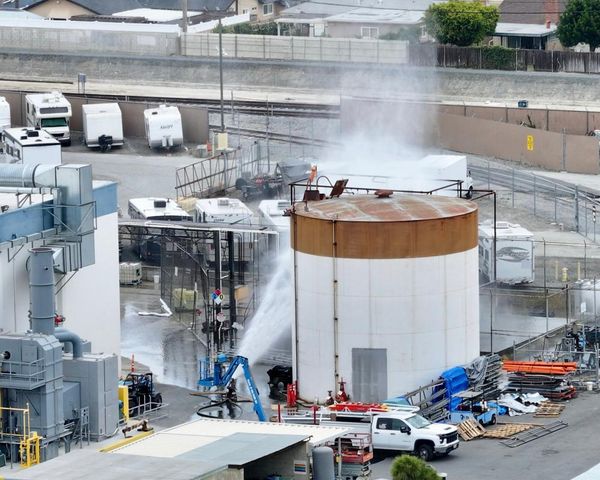
One dead, nine injured in explosion at MOL petrochemical plant in Hungary
Meanwhile, Hungary’s health minister Zsolt Hegedűs confirmed that nine people were injured, including two seriously, in an explosion at a MOL plant in Tiszaújváros (9:50).
One person also died at the scene.
Hegedűs said that no toxic substances were released to the environment and there is no broader threat to the public.
Protests at new US consulate after Trump envoy says time for US ‘to put its footprint back’ on Greenland
Nordic correspondent
In other news, hundreds of people protested against the opening of a new US consulate in Nuuk in Greenland yesterday after comments by the US special envoy that it was time for Washington “to put its footprint back” on the Arctic territory.
Many Greenlandic politicians, including the prime minister, said they would not attend the official opening on Thursday.
Protesters carried Greenlandic flags and signs that read “USA Asu” (Stop USA) and shouted “Greenland belongs to Greenlanders” outside the Greenlandic parliament before shouting “go home” outside the US consulate.
The US special envoy, Jeff Landry, arrived in Nuuk uninvited with a delegation including a doctor, who caused fury by saying he was there to “assess the medical needs of Greenland”. Landry briefly attended a business conference with the US ambassador to Denmark, Kenneth Lowery, and left Nuuk on Wednesday night.
During his visit, Landry told Agence France-Presse he thought it was “time for the US to put its footprint back on Greenland”.
He said:
“Greenland needs the US. I think that you’re seeing the president talk about increasing national security operations and repopulating certain bases in Greenland.”
Meanwhile, negotiations between the US, Greenland and Denmark are continuing, despite the fact Copenhagen is without a fully functioning government amid record-long coalition talks.
While Greenland’s prime minister, Jens-Frederik Nielsen, reiterated this week that the largely autonomous territory – a former Danish colony that remains part of the Danish kingdom – was not for sale, he also said Greenland was “obliged to find a solution” with the US.
Nato shooting down drone over Estonia sends message to Russia, Romanian minister says
Meanwhile, Romanian deputy defence minister Sorin Moldovan said at the Globsec Forum in Prague that the shooting down of a drone in Estonian airspace earlier this week sends a clear message to Russia that incursions into Nato airspace will not be tolerated.
Speaking before the summit kicked off, German foreign minister Johann Wadephul said Berlin will spend more than 4% of the country’s GDP on defence this year and is on its way to the new target of 5%, Reuters reported.
Germany will suggest intensifying defence cooperation with Ukraine with the goal to speed up production, Wadephul said.
Rubio's tone on Trump's 'disappointment' suggests fireworks in Ankara - snap analysis
Going by Rubio’s tone on Trump’s disappointment with Nato and how this is something that will have to be discussed by the leaders in Ankara, it’s clear we will be hearing a lot about it in the coming weeks.
Calling it “one of the most important summits in the history of Nato” is Trumpesque in its style, and sounds almost like a warning.
'Some slight progress' in talks with Iran, Rubio says
Rubio then goes into Iran in a bit more detail, saying there has been “some slight progress” in talks with Teheran.
“I don’t want to exaggerate it, but there’s been a little bit of movement, and that’s good. The fundamentals remain the same. Iran can never have a nuclear weapon, it just cannot.”
He says the US needs to “address the issue of the highly enriched uranium,” and restore the freedom of navigation in the strait of Hormuz.
“Iran is trying to create a tolling system. They’re trying to convince Oman, by the way, to join them in this tolling system in an international waterway. There is not a country in the world that should accept that.”
He says the the US has a draft UN resolution it’s working on with Bahrain, with “the highest number of co-sponsors of any resolution ever before the Security Council.”
“Unfortunately, a couple of countries on the Security Council are thinking about vetoing it. That would be lamentable. We are you doing everything we can, though, to achieve the sort of global consensus that’s necessary to prevent this from happening, and we’re trying to use the United Nations. Let’s see if the United Nations still works.”
He says that “almost every country” represented at Nato has signed as a co-sponsor, and he hopes the remaining few “soon will.”
He then ends on a slightly upbeat note, saying he is hoping for “a good meeting today” to “set the groundwork for the leaders to meet in about six weeks.”
And that ends his briefing.
Updated
Trump's 'disappointment' with Nato will be discussed at 'one of the most important summits in history of Nato' in Ankara, Rubio says
Rubio begins with thanks to Sweden for hosting the ministerial meeting.
But that’s where the niceties end as says the upcoming Ankara summit will be “one of the more important leaders’ summit in the history of Nato,” as the leaders will have to respond to Trump’s “disappointment” with the alliance’s “response to our operations in the Middle East.”
“That will have to be addressed, that won’t be solved or addressed today. That’s something for the leaders level to discuss.”
He notes the US announcement on Poland, but adds “the United States continues to have global commitments that it needs to meet in terms of our force deployment, and that constantly requires us to reexamine where we put troops.”
“This is not a punitive thing, it’s just something that’s ongoing, and it was pre-existing,” he says.
He says there’s plenty of scope to work with Nato on defence industrial base.
Updated
Nato’s Rutte begins by repeating his key points from the earlier statement (9:42), but also pointedly acknowledges “a couple of issues, also on your mind and the president’s mind.”
But the focus is really on Rubio and what he will say. He’s up next.
Rubio briefing press ahead of Nato ministerial in Sweden
Rutte and Rubio are here.
You can watch along below, but I will bring you all the key lines here.
For what it’s worth, we should hear from the US secretary of state, Marco Rubio, soon as he’s expected to arrive at the Nato ministerial any moment now.
Maybe he can offer a bit more clarity on the US deployment to Poland, after the host, Sweden’s Maria Malmer Stenergard, conceded that the US announcements are sometimes “confusing indeed, and not always easy to navigate.”
Italy’s Antonio Tajani stresses the need to have a balanced Nato based on two pillars, the US, and the European allies.
He also declares full support for Ukraine, not just through Nato, but also in terms of giving it a full membership of the European Union down the line – pointedly mentioning the western Balkans in this context, too.
But he also says Nato also needs to have “strong engagement in the south,” and not just look to the risks coming from “the east,” by which he obviously means Russia.
Meanwhile in Sweden, Finland’s Elina Valtonen chooses an interesting phrase to describe her expectations about today’s meeting as she says the ministers “will be hearing secretary Rubio committing the US to Nato.”
She also calls out Russia’s “unacceptable” campaign of “disinformation” against the Baltics, and more broadly talks about Moscow’s responsibility for the state of relations with Nato, which remains a purely defensive alliance.
One dead, 'several' injured after reported explosion at industrial complex in Hungary
Elsewhere, I am keeping an eye on early reports about an explosion at a plant owned by the Hungarian oil company, MOL, in Tiszaújváros in northern Hungary.
Hungarian prime minister Péter Magyar said in a post on Facebook that one person was killed and “several” were seriously injured, with the energy minister on his way to the scene.
Hungarian media outlet 444.hu reported some pictures of the scene after the reported explosion, showing billowing black smoke above the plant.
Updated
Poland's Sikorski thanks Trump for last night's announcement on US troops
Poland’s Radosław Sikorski showed up beaming after last night’s US announcement on the deployment of 5,000 US troops to Poland.
He thanks Trump for the decision, saying it means the presence of US troops in Poland “will be maintained more or less at previous levels,” after the Pentagon halted a planned rotation of 4,000 troops.
The exact detail of the proposed deployment is still not clear, but Sikorski is happy with it anyway. “All is well that ends well,” he smiles.
He says last night’s talks focused on Ukraine, where “things are looking up,” and adds that he hopes Russia’s Vladimir Putin will “recalculate” the costs of continuing the war.
Nato's defence, capabilities target and Ukraine among key topics, Rutte says
Outlining his plans for today, Nato’s Rutte said the discussions will focus on “making sure the money is there to deter and defend ourselves against any adversary,” but also turning the money into actual capabilities by ramping up European production.
“We make progress, but still a lot needs to be done. And Ankara will also very much focus on this issue.”
He also specifically mentioned Ukraine, and the need to talk about “how can we keep Ukraine as strong as possible in the fight,” including more funding from European Nato allies.
Earlier this month, Rutte floated this idea of a 0.25% GDP target for spending on Ukraine – a political non-starter, as he himself admitted later (Europe Live, Wednesday) – but expect more pressure on allies in this area.
There will also be some discussion about the reform of Nato in general to move more burden onto European allies, as the US attention gradually turns away from Europe.
“What you will be seeing over the coming time is a step by step process where the Europeans step up more, which is really important – the Americans acknowledge this – and within that process, you will always have, of course, decisions and announcements, which are part of the longer term trajectory. …
Nato is a political military alliance, so that’s the big difference with China or Russia, where one person in the end takes all the decisions. We are a democratic alliance and a military alliance, and that means that decisions will always be informed by military and political considerations, that’s that’s how it works.”
Rutte also pointedly acknowledged Trump’s “disappointment” with Nato’s response to the Iran war, so expect that to come up too.
Morning opening: Nato meets to take stock ahead of Ankara summit amid tensions with Russia in the Baltics
Nato’s foreign ministers are meeting in Helsingborg, Sweden today to discuss the state of the alliance ahead of this July’s major summit in Ankara.
The meeting comes amid growing concerns about Russia’s provocations and accusations against the Baltic states on the eastern flank, with direct threats that even a Nato membership would not save them from Moscow’s anger.
Estonia’s foreign minister Margus Tsakhna said:
“Russia is now using this opportunity to tell the fake news total fake news that Nato allows Ukraine to use our territories or Nato states as Baltic states and also Finland … for attacks against Russia, and this is fake news, because we don’t allow it.”
Latvia’s Baiba Braže added:
“We are grateful for all the allies coming out and denying Russia’s accusations against the Baltic states, Finland, Poland. No, we are not letting Ukraine use our airspace or ground or sea. That’s a fact.”
But there are good news, too, as the US president, Donald Trump, announced plans to deploy 5,000 US troops to Poland, making an apparent U-turn on a previous decision to halt a long-planned rotation of a US brigade.
While Poland’s top leaders were delighted by the news, Nato’s secretary general Mark Rutte struck somewhat more cautious note as he managed expectations about the US presence in Europe, saying:
“Our military commanders are working through all the details, but of course I welcome [the announcement].
But let’s be clear, the trajectory we are on … is a stronger Europe and a stronger Nato, making sure we will over time, step by step, be less reliant on one ally only, as we have been for so long, which is the United States, so that also for them … that they have the possibility and the option to pivot more towards other priorities, which are also in our interests, will continue.”
Let’s more to be discussed behind the closed doors, including Trump’s clear frustration with the way Nato responded to the US requests related to the Iran war.
“You have countries like Spain denying us the use of these bases – well then why are you in Nato? That’s a very fair question,” US secretary of state Marco Rubio told reporters on departure in Miami. “In fairness, other countries in Nato have been very helpful. But we need to discuss that.”
Looks like a busy day ahead. I will bring you all the key lines here.
It’s Friday, 22 May 2026, it’s Jakub Krupa here, and this is Europe Live.
Good morning.