
US forces conducted self-defense strikes in southern Iran
The US military carried out strikes on Monday in southern Iran against targets including boats attempting to lay mines and missile launch sites, in what it described as defensive actions.
US Central Command said in a statement the strikes were designed "to protect our troops from threats posed by Iranian forces."
"US Central Command continues to defend our forces while using restraint during the ongoing ceasefire," said Navy Captain Tim Hawkins, a Central Command spokesperson.
Blasts heard in Iran's Bandar Abbas city, reason unclear, Mehr news agency reports
An explosion was heard in Iran's Bandar Abbas city, Iran's Mehr news agency reported on Monday, adding that the cause was unknown.
Israel's Netanyahu orders escalation of Lebanon offensive to 'crush' Hezbollah
Israeli Prime Minister Benjamin Netanyahu said on Monday that Israel is at war with Lebanon's Hezbollah, and it would intensify strikes against them in Lebanon.
Iran's president orders reopening of international internet access, state media reports
Iran's President Masoud Pezeshkian has issued an order to reopen international internet access, Iranian state media reported on Monday, citing an official.
The report cited the head of public relations at Iran’s Communications Ministry. Most Iranians have been unable to access the worldwide web for 87 days according to the internet observatory NetBlocks, with only a few citizens having access to expensive and advanced VPNs that circumvent the restrictions.
Authorities initially imposed an internet blackout from January 8 in response to nationwide anti-government protests, with connections gradually getting back to normal in February, before a new blackout was initiated following the start of U.S. and Israeli strikes against Iran on February 28.
In normal times, access to the global internet remains heavily restricted via censorship of many websites, while authorities are increasingly relying on an intranet to provide connected services without relying on the worldwide web, notably for schools which are currently following an online curriculum.
Iran would open Hormuz 30 days after deal with US to end war, Nikkei reports
The U.S. and Iran are discussing a plan to open the Strait of Hormuz about 30 days after the two countries reach a deal to end hostilities, the Nikkei newspaper reported on Monday citing a Middle East diplomatic source.
Iran would proceed to clear mines from the strait during a 30-day window following an agreement, after which ships from all countries would be able to navigate freely and safely, and Iran would stop collecting transit fees, Nikkei said.
Iran says FIFA promised players will get World Cup visas: local media
Iran's sports minister said FIFA has promised the country's men's football team will receive visas to play in the United States at the World Cup this summer despite the ongoing Middle East war, local media reported on Monday.
Iran's participation at the global spectacle has been in question for months because it is being co-hosted by the US, which along with Israel began bombing Iran on February 28, sparking a wider regional war.
"The FIFA president promised us that all our players would receive visas. There is no reason why our players should not receive visas," said minister Ahmad Donyamali, quoted by local news agency ISNA.
"I hope that all the conditions will be met so that the national team can participate in the tournament in a calm and orderly manner."
The Iranian squad will now be based in Tijuana on the Mexican border with the United States during the tournament, according to the Islamic republic's football federation.
- Vessels carrying Middle East oil, LNG exit Hormuz, head for Pakistan, China
- Israel military issues new evacuation warning to 10 Lebanon villages
- Iran says charging fees for 'navigational services' through Hormuz
- Mexico accepts to host Iran during the World Cup
- Israel's Netanyahu orders escalation of Lebanon offensive to 'crush' Hezbollah
Key sticking points in the proposed US-Iran deal
Mexico agrees to host Iran during the World Cup
Mexico has "no problem" in hosting the Iranian squad for the 2026 World Cup, Mexican President Claudia Sheinbaum said Monday. Iran had announced on Saturday they wanted to be based in the Mexican border city of Tijuana and not in Tucson, Arizona, as originally planned.
"The United States did not want the Iranian squad on their territory," she said at a press conference. "They (Iran) therefore asked us: 'can we be based in Mexico? and we replied yes, no problem'."
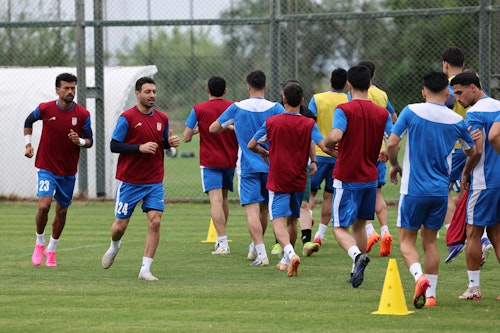
Iran's players run during a training session at their base camp in Antalya on May 19, 2026. Oner SAN / AFP
Iran hangs another protester as dozens more risk execution, rights groups say
Iran on Monday executed a man on charges related to protests this year, the latest in a spree of hangings on political or security accusations since the start of the US-Israeli war with dozens more risking execution, rights groups said.
Some three dozen men have been hanged on charges related to protests, membership of banned opposition groups, or espionage since wartime executions resumed in March, according to rights groups.
The latest man to be hanged was Abbas Akbari, who was accused of attacking an official building in Nain in the central province of Isfahan during the peak of the protest movement in January.
"The primary purpose of these executions is to instil fear in society and prevent future protests," said the director of Norway-based NGO Iran Human Rights (IHR) Mahmood Amiry Moghaddam.
He added the surge in executions has resulted in no "serious political consequences for the Islamic Republic". "Unless the political cost of executions increases, we are likely to witness the continuation, and even escalation of daily executions in the weeks and months ahead," he said.
The Hengaw group, also based in Norway, described the execution as "a clear example of state-sanctioned killing aimed at intimidating society and suppressing the people's legitimate right to protest".
Israel rate cut pace needs to be gradual due to geopolitical risk, says cenbank official
Geopolitical risk has declined but the overhang of a resumption of fighting with Iran requires a gradual pace to interest rate reductions, Deputy Bank of Israel Governor Andre Abir told Reuters on Monday.
The central bank earlier had cut its benchmark interest rate by 25 basis points to 3.75%. Abir said inflation holding at around 2% was the main factor in the decision to reduce the rate for the first time since January.
While geopolitical uncertainty has declined, it has not disappeared, he said, but a rapid appreciation of the shekel was helping to moderate inflation and "even if there is a sudden shock it's unlikely that (inflation) goes up to" the top of the inflation target range of 3%.
"The geopolitical uncertainty means that we have to be more careful in the pace in which we change interest rates," Abir said.
Israeli opposition leader Lapid says Trump’s emerging deal with Iran is 'bad for the region’
The peace deal being discussed between the US and Iran fails to achieve any of Israel’s goals for the war, Israel’s opposition leader Yair Lapid said on Monday, as he accused Prime Minister Benjamin Netanyahu of failing to influence a better agreement.
Lapid, who is part of an alliance attempting to unseat Netanyahu in elections this year, said details of the emerging deal are “disturbing".
“The deal is bad for Israel, bad for the region, bad for the citizens of Iran,” Lapid told reporters in Jerusalem.
According to regional officials, under the current deal being discussed Iran would give up its stockpile of highly enriched uranium and reopen the strategic Strait of Hormuz in exchange for ending a US blockade of Iranian ports and the lifting of sanctions against Iran. Key details on Iran’s nuclear programme would then be negotiated during a 60-day period.
It is unclear if the deal will address Iran’s missiles or support for regional militant groups.
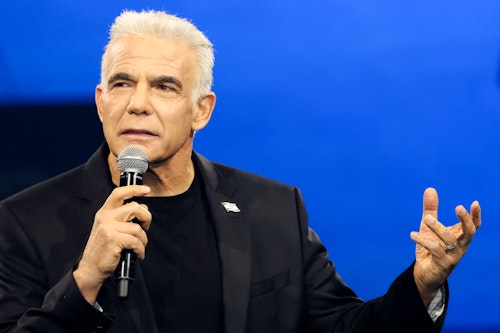
Yair Lapid, current opposition leader, speaks along with former Israeli prime minister (unseen) during their inaugural conference of their "Together - Under Bennett's Leadership" party for the upcoming national election in the Israeli coastal city of Tel Aviv on May 12, 2026
Iran says it downed a 'hostile' drone over Gulf using new air defence system, state news agencies report
Air defences activated in Iran's Gulf island of Qeshm, cause unclear, Mehr news agency reports
Iran health official says supreme leader suffered only 'superficial' wounds in US-Israel strike
An Iranian health ministry official said Monday the injuries suffered by supreme leader Ayatollah Mojtaba Khamenei in US-Israeli strikes in late February were only "superficial", offering a rare account of the day he was wounded.
The 56-year-old has not appeared publicly since he was named as Iran's supreme leader on March 8, issuing only written statements, fuelling speculation about his health.
In March, US Defence Secretary Pete Hegseth said Mojtaba was "believed to be alive, wounded and disfigured".
Mojtaba succeeded his father, Ali Khamenei, who was killed in US-Israeli strikes on February 28 that triggered retaliatory Iranian attacks across the region.
On Monday, health ministry spokesman Hossein Kermanpour described the day Mojtaba was wounded and his arrival at a hospital, which he did not identify. "Apart from superficial injuries to the face, head and legs, which caused neither amputation nor any particular medical problem, nothing major had happened," Kermanpour told ILNA news agency.
Trump demands Saudi Arabia, Qatar sign Abraham Accords as part of Iran peace deal
US President Donald Trump said on Monday negotiations with Iran were "proceeding nicely" and said he asked countries including the UAE, Qatar, Pakistan, Egypt and Jordan to sign onto the Abraham Accords as part of US efforts to reach a deal with Iran.
Trump said those countries would be honored to have Iran as part of the accords, a set of agreements to normalise relations with Israel.
Iran envoys in Doha for talks on possible US-Iran deal, official says
Iran's chief negotiator Mohammad Bagher Qalibaf and foreign minister Abbas Araqchi are visiting Doha for talks with Qatar’s prime minister on a possible US-Iran deal to end the war, an official on the visit said on Monday.
The blockade of the Strait of Hormuz and Iran's stockpile of enriched uranium -- a thorny negotiating point in any deal due to questions concerning Iran's nuclear capacity -- are key topics on the agenda.
Russia's Putin, Bahraini King discuss need for swift end to Iran crisis
Russian President Vladimir Putin and Bahrain's King Hamad bin Isa Al Khalifa discussed by phone the
need to find a rapid diplomatic resolution to the Iran crisis, the Kremlin said on Monday.
Trump says either 'great and meaningful' deal or 'no deal' with Iran
US President Donald Trump said on Monday that a deal with Iran would either be "great and meaningful" or there would be "no deal".
"The deal with Iran will either be a great and meaningful one, or there will be no deal," he wrote on Truth Social.
Pope calls idea of 'just war' put forward by US 'outdated'
Pope Leo XIV on Monday labelled "outdated" the concept of a "just war" put forward by US President Donald Trump's administration, warning that "humanity is slipping into a violent culture of power".
In his first encyclical, a sort of manifesto, US-born Leo focused mainly on the rise of artificial intelligence but also returned to an anti-war message that has caused tensions with Washington.
"Today, more than ever, without prejudice to the right to self-defence in the strictest sense, it is important to reaffirm that the 'just war' theory, which has all too often been used to justify any kind of war, is now outdated," he wrote in Magnifica Humanitas (Magnificent Humanity).
"Humanity possesses far more effective and capable tools for promoting human life and resolving conflicts, such as dialogue, diplomacy and forgiveness," he wrote.
Yesterday's key developments:
- Israeli Prime Minister Benjamin Netanyahu said that he and US President Donald Trump agreed that any final agreement with Iran must remove the nuclear threat posed by Tehran.
-
US Secretary of State Marco Rubio accused Hezbollah in a statement of trying to plunge Lebanon "back into chaos".
-
Hezbollah Secretary-General Naim Qassem again urged Lebanese authorities to abandon direct talks with Israel, ahead of a fourth round of such discussions in Washington early next month.
(FRANCE 24 with AFP, Reuters and AP)