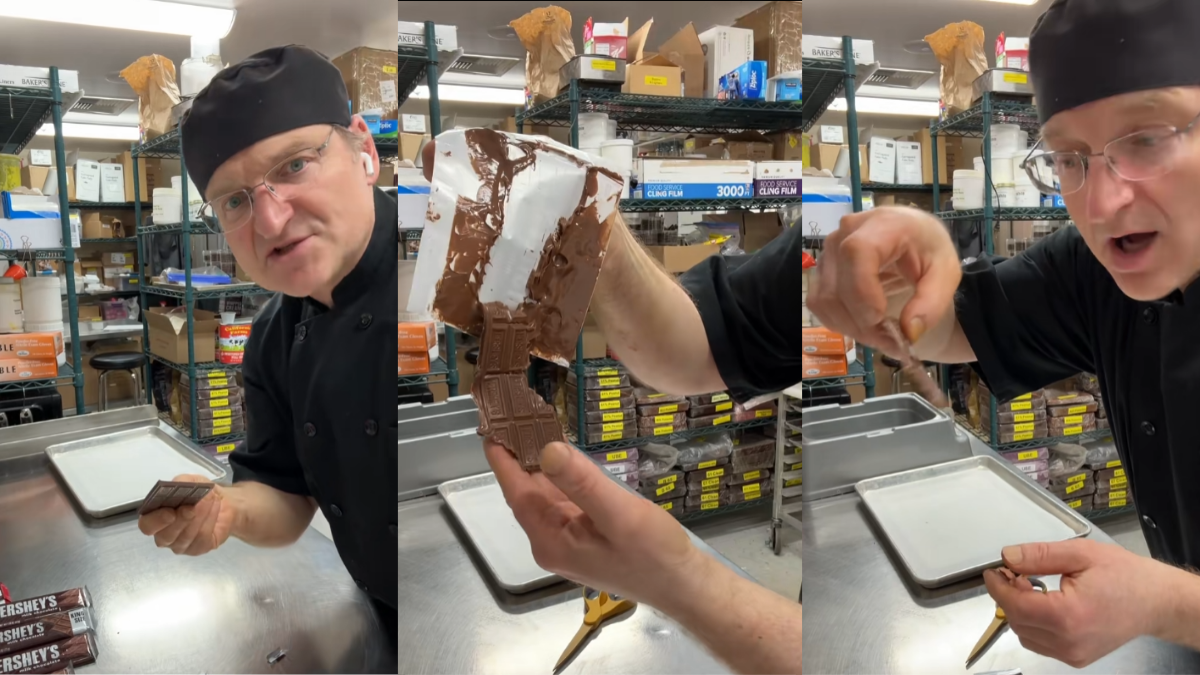
Why do Hershey’s milk chocolate bars wiggle? That’s a question that’s been trending ever since social media users posted videos of their soft chocolate bars not melting, but wiggling. TikTok users speculate that Hershey’s must be giving out “fake” chocolate. Konstantin Zsigo (@konstantinzsigo), a chocolatier from Michigan, went on to investigate why some Hershey’s bars turn wiggly.
Recommended Videos
Many social media users on TikTok tagged Zsigo to explain why the chocolates in the viral videos were flopping around, almost like a stretchy plastic.
“The first video I saw, I thought, ‘That has to be a fake.’ And then I saw a second video, and now, I’m starting to get a little concerned,” Zsigo explained his reluctance. There are many strange videos that circulate online, and not all show the full truth. But after the second video, Zsigo decided to check what was going on with Hershey’s world-famous bars.
From chocolatier to TikTok detective
“My theory is that they haven’t changed the formula in some big way,” Zsigo said, showing the Hershey’s milk chocolate bars he purchased from the store. “And my theory is that it’s mishandling. If it is real, it’s a mishandling issue,” he added.
“I feel like I’m an investigative journalist,” he joked. He’s dedicated to making the video, even if it’s already 3 in the morning. “I’m actually palpitating,” he added. Before proceeding with the test, Zsigo read the recipe label.
The usual ingredients were there—milk chocolate, sugar, cocoa butter, milk fat, and soy lecithin.
“What is that?” Zsigo squinted at an unfamiliar additive. He also checked the other bars and their labels. Upon checking, PGPR (Polyglycerol Polyricinoleate) is an emulsifier derived from castor oil.
According to Zsigo’s findings, it “acts like a stabilizer to improve flow, reduce viscosity, and replace expensive cocoa butter in formulations.”
“So basically, it’s a way to save money,” Zsigo says. Although the additive isn’t harmful, the cost-cutting measure is the first hint to the mystery that Zsigo is trying to solve. He opened one of the Hershey’s bars at room temperature, and it snapped. It didn’t wiggle the way the product did in one of the videos.
Did the Hershey’s bar wiggle?
Zsigo took his chocolate melter and mentioned that the current room temperature was at 71°F. He set his machine to 88°F to make the chocolate reach near melting point. When he took the bars out at 87°F, he peeled the wrapper.
“What in the holy f?” He looked surprised that the chocolate war was actually flip-flopping, just like in the viral videos.
“Science: I think this is what’s happening. In chocolate, you got all these bonds that are formed by the cocoa butter. They are type five bonds,” he explained. “If you have enough of them, they hold the structure of the chocolate together. Think of it as like a web, okay? The cocoa butter crystals form a web, and the other materials are floating inside of that web.”
But why is it wiggling?
“When you heat it to a certain temperature, the web gets unstable, but not so unstable that it melts. It’s just unstable enough to where, on a molecular level, things get wonky,” Zsigo said. This is what he believes is the cause of flopping for the Hershey’s bars. Once the bars cool down from that high level of heat, the crystal structure of the chemical bonds has already broken, which leads to the strange wiggling.
One commenter wrote, “The cheapest chocolate bar on the planet wasn’t cheap enough so they decided to make it cheaper.” To this, Zsigo agreed.
Another commended Zsigo’s investigation, saying, “We need to keep calling these companies out. They’re using cheaper ingredients and charging a lot more for inferior products. Great job!”
Based on Zsigo’s sleuthing, it seems that the chocolates are not “fake,” contrary to popular opinions. But social media users were still upset that Hershey’s appeared to have cut costs with cocoa butter.
(featured images: Konstantin Zsigo)