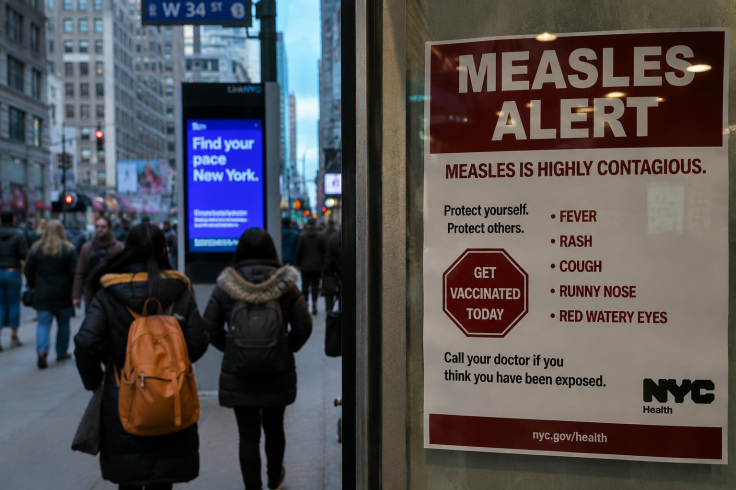
A Manhattan resident has tested positive for measles after contracting the disease abroad — visiting at least two restaurants, a performance venue, and multiple healthcare facilities across the borough before being diagnosed. New York City health officials confirmed only one of those locations publicly, leaving New Yorkers to wonder whether they were exposed.
The confirmed site: Norma Gastronomia Siciliana, a popular Italian restaurant in Hell's Kitchen. The restaurant disclosed on social media that the infected individual was on the premises on April 25 between 5 p.m. and 8 p.m. The NYC Department of Health confirmed the detail — but when pressed on the other venues visited, a department spokesperson told Gothamist that the agency isn't disclosing the remaining locations because all of them "have informed their employees and any patrons who might have been exposed."
In other words: trust us.
By the Numbers: What the City's Own Data Shows
This isn't a one-off scare. It's the latest in a pattern — and the numbers tell a troubling story.
- 6 confirmed measles cases in NYC so far in 2026 , according to the NYC Health Department as of May 8.
- All 6 cases are linked to international travel — a reflection of New York City's role as a major global entry point.
- 10 confirmed measles cases statewide in 2026 , including a separate case in Nassau County involving an unvaccinated child under the age of 5 — the county's first since 2024, per NBC New York .
- 20 measles cases were recorded in NYC in all of 2025 , up from a single case in 2023, according to the New York State Department of Health .
- 48 total cases were recorded across New York State in 2025.
- 1,884 confirmed measles cases nationally in 2026 across 40 jurisdictions as of the latest CDC data , with 93% of cases outbreak-associated.
The trajectory is heading in the wrong direction.
The Vaccination Gap: A City That Is Not as Protected as Officials Claim
When asked about public risk, the Health Department's statement was predictable: "The risk to the general public is low due to high vaccination coverage among New Yorkers."
The actual data is more complicated.
Citywide, only about 81% of children between 24 and 35 months have received their first MMR shot, according to city data analyzed by Gothamist — well short of the 95% threshold required for herd immunity, as defined by the New York State Department of Health.
Worse still, that number is declining. In 2024, 93% of NYC children ages 24–35 months had received at least one MMR dose by their second birthday. By 2025, that figure had dropped to 89% — a four-point fall in a single year, according to Healthbeat/Your Local Epidemiologist NY citing NYC DOHMH data.
In a city of 8.5 million, a four-point drop doesn't just look bad on a chart. It translates to thousands more unprotected children should an outbreak ignite.
And some neighborhoods are far more exposed than the citywide average suggests:
- Staten Island has no ZIP code with an MMR vaccination rate above 74% among young children — making it the borough most at risk.
- The lowest rate in the borough sits at 65% , well below herd immunity.
- Hell's Kitchen itself — the precise neighborhood where this exposure occurred — is among Manhattan's lowest-vaccinated areas for young children, according to city data .
That's not a coincidence. That's a vulnerability hiding in plain sight.
What Officials Said vs. What the Data Shows
| Claim | Reality |
|---|---|
| "Risk to the public is low" | Citywide MMR rate is 81% — far below the 95% herd immunity threshold |
| "High vaccination coverage among New Yorkers" | Coverage dropped 4 points in a single year (93% → 89%) |
| "All businesses notified patrons" | Only one of multiple exposure sites was publicly disclosed |
| "No evidence of community spread" | 6 cases in 2026, all travel-linked — but undisclosed venues make tracing harder |
Why Transparency Matters
Measles is not a mild inconvenience. It is one of the most contagious viruses known to science. Complications include pneumonia, brain swelling (encephalitis), miscarriage, preterm birth, and death. A single infected person in an unventilated room can expose everyone present — and anyone who walked through that space up to two hours after they left.
New York has seen what happens when the virus gets a foothold in an under-vaccinated community. In 2019, a measles outbreak in Williamsburg resulted in 649 confirmed cases, concentrated in a neighborhood with low vaccination rates.
The city's refusal to fully disclose exposure locations — even while acknowledging multiple venues were visited — puts the burden of protection on individuals who don't have the information they need to act. New Yorkers who dined in Midtown, attended a performance, or visited a healthcare facility in late April may still not know whether they were in the same room as an infected person.
Officials say they've handled the notifications privately. But private notifications only work if every patron can be reached. In a city where restaurants turn over hundreds of guests a night, that's a significant assumption.
This pattern isn't unique to New York. As MedicalDaily has reported, measles has been resurging nationwide as vaccination rates decline — with the WHO and CDC both warning that the trend is accelerating globally.
What You Should Do Now
If you were in Hell's Kitchen or Midtown Manhattan in late April and have not been vaccinated — or are unsure of your vaccination status — health officials recommend the following:
- Check your MMR vaccination records. Adults born after 1957 who have not received two doses of the MMR vaccine should get vaccinated. See the CDC's MMR vaccine recommendations .
- Watch for symptoms. Measles begins with high fever, cough, runny nose, and red, watery eyes. A rash typically appears 3–5 days later, starting on the face and spreading downward.
- Call your provider — don't walk in. If you suspect measles exposure or symptoms, call your healthcare provider before visiting a clinic to avoid exposing others.
- Get vaccinated before traveling. All six 2026 NYC cases were travel-linked. Anyone planning international travel should confirm full MMR vaccination beforehand. Check the CDC Travel Health Notices for active alerts.
- Find a vaccine near you. Use the NYC Health Map to locate vaccination sites citywide.