TOKYO — Japan and the Philippines are expected to announce Thursday their intention to begin formal negotiations to conclude a security intelligence-sharing pact, in their latest effort to boost cooperation amid shared concerns over China's military activities.
At their meeting in Tokyo, Prime Minister Sanae Takaichi and Philippine President Ferdinand Marcos Jr are also set to agree on upgrading the bilateral ties to a "comprehensive strategic partnership," according to Japanese government sources.
The partnership is considered the second-highest level of a bilateral relationship after an alliance. Japan has already established such partnerships with other Southeast Asian countries, including Malaysia, Vietnam and Laos.
Takaichi and Marcos will hold a joint press event after the talks and release a joint statement, the sources said.
Japan and the Philippines, both close US allies, have been ramping up their security collaboration in recent years, as the Tokyo-advocated vision of a free and open Indo-Pacific has gained traction in the face of China's intensifying maritime assertiveness in the region.
Beijing claims the Tokyo-controlled, uninhabited Senkaku Islands in the East China Sea, while asserting sovereignty over almost the entire South China Sea, where its coast guard ships have taken aggressive actions against Philippine vessels near disputed shoals.
The intelligence pact envisaged by Japan and the Philippines is known as the general security of military information agreement, or GSOMIA, which would oblige them to protect their shared military secrets to prevent them from leaking.
Japan has similar bilateral deals with Australia, South Korea and the United States.
In January, Tokyo and Manila signed an acquisition and cross-servicing pact for smoother sharing of defence supplies, and their reciprocal access agreement enabling faster troop deployment for joint drills and disaster relief operations took effect last September.
The Philippines has been a recipient of Japan's official security assistance programme, which supports like-minded partners by providing defence equipment, since its launch in fiscal 2023.
The two nations, both highly dependent on oil imports from the Middle East, also share the challenge of securing enough energy supplies amid global disruptions since the US-Israeli conflict with Iran began in late February.
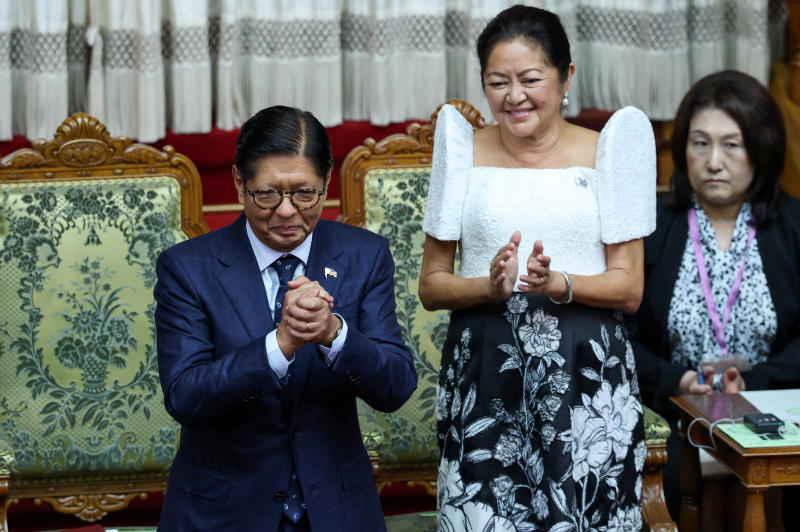
Marcos' four-day visit to Japan through Friday as a state guest comes as Tokyo and Manila mark the 70th anniversary of the normalisation of diplomatic relations this year.
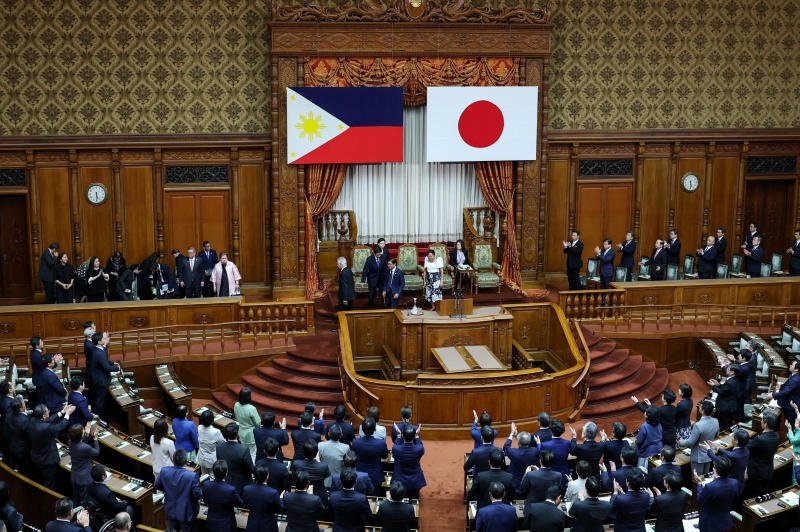
Ahead of the summit with Takaichi, Marcos delivered a speech at the Japanese parliament, saying that the two nations "remain unwavering in our commitment to uphold international law" in an "increasingly complex Indo-Pacific, where tensions test the resilience of a rules-based order."
"Let us strive to become an exemplar of strategic collaboration that inspires pathways to peace, shares opportunities toward common prosperity, and seizes new possibilities that redound to the benefit of our nations, our peoples, and the wider Indo-Pacific region," he said.