They go by names like the Doobie Others, Listen to the Music, and the Brothers Doobie. These are just some of the myriad Doobie Brothers tribute bands currently circulating. There’s even a group called the Doobie Doubles, who apparently specialize in playing only uptempo rock songs (mellow soul ballads are a no-no with these guys).
Neither Tom Johnston nor John McFee have witnessed these outfits (“I guess I’m missing out,” Johnston says with a laugh), but Patrick Simmons has checked out a few of them online, and he admits they’re not bad.
“They’ve got some great musicians,” he says. “They never sound exactly like us, but I don’t think that’s important. It’s great that musicians would want to take the time to learn those songs and perform them. I can’t fault people for trying to make a living and coming up with a novelty idea, and if they enjoy the music, that’s really flattering for the rest of us.”
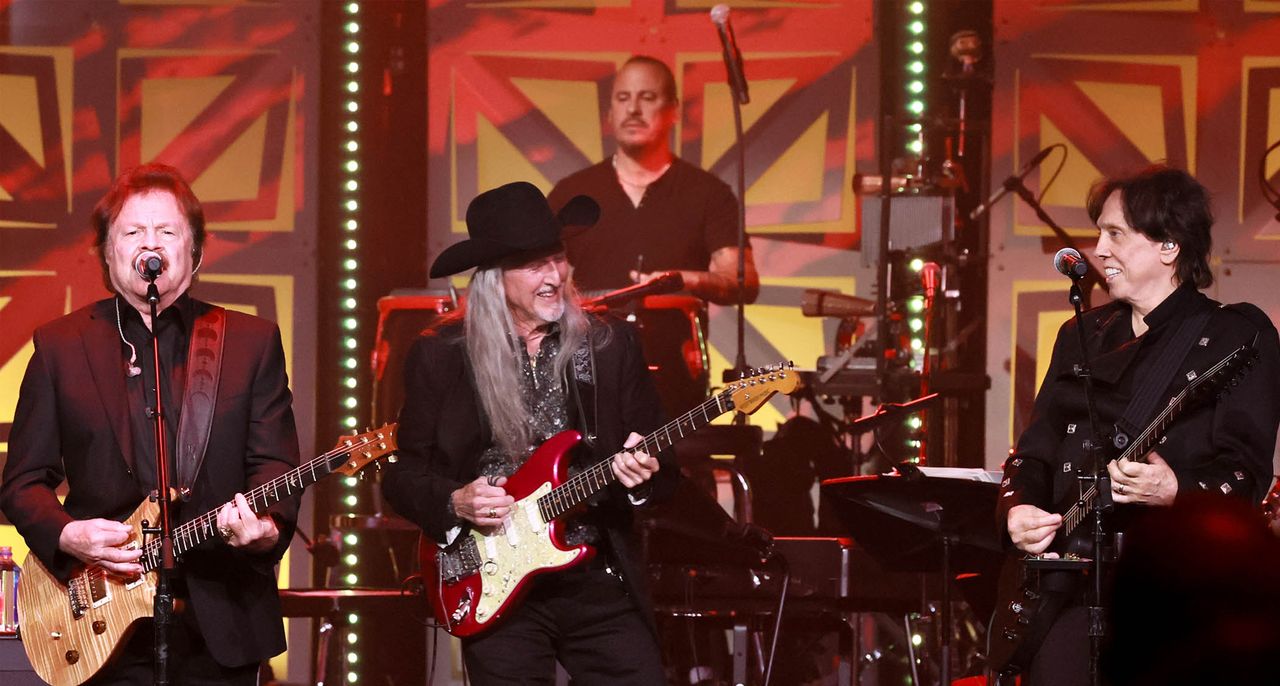
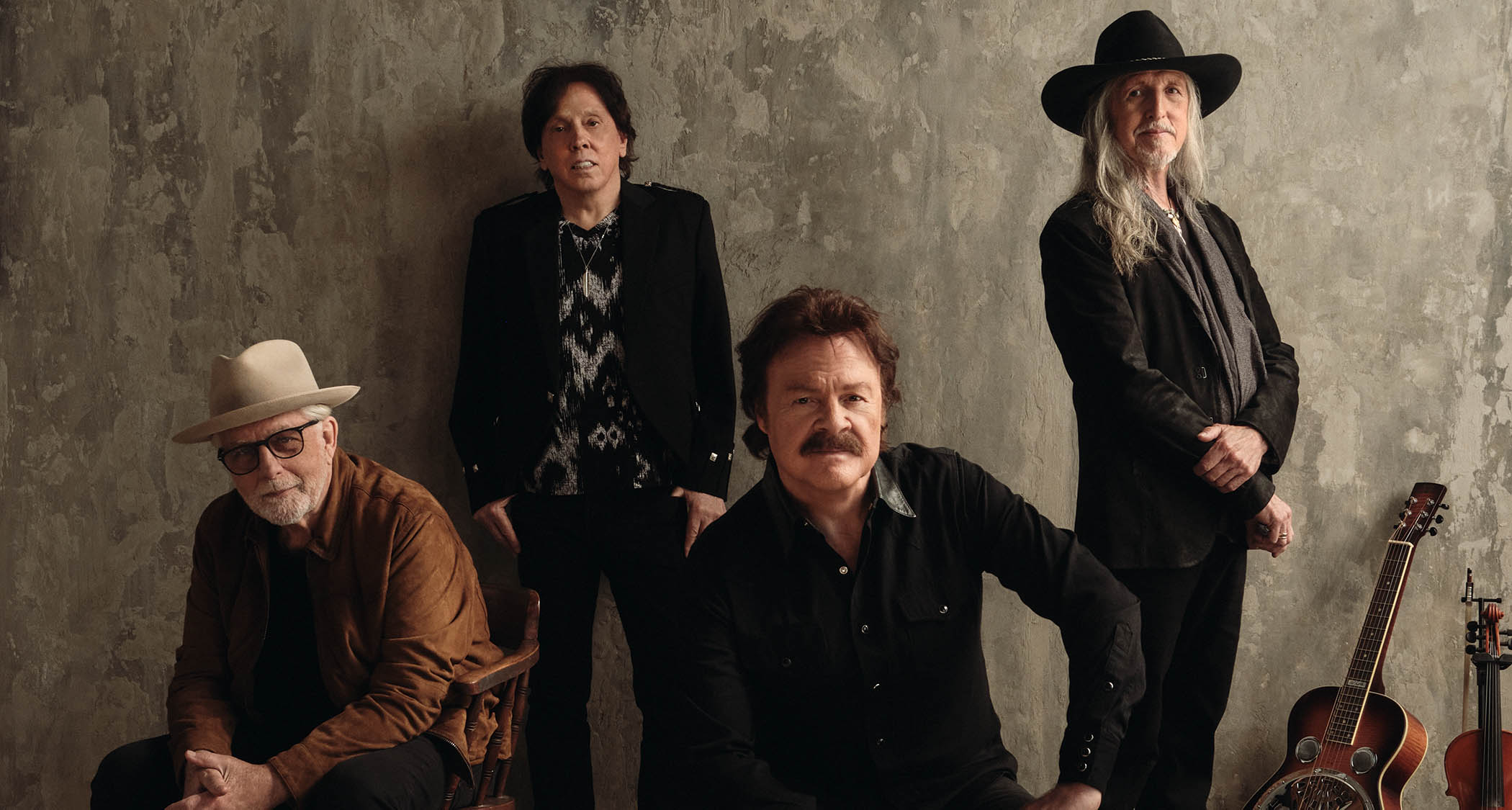
Guitarists Johnston and Simmons have been playing together off and on (mostly on) ever since they founded the Doobie Brothers in San Jose, California, back in 1970. McFee, who has something of a Swiss Army Knife role in the band (in addition to guitar, he also plays mandolin, banjo, violin, cello, and pedal steel – basically, anything with strings), joined the Doobies in 1979 but still refers to himself as “the new guy.”
Collectively, they represent each era of the hit-making, Rock and Roll Hall of Famers. There’s the funky, boogie-rock Johnston period of the early Seventies that yielded AM/FM radio gems like Listen to the Music, China Grove, Black Water, and Long Train Runnin’, along with the late-’70s/early-’80s mellow soul phase during which second-wave frontman Michael McDonald delivered crossover smashes like Minute by Minute, Real Love, and the Grammy-winning chart-topper What a Fool Believes.
The latter song is widely seen as a key example of the genre known as “yacht rock,” the very mention of which elicits good-natured chuckles and eye rolls from the group’s guitar trio.
“I’ve never even been on a yacht,” McFee says, to which Johnston adds, “I don’t even know what the term is supposed to mean – ‘yacht rock.’ It just seems kind of absurd to me.”
There have been breakups and reunions, and in-between it all McDonald established himself as a solo star, but Johnston, Simmons, McFee, and McDonald have been together as Doobies since 2019.
They released a solid studio recording, Walk This Road, last year, and this summer they join guitar legend Carlos Santana on his Oneness Tour.
“We’ve toured with Carlos before,” Johnston says. “I’ve known him since 1971, ’72. I hardly ever see him unless it’s on the road, but he’s such a good guy. I love playing with him and his band. We have a ball.”
Whatever differences contributed to the band’s various hiatuses (the longest was between 1982 and ’87) seem to have been ironed out long ago.
“We have disagreements like anybody else,” Simmons says. “We’ve certainly had our moments when we’ve gotten on each other’s nerves, especially at the end of a tour when it’s like, ‘Oh, my God, is he gonna keep snoring when I’m trying to sleep?’ But we’ve been lucky enough to sustain our relationships, and really, it’s all about the music. We’ve got great writers and players, and people love what we do.”
“We had our conflict in the Seventies,” Johnston says. “As time goes by, you learn what to do and what not to do. You learn to take care of yourself and not be destructive. We all get along now, and we just want to keep on moving forward. I think if you keep moving forward, things have a way of fixing themselves.”
The Doobies have something like 300 songs, and a lot of them are hits. Who decides the setlist each night?
Tom Johnston: Pat and I do a lot of that, and then we bring Mike in on it. It's really based around the guys who are going to sing, but we also look at the set and tailor a lot of it to what the crowd wants to hear and the songs we're okay with playing.
Obviously, we want to play the hits for the audience. We've been playing a lot of stuff off the new album, and we’ll probably do one or two new songs when we open for Carlos. The rest will be stuff everybody knows.
The new album is the first one the band has recorded with Michael in four decades. Does it feel like you’ve got two eras of the group comfortably accounted for in this lineup?
Johnston: I think it's a good idea to look at it that way, because that's what we're doing, whether it’s on record or live. We put it all out there. All the eras of the band are represented, and the people love it.
John McFee: I think the music integrates from all the different eras. I love it.
Patrick Simmons: It’s more than two eras, I think. We’ve always had multiple writers, multiple approaches and different influences. The biggest influences, of course, would be Tommy and Mike. They're both prolific writers and great singers. You're going to feel their influence over and above everybody else just by virtue of their… what's the word? Their energy!
John Shanks produced this one and the album before it, Liberté. He’s also a notable guitar player.
Johnston: A really good guitar player.
Does he get really granular with suggestions for guitar tracks – to the point where it’s annoying?
Johnston: No, not in that way. He did play on the album – and quite a bit – but everybody contributed all the stuff they normally would. Mostly John was involved with a lot of the writing. He co-wrote every song on the record.
Was it a smooth process writing with him?
Johnston: It went fine. Albums can be smooth and not smooth at any given time with pretty much anybody, but I thought it went pretty well. The only difference about working with John is that whoever co-wrote is the one that's in the studio. The whole band is hardly ever in there. You work on it to a certain point, and then you bring in guys to sing and play parts and whatnot.
That’s not the way you’ve always recorded.
Johnston: Before this one and Liberté, we’ve kind of had the whole band in a lot of the time, especially doing basic tracks. You come up with ideas as you’re hearing them – everybody throws stuff out there. That’s kind of how the band worked for a very long time. So this one and the last were different in that aspect.
Let’s talk about the guitar frequency puzzle. John, I know you play a lot of other instruments, but at any given time the three of you are playing guitar on stage. How do you divvy up the sonic real estate?
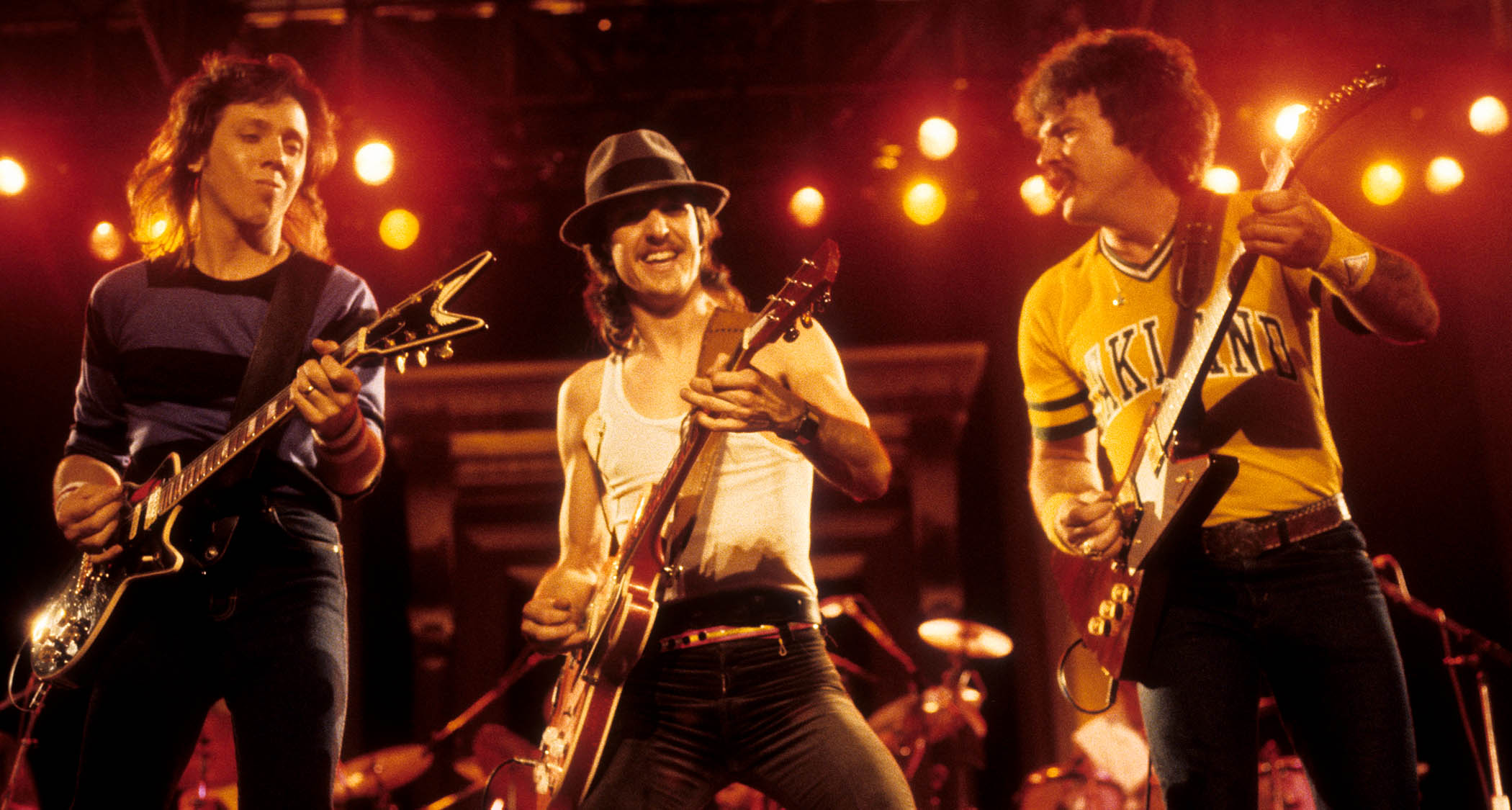
Johnston: We don't look at it like that, at least I don't. I think if it sounds good and everybody has their own parts, that’s just what naturally works itself out. John uses a digital rig, which is different from amplifiers. Pat uses an amp, but he plays Strats. I use PRS. All of that creates different sounds on stage as far as the guitars go.
McFee: I think it’s got a lot to do with the parts that are being played. A lot of the time it depends on who played what on the records. Obviously, Tom is going to start Long Train Runnin’ with that rhythmic hook of his. The other parts get divided up depending on how the record was done. A lot of times on the records there's more than two guitar parts, so live we’re able to cover those parts without anything being missed. It's a song-by-song situation.
Simmons: I don’t think we analyze it too heavily. I just want everybody to have fun and feel good. If I'm sitting there criticizing – “There's too much going on” – it starts to become contentious. I’ll certainly confront something if it’s important, but I would never go, “What can I find wrong with this?”
Do you feel obligated to try to recreate the sound of the records as much as possible?
Johnston: I think everybody kind of does the same thing they've been doing for years. We have changed songs’ arrangements here and there, but it basically kind of adheres to the way the song sounded originally.
Sometimes there’s a different way of looking at a song, like having Marc [Russo] on sax, for instance – he plays quite a few solos throughout the set. And then Mike’s on keys, so he’s got his own take on how parts are played. I haven’t changed my rhythm parts on these songs, except sometimes they get expanded.
John is a little more sophisticated in terms of his choice of notes and his ability to play a little more ‘outside.’ I won't say it’s jazz, but it’s more complementary outside chords
Patrick Simmons
John, you brought up Long Train Runnin’, which is a perfect example of Tom’s right-hand rhythm technique.
McFee: I had the hardest time teaching that to him, by the way. Just kidding! [Laughs]
Johnston: I think they call it “chunka-chunka.”
Exactly. Tom, where did that come from? Who were you listening to?
Johnston: I think it came from writing songs and playing acoustic a lot in the late Sixties. I didn’t always have people around, like a drummer or bass player or whatever. In order to implement the kind of rhythm I was thinking about, I would do it on the guitar. It’s basically like playing drums and guitar at the same time.
I mean, not exactly, but the idea is to get the rhythm structure across to somebody if you're going to end up playing it in a band or if you're going to end up recording it. I used that rhythm on quite a few songs, but it just happened naturally. I didn't think about it; I just started doing it.
Patrick, have you always found Tom’s rhythms easy to play along to?
Simmons: I think you either play along with somebody and try to complement what they're playing in terms of mimicking the part, which I've done before, or you can break it up and play counter rhythms. I’ve done that, too – it’s sort of my go-to place. I think Tommy prefers it when I play arpeggiated parts, which I do a lot.
John does that, too. Tommy and John have different voices within the context of what they play. John is a little more sophisticated in terms of his choice of notes and his ability to play a little more “outside.” I won't say it’s jazz, but it’s more complementary outside chords, which I think really helps us to create a larger palette, if you will.
That rhythm guitar playing is a big part of Listen to the Music.
Johnston: Sure. I was sitting there with an acoustic, coming up with chord changes – the rhythm and the chord changes set the tone for what I was thinking about. It reminded me of a utopian thing. I was thinking, ‘Can the leaders of the world just sit down and shut up and listen to the music instead of what they were doing?’ This was the Vietnam era.
Simmons: That was a funny track for me. We’d played it for a year and a half, two years, in clubs, and I’d always played kind of an arpeggiated, banjo-ish part. When we cut the song in the studio, I played my part, but it just didn’t kill me.
The other guys sounded great, but I didn’t know what I should do. I thought, ‘Maybe I’ll just sing on it.’ Then I started listening to the Eagles and what Bernie Leadon played on Take It Easy. He played the banjo. I mentioned it to producer Ted Templeman, and he said, “Let’s rent you a banjo and see what you can work out.”
I didn’t have anything in mind at first, but I went in the other room and worked out a banjo part. Ted said, “Let’s lay it down.” We laid it down, and he said, “That’s it. That’s the part – you did it.”
What do you guys remember about recording Long Train Runnin’?
Johnston: That was a jam.
Simmons: Tommy had that song when I joined the band. It was basically a jam with the same riff throughout the whole song. We played it that way and made it really long. He’d take a solo and I’d take a solo – we’d stretch it out. We had the “without love” part. Every night he’d make up some lyrics, and I'm going, “Man, don't you have a song for this?” He’d say, “No, not really.” Every night he’d make up lyrics. I was like, “Well, it’s a good song, but whatever.”
Johnston: I even questioned Teddy – “Are you sure you want to record this?” Because it didn't even have lyrics at that point. And he said, “Yeah, we’ve got to do this.” Because we'd been playing it for two or three years at that point, and it was just a jam we did live. It had various names, but it didn’t have words. I would just make ‘em up every night. Finally, we did the track and it got honed in. I wrote lyrics and tried ‘em out, and away we went.
Simmons: We cut the track, and Ted said, “It works, I like it, but it needs some arrangement. As it is now, it's a Latin blues with no form.” So he came up with the stops – that real break at the end before it commences again. I thought that was brilliant, because it gave the song so much more life.
People always ask me if I get tired of playing the same songs, and the answer is, ‘no’
Tom Johnston
Johnston: The same sort of thing happened with China Grove.
Another song with a brilliant rhythm guitar riff.
Johnston: It's a little different because it's more of an edgy rock and roll thing. I wrote it on an acoustic, same as the others, and came up with the chord changes. Then I grabbed [drummer] John Hartman and started blasting away. We came up with an idea for the song, and then I had to write the lyrics once again.
When you wrote these songs, did you think, “These are hits”?
Johnston: The only one I've ever felt correct about was Listen to the Music. I called Teddy up in the middle of the night and told him that, which he wasn't really thrilled about. But the others I didn't push as singles at all.
Live, you guys still perform tunes like Rockin’ Down the Highway and Jesus Is Just Alright. They must be fun songs to play on guitar.
Johnston: It depends on how long we’ve been out! [Laughs] No, really, they're still fun to play. What really makes them fun is the crowd. The crowd’s reaction drives your exuberance for a song, because we played these songs to death. We've been playing them for over 50 years. When the crowd gets up and starts singing along and dancing and stuff, that makes it all worthwhile.
There’s a lot of muscle memory that goes into playing those solos, but do you ever just say, “Screw it. I’m playing something totally different tonight”?
Johnston: Yeah, usually that's not a great ending from my experience with it.
McFee: We have a fair amount of improvisation that's available to us in the course of the show.
Johnston: People always ask me if I get tired of playing the same songs, and the answer is “no.” They're hits, and I don't get tired of them because every night is different. The challenge is to just do my best every time we go out on the stage.
I think you’d get tired of playing non-hits that nobody wants to hear.
Johnston: We try to weed those out. [Laughs]
Let’s talk about your guitars. Tom, you played Gibsons back in the day…
Johnston: Les Pauls, SGs, 335s, stuff like that.
You’re pretty much a PRS player now, though.
Johnston: Yeah, they’re really dependable. You can get pretty much any sound you want using humbucking-type pickups. If you're playing a guitar a lot, you want to know what to expect from it.
What amps are you using?
Johnston: I’ve been using Mesa for the last five years, I guess. Prior to that, I used a whole bunch of different amps. In the early days, it was all Fender stuff, and that kind of slid over into Ampegs for a while. Live, I try to get a similar sound to the records. You gotta mess around to get the right punchy rhythm tone. For soloing, you want to get something that sings a bit.
Patrick, you also played Gibsons in the Seventies and Eighties, but you’re playing something different these days.
Simmons: It’s sort of a variation of a Stratocaster. What happened was, I fell in love with Jeff Baxter’s Strat, which he built himself. I played it in the studio occasionally – it was great. A friend of mine who worked as our guitar tech for a while said, “I'm building guitars, and I'd like to build you one. What do you want?” I said, “Build me a Strat like Jeff's.” That’s what he did.
We used a lighter wood for the body. Jeff has a maple body, but I used ash. It’s a lighter wood. I used Seymour Duncans originally, and then I switched to different pickups [Ed note: EMGs].
What kinds of amps do you play that guitar through?
Simmons: Mesa Boogie Mark Vs. I’ve got two amps – one for my clean to mid-range “Keith Richards sound,” as I call it, and another for overdrive and leads, my “Carlos Santana sound.”
John, you’re pretty much a Line 6 Variax guy, right?
McFee: For live performances, for sure. I use them in the studio a lot, too. I started using them because I need to be able to get different sounds and different tunings and even different instruments. Like on Listen to the Music, there's a banjo in the chorus, and so my role in the band requires me to have these things available. It would be very difficult to achieve that without something like the Variax.
Did it take you a while to get used to playing without an amp?
McFee: Not at all. I know a lot of people who transition to in-ear monitors have difficulty, but I grew up doing session work in the studio, and I was always on headphones. That’s how I heard myself. I wasn’t standing in front of a Marshall stack, letting it blast.
Obviously, you guys know your way around a guitar, but you’re also an impeccable vocal group.
Simmons: That was always important to us. When we got together, I think our template was Moby Grape; everybody in the band sang. We knew we wanted to rock, we wanted to play the blues, but we loved Moby Grape and their harmonies. And the Beatles!
All the bands we admired were harmony bands – Chicago; Crosby, Stills & Nash… We’ve always worked on our singing. During rehearsals, we spend hours figuring out parts. We’ll have things all worked out, and then somebody will say, “There’s one note here…”
We’ll put things under a microscope. It’s something we love. I love harmony, especially the kinds of things Mike brings to our singing – close harmonies. It’s nice having a guy who really hears that and can come up with cool parts. Our harmonies really opened up, and I think it’s true now more than ever. We’ve really stepped up our game.
- Walk This Road is out now via Rhino.
- This article first appeared in Guitar World . Subscribe and save .