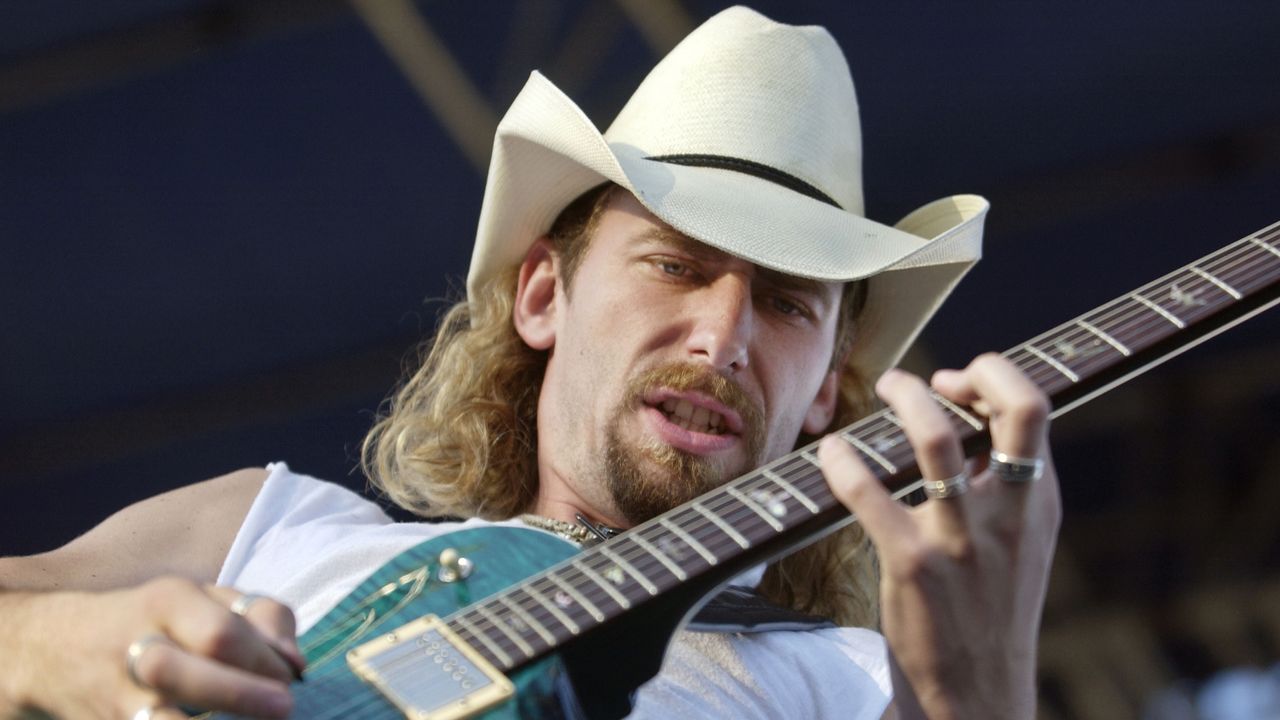
Chad Kroeger will always remember the day he wrote How You Remind Me, the song that gave his band Nickelback their big breakthrough.
In an interview with Q magazine in 2001 – when How You Remind Me was at No 1 in the US and in the band’s native Canada – Kroeger recalled how he wrote the song as he was breaking up with a girlfriend who was still living with him at the time.
“That was at the end of a nasty one,” Kroeger said. “I wrote the song when she was still in the house. She came downstairs and said, ‘I like that song!’”
He added: “We spoke again not long ago and I asked, ‘Does it bug you that this song is everywhere and it’s about you?’ She says, ‘I don’t think it’s about me!’ Denial!”
Nickelback’s story began in the early ’90s in the small town of Hannah, Alberta (pop: 3000), where singer and guitarist Kroeger put together a covers band with his brother Mike on bass, their cousin Brandon on drums and friend Ryan Peake on second guitar.
The band was originally named Village Idiot and their heroes were Metallica.
As Chad Kroeger told Q: “Metallica is a huge influence for pretty much anybody our age who listened to rock music. Metallica were gods. When I was 15 I wanted to be Kirk Hammett so bad I could fuckin’ taste it!”
For an early Village Idiot gig, drummer Brandon Kroeger had to borrow a friend’s kit so he’d have enough drums to play Metallica’s thrash metal classic Whiplash.
In 1995 the band took the name Nickelback – suggested by Mike Kroeger, who worked at Starbucks and would routinely give change to customers while saying, “Here’s your nickel back.”
After relocating to the big city of Vancouver, the band made a self-released EP called Hesher before singing to specialist metal label Roadrunner Records.
Nickelback’s first two albums, Curb (1996) and The State (1998), sold poorly. But at the third time of asking they hit big with How You Remind Me and the album Silver Side Up.
Speaking to Kerrang! in 2001, Chad Kroeger said of How You Remind Me: “It’s our Stairway To Heaven, our Hotel California. It’s a song that Nickelback’s never going to able to duplicate.”
In his interview with Q he elaborated: “That song’s got power. It can get in the ring with anybody and whup some ass! You wouldn’t believe the moshpit that starts during that song. There’s 250lb men going, ‘Yeah, she broke my heart!’”
He also said that the black humour in the song’s lyrics was not always understood: “I’m being so sarcastic in that song, I can’t believe so many people don’t get it. Come on! ‘This is how you remind me of how what I really am’. I could have finished the song with ‘on a daily basis.’”
In 2022, when Kroeger looked back on Nickelback’s career in an interview with Classic Rock, he said of that first big hit: “At that time, I was probably terrified I’d never write another song as good as that.”
He also talked about a common thread in Nickelback’s hit songs. In a word: “Relatability.”
How You Remind Me was his ‘I hate you’ breakup song. In the 2005 song Photograph he recalled his teenage rites of passage with bittersweet nostalgia. And in the 2006 hit Rockstar he sang, with tongue in cheek, of how he, like so many others, had dreamed of getting rich and famous.
Kroeger told Classic Rock: “I love universal themes. You want people to identify with what you’re singing about. I want them them say, ‘He’s singing my song. He’s singing to me. I know what that feels like.’ If you can achieve that relatability in a song, it can be very powerful.”
He described the Silver Side Up album as personal breakthrough for him as a songwriter:
“I refer to it as cracking the code,” he said. “And what I mean is: I was no longer hiding behind metaphors. It was about me no longer having to explain what a song was about. I was really putting it out there.”
He referred to his lyrics in two key tracks from that album: Too Bad, in which he spoke of the pain he experienced in discovering at the age of 18 that he and his brother Mike had different fathers, and Never Again, in which he addressed the subject of violence against women.
“When I said how I love writing about universal themes, that includes those things that other people are afraid to talk about,” he said. “And domestic abuse was one of them.
“No one has to ask me what Too Bad and Never Again are about. If you have to ask, you’re not listening to the song. So that type of openness and honesty is what I refer to as cracking the code. And the more I did it, the more I enjoyed it.”