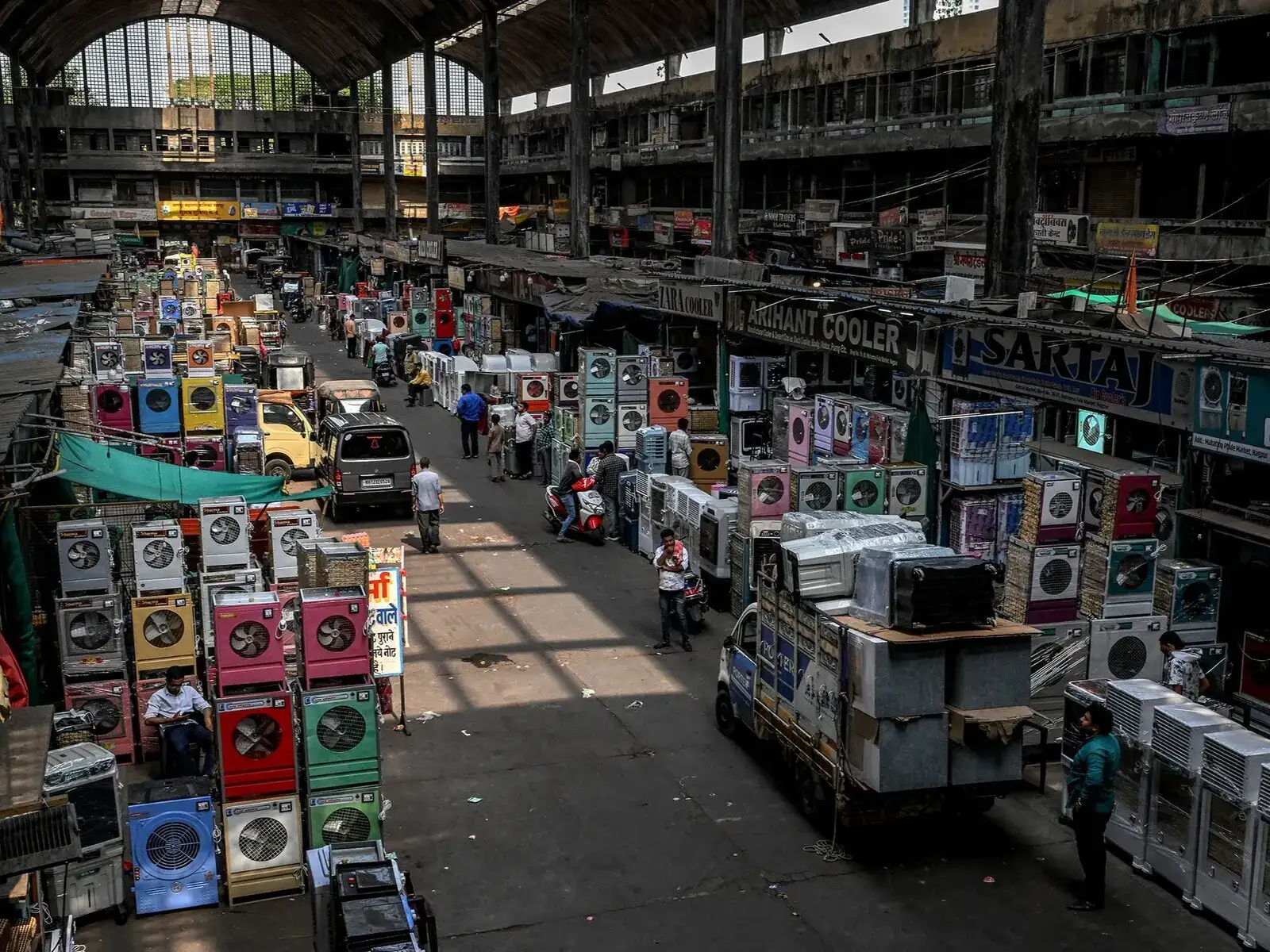
In the dusty heart of India, even the power equipment needs help to get through the peak of the summer.
Outside Nagpur, one of the hottest cities in the world, engineers regularly check transformers that have been fitted with multiple giant coolers, and substations supported by fans. On this May morning, still weeks from the monsoon, the news is good. Thanks to the new kit, the grid continues to cope with high seasonal demand and average temperatures that exceed 40C (104F), even during a historic energy crisis that has left many fearing widespread outages.
The catch, for millions of households here and in surrounding areas, is that this resilience comes at a cost — one that they cannot afford.
Also Read | Mercury Rising: Peak power demand hits record 260.5 GW
Take the working class neighborhood of Sudam Nagari. Past 10 p.m. on a regular weekday evening, the main thoroughfare lined with makeshift homes is buzzing with activity. Unable to stay inside their sweltering dwellings for long, residents are sitting on the pavement chatting, scrolling through their phones or watching children playing hide-and-seek.
Anuradha Shravan Kavle, a 40-year-old who works as a housemaid, is one of few still hurrying through her last kitchen chores indoors, under the dim light of an LED lamp. The temperature inside the cramped room is stifling, the May heat trapped inside sun-baked, corrugated iron walls. Her cooler sits in the corner — unplugged.
“Electricity is too expensive. We have to use it only sparingly,” said Kavle, pointing to a power bill for April that shows she paid 1,960 rupees, or more than $20, for 188 units (kilowatt hours) of consumption.
That’s at least 10% of the family’s income, which varies month to month, stretching her budget along with other rising costs to the point that she ignores any illnesses to avoid doctors’ fees. Her son and daughter work part-time to cover their own tuition.
Also Read | Why heatwaves are becoming India’s new normal
Maharashtra, the state that includes Nagpur, has some of the costliest power in the country — partly as a result of its large industrial base and partly because of the funds needed to keep a vast grid functioning. Maharashtra State Electricity Distribution Co., the power supplier, reported an 85% year-on-year increase in capital expenditure for the 12 months through March 2026 to 234.5 billion rupees ($2.4 billion), because of investment in the supply network, according to a regulatory order granting approval.
At more than 10 rupees a unit, Kavle’s bill is nearly 50% more than the average per unit revenue earned by electricity retailers in the year through March 2025. It’s also the maximum price allowed for most power sales on India’s exchanges.
For her family and many others on the street, the immediate consequence is the need for long periods spent outside the house to keep charges down, and limited sleep before they have to rise again for work the next morning.
“On some days, I feel sick and I think I can’t go to work, but that’s not an option,” she said. “I can’t spend an entire day in the heat of this house.”
Maharashtra last year unveiled a plan to bring down electricity prices for residential consumers by as much as 26% through 2030 by raising the share of renewable power generation in the supply mix.
The biggest beneficiaries of the plan would be clients who consume less than 100 kilowatt hours of power, according to a petition by the state’s main power distributor — enough for a few LED bulbs, a fridge and a fan, but not regular use of a cooler or an air conditioner. Consumers like Kavle, who surpass those modest limits, would see the cost of consumption above that level decline by a far more modest amount — just 5% through 2030, the document showed.
“Merely providing electricity doesn’t guarantee access to cooling. We need to make it affordable for all,” said Rohit Magotra, a director at New Delhi-based thinktank Integrated Research and Action for Development, or IRADe. “States need to consider giving seasonal subsidies for power to low-income people. The benefits would far outweigh the costs to the economy, in terms of productivity losses and the burden on healthcare system caused by heat.”
India’s summers are becoming more unlivable almost every year, with the combination of heat and humidity rising in some areas to the limits of survivability. Temperatures are higher and heatwaves last longer, sapping productivity and raising the cost of caring for those who fall ill. Even nights are scorching, a predicament exacerbated by poor urban planning and social inequality.
In the middle of the day on May 19, a leaderboard managed by AQI, a platform that monitors air quality, showed all 50 of the world’s hottest cities were in India. According to McKinsey Global Institute, hours lost due to heat stress could threaten as much as 4.5% of India's GDP by 2030.
In Nagpur, that battle with sweltering temperatures is everywhere — men and women cover the heads and faces to shield themselves from the sun, fruit sellers require water sprinklers to protect produce and what was a colonial-era cotton trading hub has become a vast market for coolers.
But measures to grapple with the unequally distributed consequences of the problem have been piecemeal — even here, in a district that was among the first to introduce a heat action plan, and has set up cool wards in hospitals, provided shade at traffic junctions to protect drivers and moved some work shifts to the early morning.
For those outside the city, the conditions are no better. Summers bring brutal outdoor working conditions — and electricity supplies that fall short of what is needed.
At the end of the afternoon in Kelapur, a town about about 100km (62 miles) from Nagpur, a group of farmers gathered on the steps of a school building to work through their problems in the receding sunlight. Some have already been taken ill due to the punishing temperatures. But the most recurrent complaint is around subsidized electricity, a vital commodity which they say is arriving only during hours when it is too hot for it to be used to pump water and irrigate fields.
Maharashtra, like other states, provides subsidized electricity specifically for farm work. But that currently arrives here only at 8am and stops in the middle of the afternoon, they say — a period outside evening hours that is convenient from the point of view of utilities seeking to balance the grid, but not for those in the fields.
“When we need water, when we need power, we don’t get it,” said Raju Bhiwaji Munjewar, 53, whose two-acre plot is sitting idle, waiting instead for the monsoon rains to start sowing. “If I have to use that power, I’ll have to be out in this murderous sun.”
Better irrigation times, they agree, would mean more crops, and improved yields.
Maharashtra accounts for the largest share in peak demand, and the push to supply agricultural power in the daytime is intended to narrow the gap between supply and consumption — while making the most of solar.
Farmers are unlikely to see a change soon, especially with above-normal minimum temperatures forecast across India.
Residents of Sudam Nagari too are prepared for another summer of sweltering days and nights, plus punishing prices, not least with a war that is pressuring other daily energy costs, from cooking gas to fuel. The priority, said Kavle, under the light of her bare bulb, is to save enough for a few cool hours at night.
“We keep our consumption to a bare minimum. Just enough to get some rest in the night.''