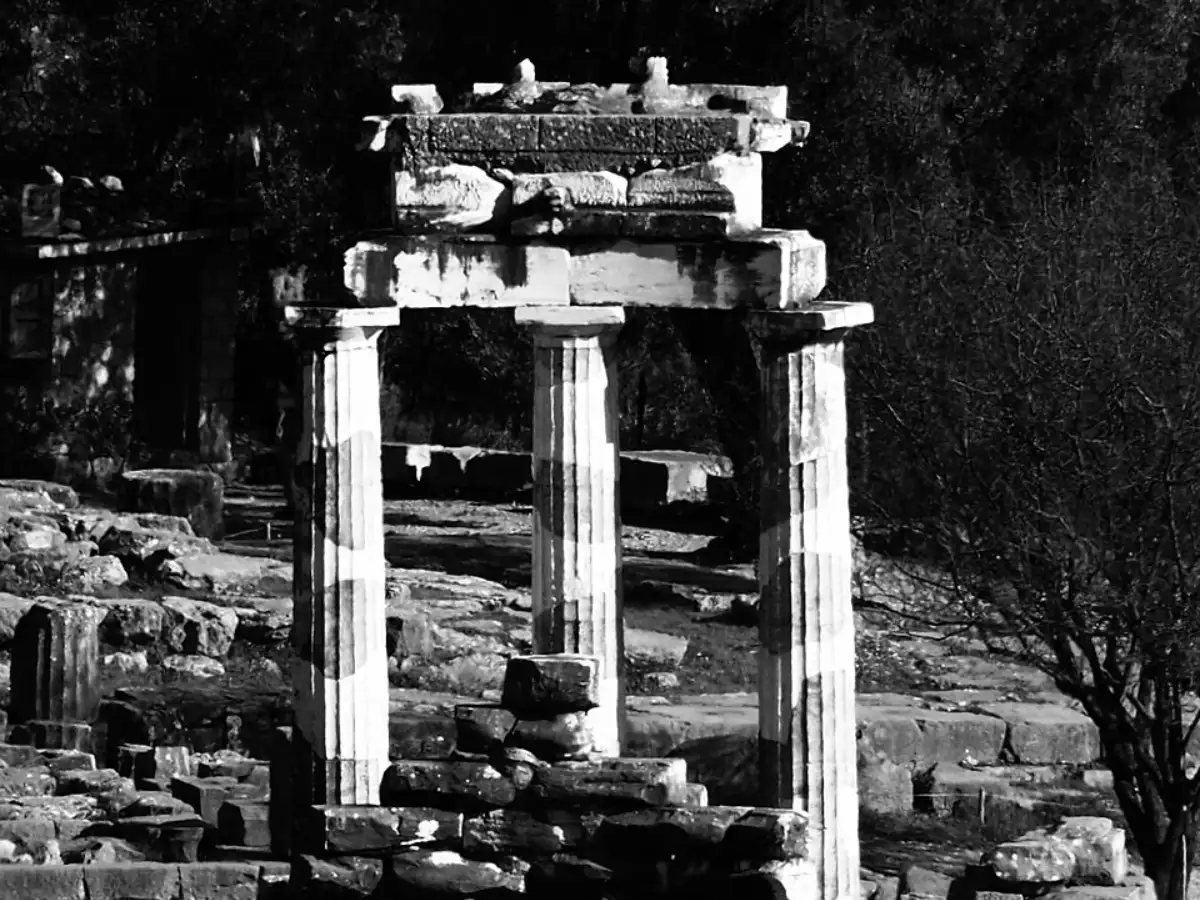
The Oracle of Delphi has had an interesting place among religion, literature, and mythology for hundreds of years. According to ancient Greek writers, travelers came to Delphi in search of prophecy, delivered through the Pythia, who delivered prophecies inside the sanctuary. This location became known as the most popular location among oracles in ancient Greece, affecting politics, warfare, and individual lives throughout the centuries.
But along with the element of spirituality, there was an element that was hard to shake off entirely.
Some historical records indicated that the prophecy was influenced by vapors and exhalations that rose up from the ground underneath the temple. Modern history largely ignored such ideas, considering them to be exaggerated myths and legends. The site remained important, yet not much was believed about fumes emanating from below the sanctuary.
That is, until geology stepped in.
What researchers found beneath Delphi
As discussed in a geologic and geochemical study in the Journal of the Geological Society and further described on ResearchGate, scientists found fault structures under the sanctuary at Delphi, which could have enabled the flow of gases and fluid from within the ground to rise to the surface.
It was suggested that the geological context might reasonably allow the interpretation of traditional descriptions of strange vapor associated with the oracle experience. What is crucial here is the fact that the scientists did not claim that geology "solved" Delphi and turned the sanctuary into merely a chemical experience. Rather, what this research opened up was an old hypothesis about the involvement of natural processes beneath the temple that might have been contributing to the spiritual ambiance.
This is crucial because now there is no more dispute about the conflict between myth and science; on the contrary, scholars have started considering various factors in their combination.
Why the geology debate became important
The importance of Delphi in part derives from its power to fully occupy the ancient Greek imagination.
As stated by the Encyclopedia Britannica, Delphi was considered one of the most holy sanctuaries in ancient Greece. People sought advice from the gods, while rulers and cities went to the oracle for guidance on crucial decisions.
The cultural significance was what made the subsequent geological discoveries particularly powerful. For years, the idea of dismissing the "vapors" theory without question had become routine practice among certain academics. The mention of fumes was usually taken as a figure of speech rather than an actual description. However, the geological findings forced scholars to rethink their assumptions.
As described in the Journal of the Geological Society article, the overlapping fault lines around Delphi allowed the existence of fluids and gases capable of rising from underground to the surface. The Britannica definition of a geological fault indicates that it is a break in the rocks where motion and underground fluid flow can happen.
The ancient texts did not sound so impossible anymore. The point was not about proving that the oracle used chemical substances. The idea that the entire concept was simply a myth became increasingly difficult to hold.
A sanctuary shaped by landscape
What makes Delphi particularly fascinating is that there could be more to the mysteries of the place than what was inside the temple itself. According to Britannica, the sanctuary was located on the slopes of Mount Parnassus and characterized by dramatic cliffs and rocky terrain. In addition, according to Britannica's article on the oracles of ancient Greece, such sanctuaries were seen as points of intersection between divine powers and the natural world.
This might be the case for Delphi as well. Fault lines and underground emissions cannot be easily seen, as opposed to ancient temples, columns, and marble ruins. However, if there were gases or any unusual scents in the air at certain times, this would make the place all the more mysterious and divine.
This brings new meaning to the exploration of the Delphi site.
It is important to remember that geology and religion did not stand in opposition to each other but complemented one another.
What scholars still debate
Despite the resurgence in popularity for the theory of fault and gas, there remains much uncertainty. The findings have sparked debates anew, yet they have not put an end to the controversy. Scholars persistently explore just how significant underground gases were, which substances might have been involved, and whether these circumstances had any impact on the rituals.
As per the Journal of the Geological Society report, the results have only reinvigorated the debate about the sanctuary's past without putting an end to it.
This ambiguity is a significant reason for the continued fascination with Delphi. It is a sanctuary that cannot be easily explained since it is situated between science, myth, and interpretation. The ancients did not perceive Delphi in terms of science or myths but in terms of its religious importance and symbolism inherent in its surroundings.
Why the story still endures
The fascination with Delphi has not yet faded from modern imagination due to the combination of visible splendor and the underlying powers that existed underground.
The sanctuary above was one of the most famous landmarks in the ancient world. Underneath it could have been geological processes that influenced the composition of the air in the area.
As noted by Britannica, Delphi was an important landmark in Greek religion even before the development of geological theories. However, the new findings seem to give additional value to the place, making it even more tangible while preserving its mysteriousness at the same time.
This dual nature is probably what makes the site relevant for modern visitors. Indeed, it is rare to encounter a historical landmark in which scientific explanations increase rather than reduce awe.