Apple (AAPL) stock has been in a slump since notching a record high at the end of 2025, but that means little to truly long-term investors.
Recall that at one point last year, AAPL stock lost as much as 30% of its value. Shares soon went on a remarkable run, adding about $1.6 trillion to the company's market cap in only eight months.
Given that context, a 9% drawdown from AAPL's December record is just the cost of doing business. If you want to own equities, volatility is merely the price of admission.
Truly long-term buy-and-hold Apple investors already know this. After all, they've been through these sorts of things many times before – and have been rewarded with incomparable returns over the past few decades.
As famed speculator Jesse Livermore once said, the big money is made by "sitting tight." If any stock proves the wisdom of his words, it's Apple.
From January 1990 through December 2020, AAPL stock created $2.67 trillion in shareholder wealth, or an annualized dollar-weighted return of 23.5%, according to an analysis by Hendrik Bessembinder, a finance professor at the W.P. Carey School of Business at Arizona State University.
Indeed, per Bessembinder's findings, which account for a stock's increase in market cap adjusted for cash flows in and out of the business and other adjustments, Apple was the best stock in the world over those 30 years.
True, AAPL stock traded sideways for the first few years of the 21st century, but an explosion of innovation soon put an end to that.
Under the visionary leadership of the late Steve Jobs, Apple essentially reinvented itself for the mobile age, launching revolutionary gadgets such as the iPod, MacBook and iPad.
But what really set Apple on its course to becoming the world's third-largest publicly traded company – and one of hedge funds' favorite blue chip stocks – was the 2007 debut of the iPhone.
Today, Apple isn't just a purveyor of gadgets; it sells an entire ecosystem of personal consumer electronics and related services. And it's a sticky ecosystem at that.
No less an eminence than Warren Buffett has called the iPhone maker Berkshire Hathaway's (BRK.B) "third business," noting Apple fans' fantastic brand loyalty as one reason for being all-in on the stock. (Apple accounts for more than fifth of the value of the Berkshire Hathaway equity portfolio.)
True, Berkshire Hathaway cut its Apple stake sharply over the past year, but that was because the holding company believes that corporate taxes are likely to rise at some point in the future. Bulls needn't worry about Berkshire losing its taste for the stock. Warren Buffett adores Apple as much as ever.
Little wonder the iconic tech firm was tapped to become one of the elite 30 Dow Jones stocks. In 2015, Apple replaced AT&T (T) in the Dow Jones Industrial Average.
The bottom line on Apple stock?
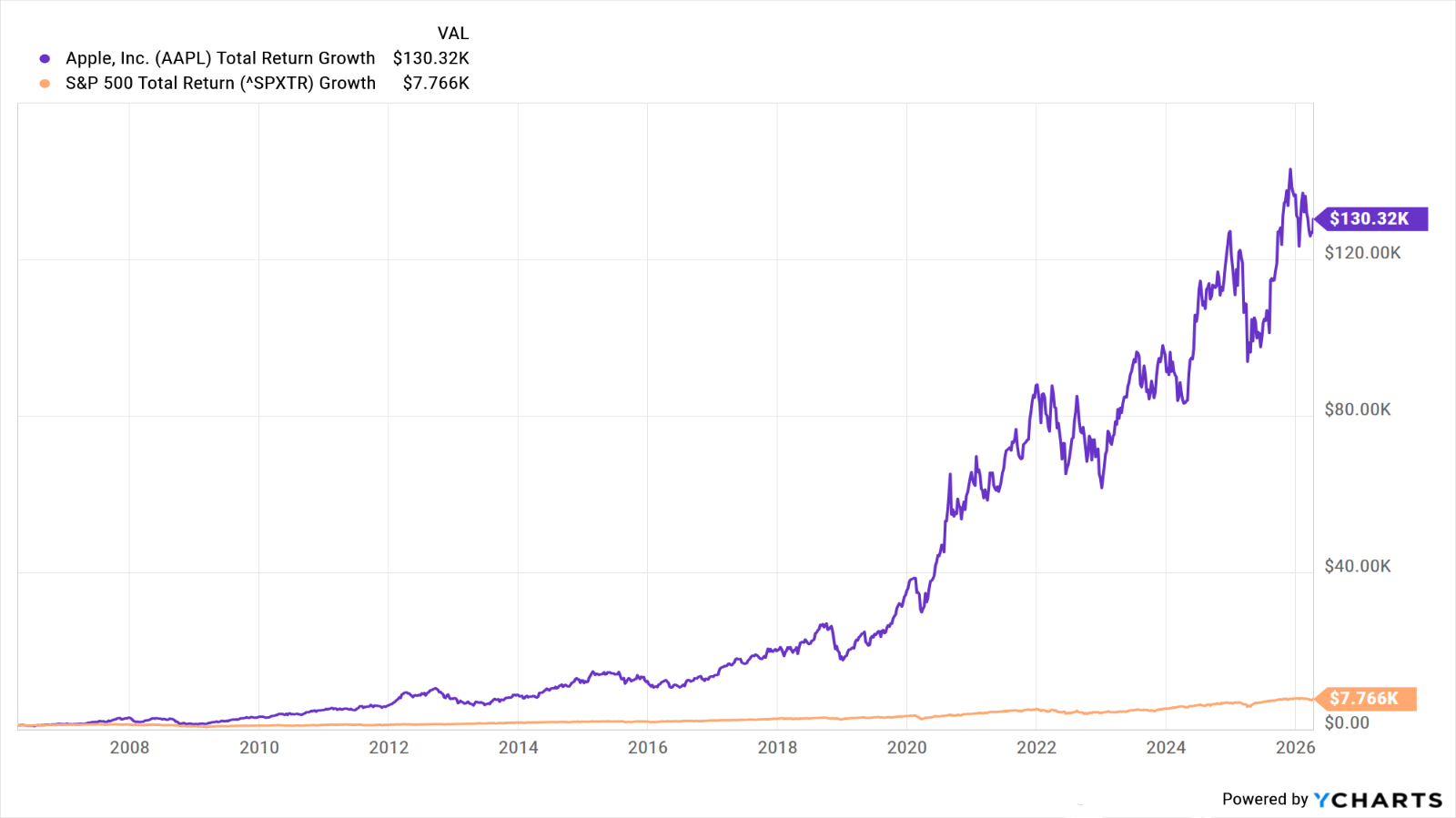
Over the past 20 years Apple stock generated an annualized total return (price change plus dividends) of 27.4%. By comparison, the S&P 500 delivered an annualized total return of 10.8% over the same span.
What does that look like on a brokerage statement? Check out the chart below and you'll see that if you invested $1,000 in Apple stock 20 years ago, it would today be worth about $130,000.
The same $1,000 invested in an S&P 500 index fund would theoretically have turned into less than $8,000 over the same period.
For those wondering if Apple stock is a buy at current levels, Wall Street certainly thinks so.
Of the 48 analysts covering AAPL surveyed by S&P Global Market Intelligence, 25 rate it at Strong Buy, six say Buy, 15 have it at Hold, one says it's a Sell and one has it at Strong Sell.
That works out to a consensus recommendation of Buy, with high conviction.